Understanding Load Testing for Bamboo Trays
Bamboo trays are gaining popularity in hospitality, food service, and retail—not just for looks, but for their strength and reliability. Whether used for serving, display, or storage, every bamboo tray must meet minimum load-bearing standards. Load testing for bamboo trays helps ensure each unit performs safely in real-world conditions. This article explores practical lab protocols, reinforced construction techniques, and common failure modes, providing a step-by-step guide for business buyers. You’ll also find a ready-to-use spec sheet template for your quality assurance workflows.
Setting Up Practical Lab Protocols

A controlled load test protocol is vital for accurate, repeatable results. You need to simulate actual tray use, factoring in not just distributed weight but also handling stresses. Start with these core steps:
- Sample selection: Randomly select trays from each production batch to avoid sampling bias. For export orders, at least 3–5 trays per batch is standard.
- Conditioning: Stabilize trays to 8–12% moisture content, reflecting typical indoor environments. Too much moisture can skew test results—bamboo’s strength drops as it absorbs water.
- Inspection: Note visual defects like warpage, cracking, or glue line weaknesses. Pre-test documentation helps trace failures to root causes.
Prepare the tray on a flat, rigid surface. Apply incremental weights (typically sandbags or metal disks) at defined locations. Common placements are center, edges, and handles. Use a digital gauge to log deformation. The test ends at visible tray failure, significant warping (over 5 mm arch), or at a predetermined safety threshold.
Recommended Equipment and Metrics
- Precision scale (±50g)
- Height/deformation gauge (±0.1mm)
- Camera for failure snapshots
- Load weights in suitable increments (0.5 kg, 1 kg, etc.)
Measurement focus: maximum supported weight, permanent deformation (plasticity), warpage, fastener or handle detachment, surface delamination, and joint failure.
Bamboo Tray Load Test
The core of any quality protocol is the bamboo tray load test. Typical trays undergo both static and dynamic (shock/drop) tests. Here’s a practical walkthrough:
Static Load Test: Step-by-Step
- Prepare the tray: Place on a flat support, verify no rocking. Record initial state with photos and notes.
- Apply load: Start with expected maximum operational load (e.g., 5 kg for serving trays). Increase by increments (e.g., 1 kg) every 2 minutes.
- Observe changes: At each stage, measure sag, listen for creaks, and check handle integrity and base stability.
- Document results: Upon failure (break, glue delamination, major flexing), log the weight and describe the mode of failure—the data should link back to construction details like rib spacing or handle joinery.
- Repeat: Minimum three repetitions per tray design for statistical consistency.
Dynamic and Shock Testing
For trays likely used in food service or hospitality, add a shock/drop test:
- With loaded weight onboard, drop the tray from 30 cm onto a hard surface.
- Inspect for handle detachment, base cracking, or sudden deformation.
This simulates accidental knocks or drops during heavy restaurant shifts or buffet setups.
Optimizing Rib and Handle Geometry
Geometry matters. The load capacity and weight limit of a bamboo tray depend heavily on its rib layout, handle joinery, and edge thickness. At Bamboo Wood Art, engineers fine-tune the following:
- Rib Spacing and Cross-section: Wider trays need stiffer ribs—ideally, 35–45 mm apart. Thicker ribs (≥10 mm) offer better resistance to sag without excess weight.
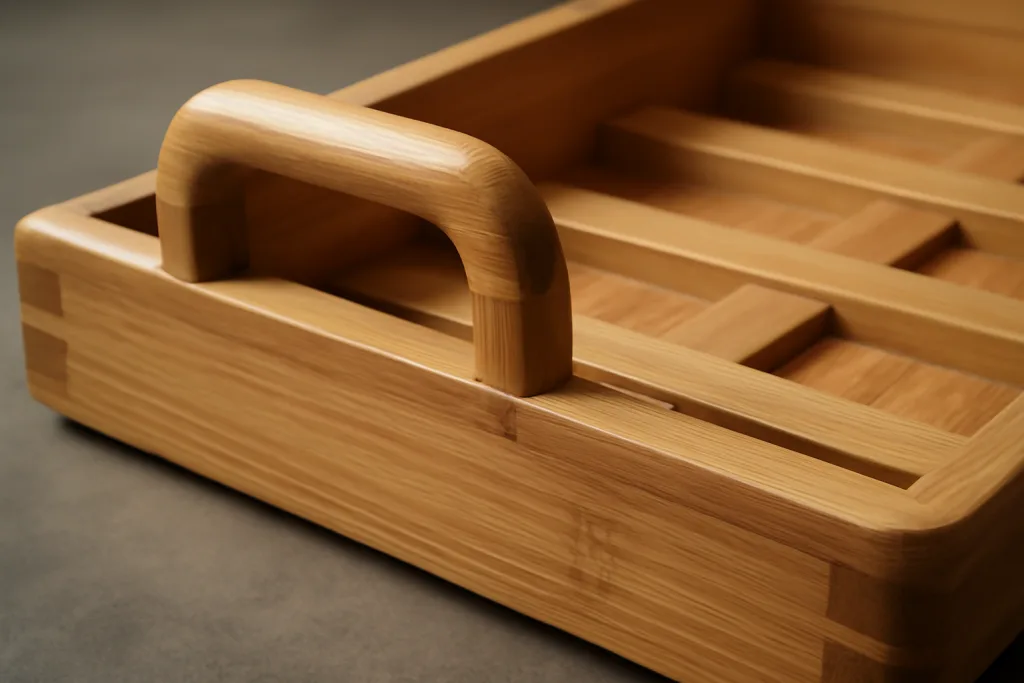
- Handle Style: Mortise-and-tenon or dowel-reinforced handles outperform surface-glued ones. Handles joined with CNC-milled mortises or dowel pins can endure 1.5–2x higher pull loads before failure.
- Base Lamination: Multi-ply or cross-laminated bases are less prone to warp and hold their shape at higher loads. Bamboo veneer finishes boost aesthetics without compromising strength.
Subtle adjustments, like a slightly deeper finger groove or sanded transition between handle and base, enhance grip and distribute force evenly to prevent splitting.
Comparison Table: Geometry and Performance
| Design Feature | Impact on Strength | Best Use Scenarios |
|---|---|---|
| Thick ribs (≥10 mm) | High weight limit, minimal sag | Banquet, oversized food platters |
| Mortise-and-tenon handles | Superior handle retention | Hotel room service, catering |
| Cross-laminated base | Stable against warping | Coffee shop display, humid zones |
| Single-ply, glued handle | Most likely failure under load | Light retail display, home décor |
Common Failure Modes in Bamboo Trays
No tray is indestructible. Identifying the most frequent failure points helps refine both design and manufacturing processes. Here are the main culprits discovered during rigorous bamboo tray load testing:
- Handle tear-out: Often due to weak adhesive, shallow mortises, or insufficient pinning—shows up in abrupt detachment during drop tests.
- Base sag or crack: Visible as a permanent arch or clean split, usually from insufficient rib support or improper moisture control during production.
- Rib–base separation: Poor lamination or under-cured adhesive leads to rib detachment inside the tray wall, especially after heavy, concentrated loads.
- Edge splitting: Sharp or unrounded tray edges can initiate hairline cracks, which grow under repeated stress.
Corrective steps involve tighter dimensional tolerances, better joinery (like finger joints for edge reinforcement), advanced adhesives meeting E0/E1 emission standards, and improved sanding (grits 180–320 for smooth transitions). Modern, eco-safe water-based varnishes or food-grade oils (tung, linseed) protect surfaces from kitchen spills and heavy use.
Defining Safety Thresholds and Weight Limits
One of the most important outcomes of bamboo tray load testing is mapping out a reliable bamboo tray weight limit. This isn’t just about absolute failure. According to industry best practices (and real-world hospitality scenarios), a good safety margin is at least 2x the intended operational load. If a serving tray is used for up to 4 kg, it should withstand at minimum 8 kg during testing, with no permanent damage or excessive deformation.
- Operational load: The expected working mass—dishes, drinks, or products routinely placed on the tray.
- Ultimate load: The weight at which significant failure occurs.
- Safety factor: Ratio of ultimate load to operational load. For commercial use, a factor of 2–2.5 meets most buyer requirements.
Always note load limits on official spec sheets, especially for OEM/ODM and export. Buyers in regulated markets—like Europe or North America—may require explicit safety margins, food-contact certification (FDA/LFGB), and third-party lab validation.
Documenting Results: A Spec Sheet Template
Fact-based specification sheets build trust with hotel, restaurant, or retail buyers. They also simplify procurement by making tray strength and compliance transparent. Here’s a customizable template for any bamboo tray line:
| Test Parameter | Specification | Result |
|---|---|---|
| Tray dimensions | e.g., 400 × 300 × 35 mm | |
| Material | Moso bamboo, cross-laminated | |
| Handle joinery | Mortise-and-tenon, glued | |
| Base ribs | 3 ribs, 12 mm thickness | |
| Load limit (operational) | 5 kg | |
| Ultimate load (failure) | 12 kg | |
| Finish | Food-grade oil, E1 glue | |
| Sourcing | FSC-certified bamboo | |
| Food contact compliance | FDA/LFGB |
Quality and Compliance in Bamboo Tray Manufacturing
Strength isn’t just a matter of thick slats and robust joinery. It’s a result of holistic manufacturing and ethical sourcing. Bamboo Wood Art, for instance, sources only FSC-certified Moso bamboo, kiln dries every batch to consistent moisture (8–12%), and calibrates its CNC machines for precision joinery within ±0.2 mm tolerances. Each tray undergoes multi-step hand and machine sanding (grits 180 → 240 → 320), which not only creates a soft-to-touch surface, but also prevents edge splitting.
After assembly, every batch is spot-checked for adhesion strength (pull-off and shear), while finishes comply with food safety and VOC regulations as required. Final packaging is designed for export, with multi-layer protection against moisture and impact in transit.
Material Choices: How They Influence Load and Longevity
Material selection impacts both the weight limit and long-term performance of a bamboo tray. Premium trays typically use cross-laminated bamboo or combine bamboo veneer with a stable plywood core, which is less prone to warping. Lower-end trays may use single-ply or surface-glued construction, but these are best reserved for light-duty or décor use. For heavy, repeated use, opt for trays with:
- Moisture-resistant adhesives (E0/E1 formaldehyde class)
- Plant oil or UV-cured finishes
- Edge and handle reinforcement
Choosing the right base, rib, and finish combination ensures each tray meets project requirements, from luxury hotel serving sets to affordable bulk catering.
The Bamboo Tray Weight Limit in Context
Understanding the bamboo tray weight limit protects both the end-user and brand reputation. For hotels, restaurants, and retailers, realistic test data helps prevent accidents and costly replacements. For designers and manufacturers, a clear weight limit guides material selection and construction improvements. A robust OEM/ODM partner, like Bamboo Wood Art, merges materials science, practical load testing, and precision joinery to guarantee every tray performs above your minimum expectations.
Expert Tip: Always calibrate lab tests to actual field conditions—a tray that passes in the lab must hold up after months of daily dishwashing, sanitizing, and accidental knocks.
Frequently Asked Questions
What is the standard weight limit for a commercial bamboo tray?
Most commercial bamboo trays are designed for an operational load of 4 to 8 kilograms, with laboratory testing ensuring they withstand double this amount before failure.
How is a bamboo tray load test performed?
The load test involves incrementally adding weight to a conditioned tray while monitoring for sag, warpage, or handle failure, halting at visible breakage or significant deformation.
Which tray features improve load capacity most effectively?
Cross-laminated bases, thick ribs spaced closely, and robust mortise-and-tenon handle joints are the main features that increase a bamboo tray’s strength and load capacity.
What are the main failure modes during tray load testing?
Typical failure modes include handle detachment, rib or base cracking, delamination at glue joints, and edge splitting under concentrated or shock loading.
Are food-contact finishes necessary for all trays?
Trays intended for food service or hospitality must have food-grade finishes, complying with FDA or LFGB standards, to ensure safety and regulatory acceptance.
What quality standards should buyers look for?
Seek bamboo trays with FSC sourcing certification, E0/E1 adhesives, documented load limits, and clear compliance with relevant food-contact and export regulations.