Executive summary: which material fits which wholesale strategy?
The fastest way to decide is to work backward from your channel. If you need low-to-mid price retail, simple packaging, and stable visual consistency across large runs, bamboo is often the more efficient starting point. If your line needs a richer natural look, stronger premium perception, and a more differentiated shelf story, acacia is usually the better fit. For hospitality or promotional programs, bamboo is often easier to standardize; for boutique or gift-oriented ranges, acacia may justify a higher ticket price. In practice, many brands use both: bamboo for core volume SKUs and acacia for higher-margin hero products.
Who this guide is for
This guide is written for wholesale buyers who need a sourcing decision, not a lifestyle opinion. It is especially useful for mass-market retailers, boutique kitchen brands, hospitality buyers, distributors, promotional product teams, and exporters who must compare product cost, finish quality, MOQ, and repeatability. If you are planning a private label program, you also need to think about branding, packaging, and sample approval timing. The buying logic is different for a supermarket chain than for a direct-to-consumer brand, even if both sell the same board size.
Quick decision matrix for wholesale buyers
| Channel or use case | Better fit | Target price band | MOQ sensitivity | Customization level |
|---|---|---|---|---|
| Mass retail | Bamboo | Low to mid | High | Moderate |
| Boutique kitchen brand | Acacia | Mid to premium | Medium | High |
| Hospitality and catering | Bamboo | Low to mid | High | Low to medium |
| Promotional gifts | Bamboo or acacia | Depends on campaign | Medium | High |
| Premium gifting | Acacia | Premium | Medium | High |
That matrix is only a starting point. The real answer comes from material behavior, construction method, and how the board will be packaged and replenished over multiple reorder cycles. If your product range is broader than a single SKU, it is often smarter to build a tiered assortment rather than force one material to do every job.
Acacia vs bamboo cutting board: what each material really is
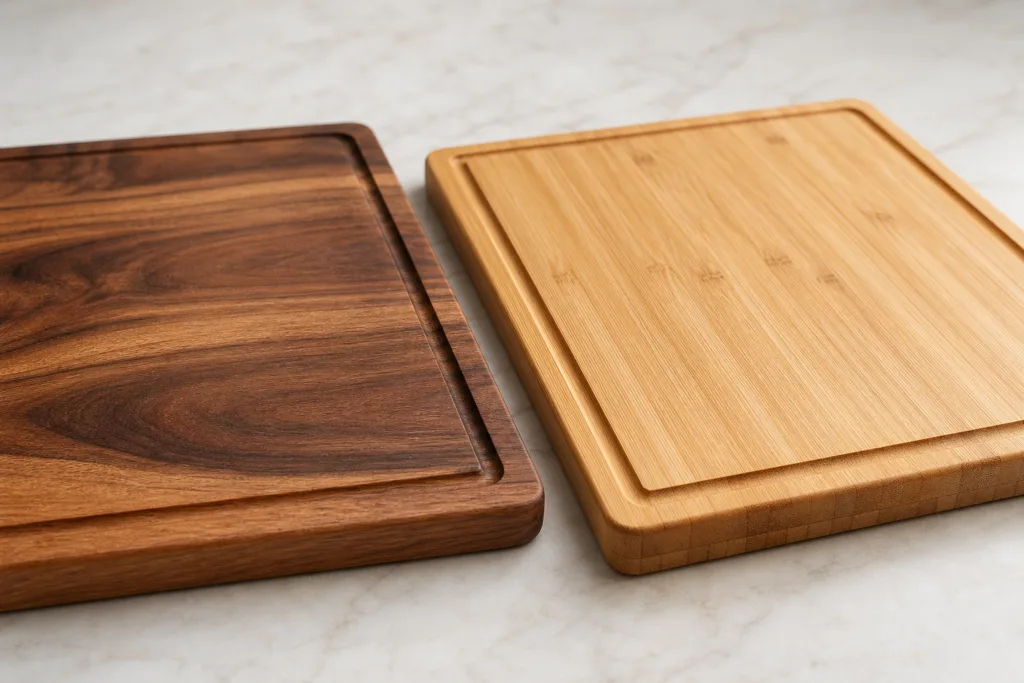
Acacia is a hardwood category used in many kitchen products, and in the cutting board market it is valued for its natural grain variation, warm tone, and premium visual character. Because acacia is a wood species group rather than a single uniform look, boards can vary more from batch to batch in color and grain. That variation can be a strength for brands that want an artisanal or furniture-inspired presentation, but it can also create inventory matching challenges if your buyers expect exact visual consistency.
Bamboo is a grass-based material that is processed into boards through lamination or strand-based construction. In wholesale cutting boards, bamboo is often supplied as strip-laminated panels or engineered boards that are pressed and bonded for stable flatness. Bamboo is typically more uniform in appearance than acacia, which makes it useful for large retail programs, private-label programs, and products that need a clean, modern look across many units.
From our manufacturing perspective, the most important difference is not only the raw material, but how it is built. A bamboo board with weak glue lines or poor moisture control can be less reliable than a well-made acacia board, while a properly structured laminated acacia board can be very stable. When sourcing Bamboo Wood Art products for retail, we advise buyers to evaluate construction details first, then appearance, then branding potential.
Visual and tactile differences that affect retail positioning
Acacia usually has stronger grain movement, deeper natural color variation, and a more organic feel in hand. That makes it easier to position as a premium or giftable product. Bamboo usually looks cleaner, lighter, and more consistent, which supports value-driven retail packaging and multi-SKU uniformity. If your shelf strategy depends on a warm rustic story, acacia has an advantage. If your brand voice is minimalist, modern, or sustainability-led, bamboo often photographs and merchandises more predictably.
The tactile difference matters too. Acacia often feels denser and more “wood-like” to consumers, while bamboo can feel harder and slightly more engineered depending on the laminate and finish. That perception can influence perceived value even when both boards are comparable in practical use. For e-commerce, product images may oversimplify this difference, so sample review is essential before setting a final price point.
Product grade and perceived value
In wholesale buying, grade is not only about defect rate. It also affects story, pricing tier, and how easily the item can be sold as a branded SKU. Acacia’s natural variation creates a more premium visual identity, but it also means a tighter visual sort may be needed if you want a consistent retail look. Bamboo’s uniformity makes grading simpler, especially when you need many units to match across replenishment orders.
For SKU planning, a practical approach is to use bamboo in entry-level and high-volume SKUs, then reserve acacia for premium set pieces, charcuterie-style boards, or display-forward items. That reduces pressure on one material to meet every market position. It also gives your brand room to increase average order value without changing the product family entirely.
Structural performance: hardness, weight, and daily use
Cutting board buyers often ask which material is “harder,” but hardness alone does not define usefulness. A harder board can resist denting better, yet it may also show knife wear differently and feel heavier or more brittle under certain conditions. Acacia is commonly perceived as a strong hardwood option with good impact resistance, while bamboo’s laminated structure can produce impressive surface hardness, especially in strand-based constructions. The real issue is how the board handles repeated cutting, washing, drying, and stacking in commercial environments.
For retail and hospitality use, weight matters. A heavier board can feel substantial and premium, but it can also increase freight cost and make handling less convenient for consumers or kitchen staff. Bamboo boards are often slightly more predictable in weight across production lots, which helps when you are building sets or shipping large quantities. Acacia may offer a more premium hand-feel, but buyers should confirm that the final board size does not push freight or parcel rates beyond the intended margin.
What to compare during sampling
- Flatness after unpacking
- Edge stability and corner finish
- Surface smoothness after oiling or coating
- Weight consistency across samples
- Visible glue lines on laminated constructions
- Initial knife-mark appearance after test use
When we support custom programs, we usually recommend testing both materials under the same use scenario instead of comparing sample pieces in isolation. A board can look excellent in a showroom and still perform poorly after thermal cycling, humidity changes, or repeated washing.
Moisture, stability, and warping behavior
For kitchenware, stability is often more important than absolute hardness. Bamboo’s laminated structure can be very stable when moisture is controlled, but poor adhesive quality or uneven pressing can create delamination risk. Acacia, as a natural hardwood, can move with humidity changes and may warp if boards are too thin or dried unevenly before assembly. Both materials can perform well if the construction method and storage conditions are right.
As a rule of thumb, thicker boards are easier to stabilize than thin decorative pieces. Buyers often push for lower weight to reduce freight cost, but cutting boards that are too thin are more likely to cup or twist, especially in humid export destinations. For most wholesale programs, we recommend specifying a thickness that supports rigidity first, then optimizing weight second. This is especially important for boards with juice grooves or handles, which remove material and can reduce stiffness.
Environmental variation during transit also matters. A board that leaves the factory at the correct moisture content can still shift if it is packed in a poorly ventilated carton or stored in a humid warehouse. For repeat orders, ask suppliers how they condition raw material, how long finished goods rest before packing, and how they protect cartons during sea freight.
Surface wear, maintenance, and refinishing
Cutting boards are expected to show some wear. The question is whether that wear is acceptable for your market. Bamboo boards often show a cleaner, more uniform surface over time, but deep scratches or edge chips can be more visible if the finish is very light. Acacia can disguise minor wear more naturally because grain variation makes small marks less obvious, although repeated knife use still affects appearance and hygiene perception.
For wholesale products, finish tolerance should be defined before production. A light food-safe oil finish can create a natural look and is easy to maintain, while a harder topcoat or varnish may improve moisture resistance but can be less desirable for direct food-contact use depending on the intended market and regulatory path. Buyers should make sure the finish statement matches the actual use case and label claim. For official technical guidance on food-contact substances and coatings, the official FDA guidance on food-contact substances is a useful reference point when aligning product claims with the intended application.
In practical sourcing terms, the best finish is the one you can repeat consistently. A premium oil finish on acacia may look excellent but needs tight control over absorption and drying. A bamboo board with a uniform factory finish may be easier to replicate across a large program, especially when the product is sold in sets.
Food safety, compliance, and labeling
For boards sold into consumer markets, the language you use on packaging matters. Avoid making broad claims that cannot be supported by the actual finish system or test documentation. If a board is oiled, say so clearly. If it is coated or varnished, confirm whether the coating is suitable for food-contact use in the target market. Different regions have different expectations for labeling, traceability, and compliance records, so procurement teams should request material declarations and finish specifications early.
Responsible sourcing can also influence buyer confidence, especially for acacia products where wood origin and traceability may matter in premium channels. For buyers who want to communicate sourcing responsibility, the FSC guidance on responsible wood and bamboo sourcing is a practical benchmark when evaluating certification possibilities and supplier documentation. Even when certification is not a strict requirement, traceability records and consistent supplier declarations can reduce risk during retailer onboarding or import review.
From a manufacturer standpoint, food-contact safety is not only about the oil or coating. It also involves adhesive selection, drying process, packaging cleanliness, and whether the product is intended for direct food use or serving presentation. A charcuterie board sold as a serving item may face different expectations than a functional chopping board.
Manufacturing and construction options
Construction determines most of the real-world performance. Acacia boards can be made from solid planks, laminated panels, edge-grain construction, or decorative assemblies. Bamboo boards are typically made from strips or engineered panels, and the bonding pattern affects both cost and stability. Solid wood options can look premium but may move more with humidity; laminated boards can be more stable and more efficient to produce in volume.
For acacia, buyers should ask whether the board is made from a single-piece construction or from joined components. For bamboo, ask whether the board is strip-laminated, strand-based, or an engineered panel with a specific density target. If a supplier cannot explain the construction clearly, that is a warning sign for bulk purchasing. Clear construction details also help you decide how the product should be positioned in your catalog.
If your strategy includes multiple wood categories, our custom wood cutting board manufacturing solutions can support evaluation of panel structure, finish options, engraving placement, and retail packaging for acacia-based programs. That is especially useful when buyers need one common board family across different size sets or gift bundles.
How construction affects cost and stability
| Construction type | Cost tendency | Stability tendency | Retail positioning |
|---|---|---|---|
| Solid acacia plank | Higher | Medium | Premium |
| Laminated acacia panel | Medium | High | Mid to premium |
| Strip-laminated bamboo | Efficient | High | Value to mid |
| Engineered bamboo panel | Efficient to medium | High | Value to mid |
Customization potential for private label programs
Customization is where the acacia vs bamboo cutting board decision often becomes commercial rather than technical. Both materials can be engraved, shaped, grooved, beveled, or branded, but the visual result differs. Laser engraving on bamboo is usually crisp and high contrast. On acacia, engraving can look richer and more artisanal, but wood grain variation may create slight differences in tone from board to board. That can be positive for premium storytelling, as long as the brand accepts natural variation.
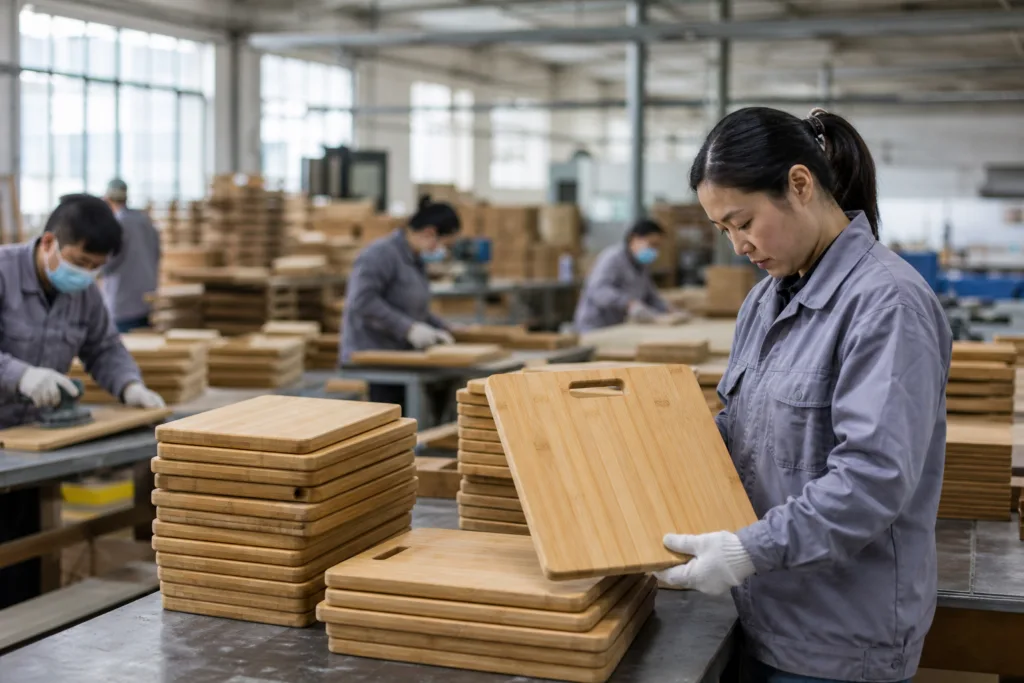
Private-label buyers should also consider how easily the product can accept routed juice grooves, handle cutouts, hanging holes, or mixed surface finishes. Bamboo is often straightforward for standard CNC shaping in larger production runs. Acacia can support more upscale detailing, but material waste and yield loss may be higher depending on board layout. If you need specific branding placements or set packaging, our bulk bamboo product manufacturing for cutting boards is useful when planning larger programs that need repeatable engraving, packed sets, and export-ready cartons.
For brands that want a more tailored private-label presentation, the article on specifying custom bamboo cutting boards for private label provides a useful lens on sizing, logo location, and packaging planning. Even if your final choice is acacia, the same logic applies: define the retail story first, then map the manufacturing features to that story.
Branding and packaging considerations
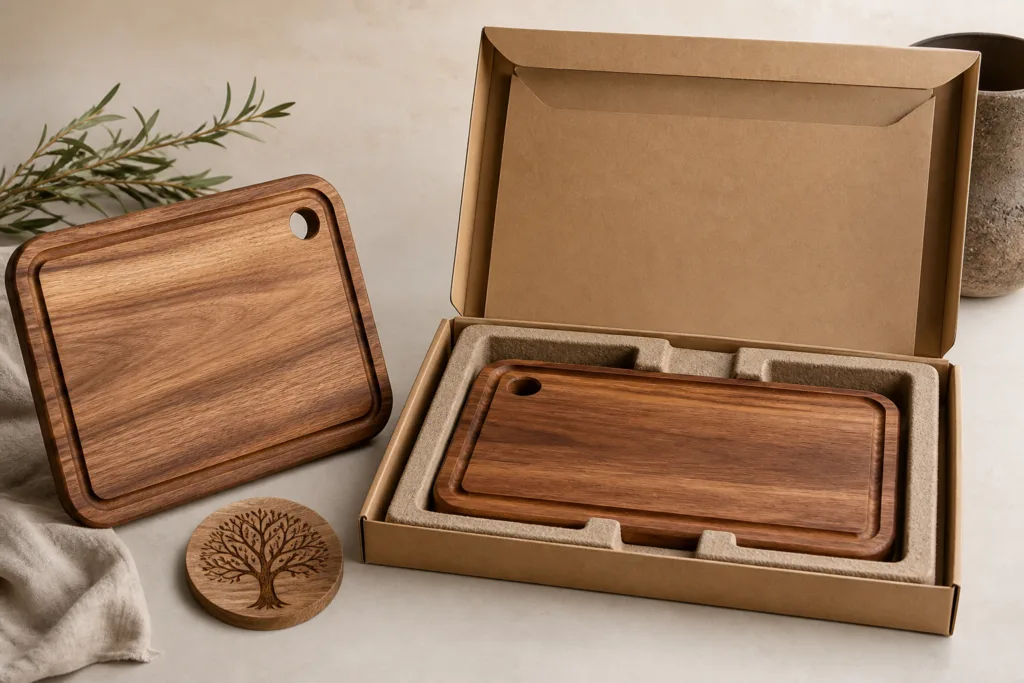
Packaging can change how the same board is perceived on shelf. Acacia usually benefits from packaging that signals premium, such as rigid sleeves, refined inserts, or window cartons with a natural color palette. Bamboo often works well in efficient retail packaging that emphasizes clarity, sustainability, and easy replenishment. For export, both materials need protective inner packing to reduce rubbing, edge chipping, and moisture exposure during transit.
We recommend thinking in three packaging layers: product protection, shelf presentation, and logistics efficiency. A board that looks impressive in a gift box may be too costly for a high-volume retailer. A board packed too simply may underperform in premium channels even if the product itself is excellent. The correct answer depends on the margin structure and the customer’s unboxing expectation.
Cost structure and wholesale pricing logic
Because prices change with size, thickness, finish, and packaging, it is more useful to think in cost drivers than in one fixed price. Raw material cost is only one part of the equation. Thickness, lamination complexity, sanding level, logo application, packaging type, and freight volume all influence landed cost. In many programs, bamboo is more cost-efficient for standardized ranges, while acacia becomes more expensive as you move toward premium grain selection and richer packaging.
For budget planning, buyers often compare FOB or EXW quotations across multiple build specs. The same board can move from an entry-level item to a premium SKU simply by changing finish, box quality, or engraving complexity. That is why we encourage procurement teams to request line-item pricing rather than a single all-in number. It makes it easier to isolate which feature is driving cost and where margin can be protected.
MOQ, sampling, and lead time expectations
In wholesale production, sampling should never be rushed. The first sample is not only for appearance; it is for checking flatness, smell, finish cure, engraving clarity, and how the board feels in hand. We usually recommend one sample round for visual approval and one pre-production confirmation round if the SKU includes a new finish, packaging format, or unusual shape. For custom products, the approval path matters more than the sample count.
MOQ varies with construction complexity, packaging, and whether the board is stocked or fully custom. A simple bamboo board with standard dimensions can usually support lower MOQ than a highly customized acacia board with premium packaging and multiple engraving locations. Production lead time is also affected by raw material availability and order queue. For buyers comparing sourcing options, our bamboo vs hardwood material selection guide can help frame the trade-off between visual appeal, processing behavior, and cost structure before you finalize a purchase order.
As a planning rule, leave room for sample approval, artwork revision, and pre-shipment inspection. Many delays happen not in cutting or sanding, but in waiting for packaging confirmation or label correction. Early approval saves more time than aggressive expediting later.
Quality control checklist for wholesale buyers
A good QC checklist should focus on measurable acceptance criteria. Do not rely on “looks okay” alone. We recommend checking moisture content targets, board dimensions, edge radius, surface smoothness, glue line visibility, and engraving consistency. For laminated products, adhesion integrity is critical. For all boards, smell and finish tackiness should be checked before packing because packaging can trap defects that are hard to correct later.
- Confirm board thickness and size tolerance
- Check flatness on a level surface
- Inspect for cracks, chips, and voids
- Verify finish uniformity under angled light
- Test engraving depth and placement consistency
- Review carton protection and inner packing
- Confirm labeling accuracy and barcode placement
For food-contact products, ask suppliers for the finish specification and test documentation relevant to your market. If you plan to sell through multiple channels, build a written acceptance standard that covers both functional and cosmetic defects. That reduces disputes later when reorder shipments need to match the original sample.
Supply risks and how to reduce them
Acacia can face more variability in appearance because natural grain and color are less uniform than bamboo. That is not inherently a problem, but it may require better sorting and clearer buyer expectations. Bamboo supply chains can be efficient, but buyers should pay close attention to lamination consistency, carbonization variance if used, and adhesive control. Neither material is risk-free; each has its own failure mode.
One practical mitigation strategy is dual-sourcing within the same product family. For example, a brand might keep bamboo as the core value line and acacia as the premium line, using shared packaging architecture but different finish and visual standards. This reduces dependence on a single material category and helps protect inventory continuity if one supply path tightens. It also makes it easier to shift demand between SKUs when freight or raw material costs move.
Cost-performance trade-offs and SKU planning
The smartest assortment strategy usually mixes materials. Bamboo can anchor the range with efficient pricing and stable reorder performance. Acacia can add differentiation and higher perceived value. If you force all SKUs into acacia, you may overprice the lower end of the market. If you force everything into bamboo, you may leave premium margin on the table. The best assortment is the one that matches your channel mix and your customer’s buying behavior.
In a practical lineup, a buyer might use bamboo for standard rectangular boards, acacia for round serving boards or premium gift sets, and a branded premium version for seasonal promotions. That structure lets you manage raw material costs while still offering visual variety. It also gives sales teams more flexibility when negotiating with different retail customers.
Channel-specific recommendations
For mass retail, bamboo is usually the safer bet because it delivers predictable visual consistency, efficient unit economics, and easier stackability in cartons. For premium kitchenware, acacia often performs better because it supports a richer shelf story and higher retail pricing. Hospitality buyers often prefer bamboo because it is straightforward to spec, easy to replenish, and cost-sensitive at scale. Promotional buyers may choose either material depending on brand presentation, but bamboo is generally easier for large logo runs and standardized giveaways.
For buyers building a broader bamboo assortment, our Bamboo Wood Art manufacturing view is that the best channel match depends on how much variation your customer will tolerate. If the answer is low tolerance, select bamboo and tighten the spec. If the answer is high tolerance and the brand wants premium cues, move toward acacia with stronger packaging.
Sample buyer scenarios
High-volume discount retailer
Choose bamboo with a simple finish, standard dimensions, and protective retail packaging. Keep engraving minimal and focus on price stability, carton efficiency, and reorder continuity.
Boutique direct-to-consumer kitchen brand
Choose acacia if the brand wants warmth, grain character, and a premium look. Invest in better packaging, refined edge finishing, and a sample approval process that includes photography review.
Hotel group or catering program
Choose bamboo for consistency, easier replenishment, and controlled cost. Prioritize flatness, stackability, and finish durability over decorative detail.
Gift or promotional campaign
Either material can work, but the decision should follow the campaign message. Bamboo is efficient for high-volume branding. Acacia works well when the gift needs a richer perceived value and more upscale unboxing.
Negotiation and supplier selection tips
When comparing suppliers, ask the same questions every time. Request construction details, finish specification, packaging structure, sample timeline, MOQ, and target lead time. Ask how the supplier handles rework if the engraving is off-center, the board is warped, or the finish is inconsistent. If those questions are uncomfortable for the supplier, that may indicate weak process control.
Commercial terms should also reflect the risk profile. For custom programs, confirm whether the sample fee is deductible from the production order, whether artwork approvals are final, and how packaging changes are handled after confirmation. It is much easier to correct a carton design before production than to reprint after goods are packed. Buyers who specify custom bamboo cutting boards should be especially careful about artwork files, barcode placement, and carton drop protection because these details become expensive once mass production starts.
Implementation checklist for first-time buyers
- Define the target channel and price band
- Select bamboo, acacia, or a two-tier assortment
- Approve size, thickness, and finish specification
- Confirm logo placement and packaging format
- Request and review physical samples
- Set QC acceptance criteria in writing
- Approve pre-production sample and carton artwork
- Schedule inspection before shipment
- Plan reorder lead time before peak season
If you build the process in that order, you reduce the chance of buying the wrong board at the wrong price. The best sourcing outcomes usually come from disciplined specification, not from last-minute price chasing.
Acacia vs bamboo cutting board: final buying guidance
For most wholesale programs, bamboo is the more efficient choice when you need stable supply, uniform appearance, and strong value positioning. Acacia is the better choice when the board must feel more premium, carry richer natural character, and support a higher retail price. The best solution is often not either-or, but a structured assortment that uses bamboo for volume and acacia for margin. That approach gives brands, distributors, and retailers a more resilient buying model across seasons and customer segments.
Before placing volume orders, compare samples under realistic use conditions, confirm packaging durability, and align your finish claims with the target market. In the end, the right acacia vs bamboo cutting board decision is the one that supports your channel, protects your margin, and reorders cleanly.
FAQs
Is bamboo or acacia better for wholesale cutting boards?
Neither material is universally better. Bamboo is usually better for value-driven, high-volume programs because it is more uniform and easier to price consistently. Acacia is usually better when the product needs a warmer premium look and a more natural grain story. The right choice depends on your channel, target margin, and packaging strategy.
Which material is more stable against warping?
Both can be stable if the board is built correctly and stored properly. Bamboo often performs well in laminated construction because it is engineered for consistency, while acacia can be very stable when thickness, drying, and storage are controlled. Thin boards of either material are more likely to warp in humid or poorly ventilated environments.
Can both materials be customized with logos?
Yes. Both bamboo and acacia work well for laser engraving, stamping, and shaped details. Bamboo often produces a crisp, high-contrast engraving, while acacia can deliver a more artisanal look. The supplier should confirm engraving depth, placement tolerance, and packaging protection before production starts.
What MOQ should I expect for custom boards?
MOQ depends on board size, material, construction, finish, and packaging. Standard bamboo programs often support lower MOQ than highly customized acacia programs. A useful way to manage risk is to start with a sample approval and then move into a production run sized for your first replenishment cycle, not just the initial launch.
What finish is usually safest for food-contact use?
A food-safe oil finish is often the simplest option for boards intended for direct food use, but the right answer depends on your market and product claim. Some coatings may be acceptable only for certain applications, so the supplier should match the finish system to the intended use and provide the relevant product statement or documentation.
How should I compare suppliers before placing a bulk order?
Compare sample quality, dimensional tolerance, finish consistency, packaging protection, lead time, and how clearly the supplier explains construction details. Ask for written QC criteria and a sample approval process. A reliable supplier should be able to explain raw material selection, adhesive control, and rework handling without vague answers.