In humid markets, the same board that looks stable in a showroom can start to cup, hold odor, or split after only a few cycles of washing and drying. That is why buyers searching for bamboo cutting board humid climate problems need a practical way to separate normal wear from avoidable manufacturing or care issues. From our manufacturing perspective, most failures come from moisture imbalance, poor drying habits, weak construction choices, or packaging that traps humidity before the board even reaches the user.
If your sourcing team is comparing specifications, our bamboo cutting board manufacturing support page is a useful starting point because it connects product structure, moisture control, finishing, and bulk production planning. At Bamboo Wood Art, we help buyers choose the right board build, surface finish, and packaging approach for humid destinations, then confirm the sample, approve the details, and scale production with QC checkpoints that reduce warping, odor complaints, and early returns.
What Humid-Climate Problems Look Like in Real Use
Humidity-related failures rarely happen all at once. They usually show up as a small change in flatness, then a smell that lingers after cleaning, and later a visible split or edge lift. For buyers and end users, the key is to understand which symptoms are cosmetic and which point to a structural issue.
The most common bamboo cutting board humid climate problems are:
- Warping or cupping: the board no longer sits flat and may rock on the counter.
- Persistent smell: moisture and food residue remain in the fibers or joints.
- Splitting or cracking: glue lines or bamboo strips fail after repeated wet-dry cycles.
- Surface roughness: the finish feels dry, fuzzy, or uneven after cleaning.
- Mold risk: dark spots or musty odor appear when boards stay damp or are stored without airflow.
Not every board that smells after heavy use is defective, and not every slight curve means a product is unusable. But in humid destinations, repeated small problems are usually signs that the board specification, drying method, or care routine needs improvement.
Why Humidity Changes Bamboo Board Performance
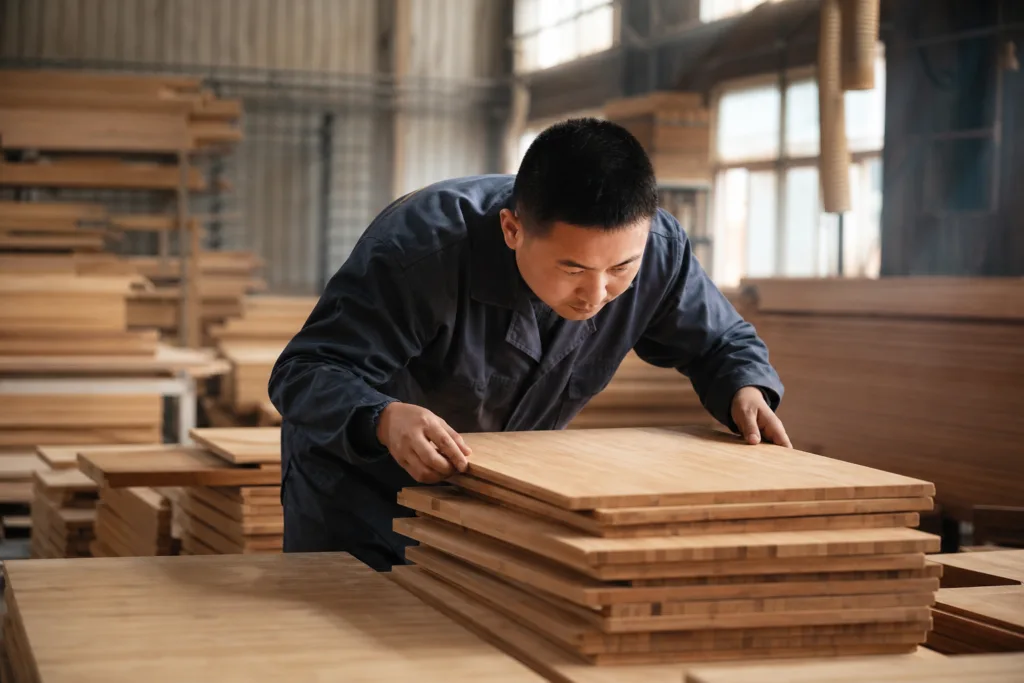
Bamboo is stable in many applications, but a cutting board is a high-exposure product. It sees water, soap, food acids, kitchen heat, and repeated wiping. In humid climates, the board spends less time fully drying between uses, which increases moisture retention and puts more stress on adhesive joints and surface fibers.
There are four main reasons the environment matters so much:
- Moisture absorption: bamboo fibers take in and release moisture, so the board expands and contracts.
- Glue line stress: if the board is laminated poorly, repeated movement can weaken bonds.
- Density variation: different bamboo sections move at slightly different rates.
- Airflow limits: kitchens, cabinets, and packaging can hold humidity around the board for too long.
That is why a board that performs well in a dry warehouse can behave differently in a coastal kitchen. When buyers evaluate bamboo cutting board humid climate problems, they should think beyond the material name and ask how the board was built, dried, finished, packed, and stored.
Moisture imbalance is usually the root cause
A bamboo board often warps when one side dries faster than the other. For example, a wet board placed flat on a countertop may dry on the top surface while the underside stays damp. That uneven movement pulls the board into a curve. The same thing can happen during packing if boards are sealed before they are fully dried.
From a production viewpoint, we pay close attention to moisture balance because the problem often begins before shipping. A stable board is not only about good raw material; it is also about controlled drying, consistent pressing, and a finish that does not lock in hidden moisture.
Warping Explained: Why Boards Bend or Cup
Warping is the most visible complaint because customers see it immediately. A warped board can make chopping less safe, reduce perceived quality, and create negative feedback even if the board is still technically usable.
Warping usually comes from one or more of these conditions:
- one-sided washing or soaking
- drying the board flat on a wet surface
- storage in a cabinet with trapped humidity
- poorly balanced lamination or strip orientation
- inconsistent finishing on the two faces
Some boards cup toward the wetter side, while others twist slightly across the diagonal. In both cases, the root issue is moisture moving unevenly through the board. A thin board is generally more sensitive than a thicker one, and a decorative shape with cutouts can lose stiffness faster than a simple rectangular form.
For buyers evaluating design options, the buyer checklist for board stability and finish is a practical reference point because construction details matter as much as appearance. If you want fewer complaints in humid markets, look for balanced thickness, clean edge finishing, and a construction style that resists one-sided moisture exposure.
What helps reduce warping at the source
We usually recommend a specification that starts with the right board geometry. A slightly thicker board, better surface sealing, and consistent sanding can all improve performance. On the sourcing side, buyers should ask how the board is laminated, whether the grain direction is balanced, and whether the surfaces receive equal finishing.
A good product also needs realistic end-user instructions. A stable board still warps if it is soaked, left in standing water, or dried against a hot appliance. Product performance is always a combination of manufacturing and care.
Smell Problems: When Moisture and Residue Stay Trapped
Odor is one of the most misunderstood complaints. Customers often say a board “smells bad,” but the issue may actually be trapped moisture, retained soap, or food residue inside small pores and knife marks. In humid climates, drying is slower, so that trapped moisture has more time to support odor buildup.
Common odor sources include:
- food proteins left in knife grooves
- soap residue that is not fully rinsed away
- standing moisture after washing
- poorly aired packaging or carton storage
- low-quality finishing that does not seal the surface consistently
Some boards are also packed too soon after finishing or oiling, which can create a fresh but lingering manufacturing smell. That is not always harmful, but it should be controlled so customers do not mistake it for mildew or contamination.
For this reason, many buyers want to understand the difference between finishing for appearance and finishing for odor control. The oil treatment for odor control and protection article is relevant because a light, well-timed oiling step can support the surface and help reduce unwanted odor retention when it is paired with proper drying and ventilation.
How to tell odor from mold risk
A mild natural wood or bamboo scent is normal. A sour, stale, or musty smell that stays after cleaning is a warning sign. If a board smells worse after being stored in a closed cabinet, the issue may be airflow, not the board itself. If the odor comes with black specks, discoloration, or a sticky feel, mold risk should be considered and the board should be removed from use.
From a buyer’s perspective, odor control is both a product and packaging issue. A well-finished board can still arrive with complaints if the warehouse or carton environment is damp. That is why procurement teams should ask suppliers about drying time, storage conditions, and packaging materials before bulk orders.
Splitting Explained: Why Bamboo Boards Crack
Splitting usually gets worse over time. At first, it may appear as a hairline crack at the edge, near the handle cutout, or along a joint line. Later, the crack grows as the board goes through repeated moisture cycles.
There are several root causes:
- End-grain or exposed fiber stress: vulnerable edges absorb and release moisture faster.
- Glue weakness: poor adhesive performance or uneven pressing can create a failure line.
- Repeated wet-dry cycles: the board expands and contracts until a weak point opens.
- Impact or flexing: bending a board while washing or carrying it can worsen a hidden crack.
In our production work, cracks are often a sign that the construction and environment were not matched. A board intended for humid kitchens needs dependable adhesive, uniform material preparation, and a finish that does not leave unprotected edges.
The seasoning and care steps for new bamboo boards guide helps explain why initial conditioning matters. A board that is used correctly from the start is less likely to develop early splits, especially when the user follows a regular dry-and-oil routine rather than letting the surface cycle from very wet to very dry.
Why glue quality and press control matter
Buyers sometimes focus only on bamboo species, but the adhesive system matters just as much. If glue lines are too brittle, too thin, or unevenly pressed, the board may look fine at first and fail later in humid use. Pressure, cure time, and edge trimming all affect whether the final board can tolerate daily kitchen moisture.
When sourcing for tropical or coastal markets, we encourage buyers to treat split resistance as a specification item, not a guess. Ask how the board is pressed, whether the glue is suitable for food-contact applications where relevant, and how the supplier checks bonding consistency during production.
How Cleaning Habits Affect Board Life
Many board complaints are caused by cleaning habits rather than material defects. The most damaging routine is soaking, because standing water can enter seams, edges, and knife marks. Dishwasher use is even more aggressive: heat and prolonged moisture exposure are hard on bamboo boards and often shorten product life.
What usually helps:
- wash quickly with mild soap and minimal water
- rinse thoroughly to remove detergent residue
- dry immediately with a towel
- stand the board upright for airflow
- avoid leaving wet boards on sealed counters or in closed sinks
What usually hurts:
- soaking for long periods
- dishwasher cleaning
- air-drying flat with no airflow underneath
- stacking boards while damp
- using harsh scrubbers that roughen the surface
For commercial buyers, cleaning guidance should be part of the packaging insert or product card. If the end user receives a bamboo board with no care instructions, they may unintentionally create the exact humidity-related problems the product was designed to avoid.
When wholesale teams compare options, the wholesale bamboo cutting board sourcing factors page is useful because it connects product price, construction choices, and expected usage conditions. In humid regions, the lowest-cost board is often not the lowest-risk board.
Drying and Storage Choices Make a Bigger Difference Than Most Buyers Expect
Drying is not just a consumer issue. It also matters in the warehouse, during sample storage, and while boards are waiting for packing. Bamboo cutting board humid climate problems often start when a board is stored in a poorly ventilated area or packed before internal moisture has escaped.
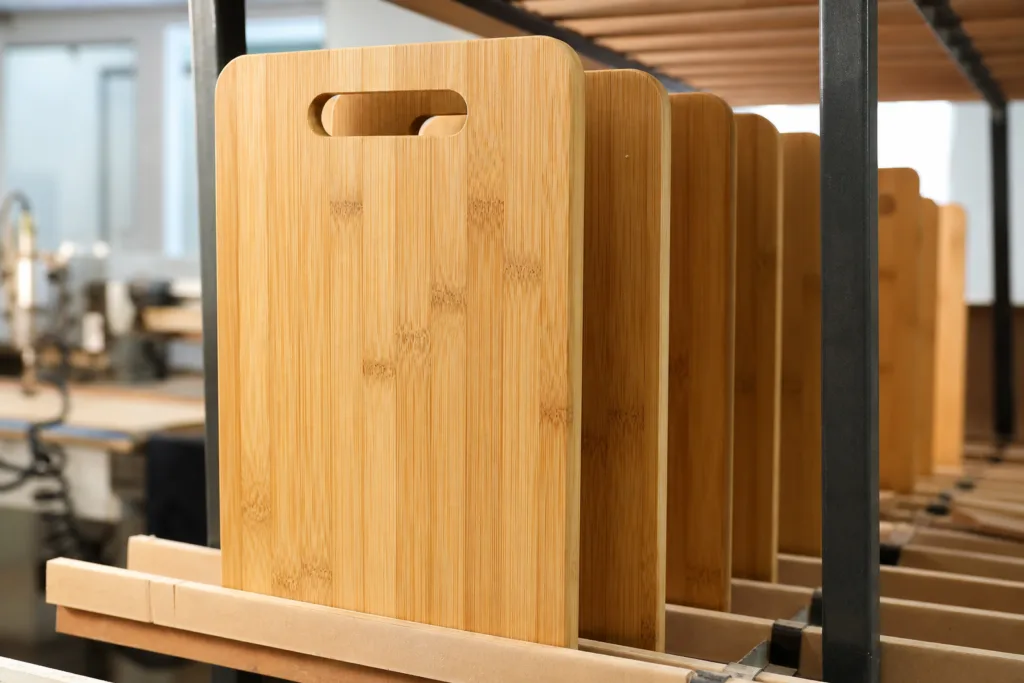
Best practices include:
- dry vertically or on an angled rack
- keep air moving on both faces
- avoid direct heat sources that can dry one side too fast
- do not store boards in sealed plastic while they are still warm or slightly damp
- rotate stock so older cartons do not sit in humid corners
Sunlight can help with drying, but too much direct heat can create uneven movement and surface stress. A balanced approach is better than trying to force moisture out too quickly.
At Bamboo Wood Art, we often discuss storage and airflow with customers who need boards shipped to hot or coastal destinations. A product can be well made and still arrive with issues if the warehouse environment is not controlled. That is why buyer-side planning should include carton design, pallet placement, and humidity exposure during transit and storage.
Packaging and Warehouse Conditions Can Create Hidden Problems
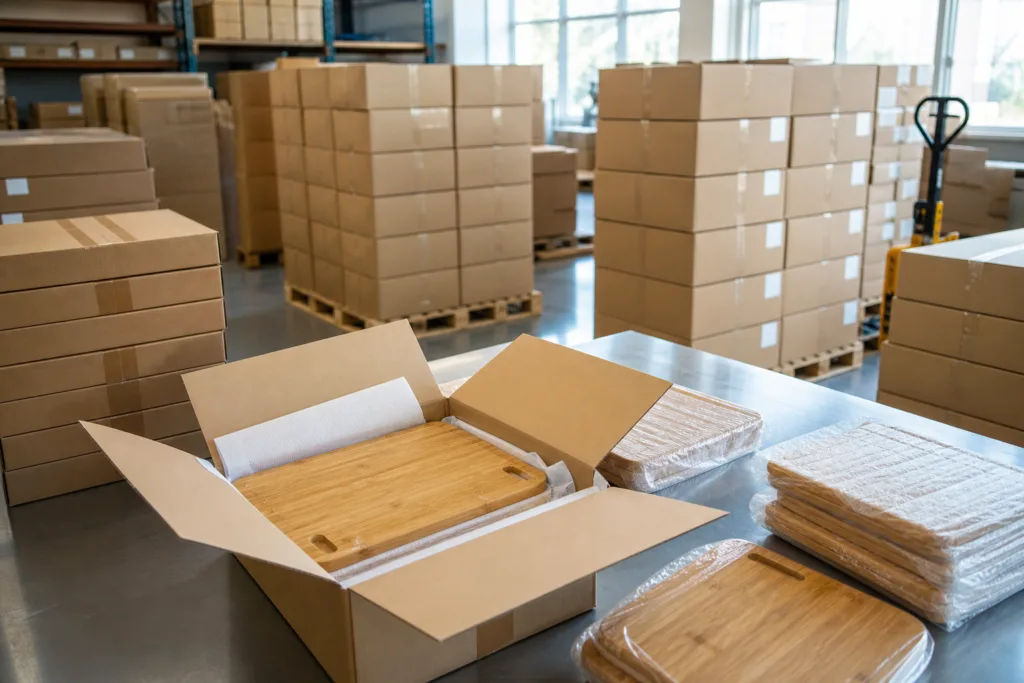
Packaging does more than protect the product from scratches. It also affects odor, moisture retention, and the first impression when the carton is opened. If a board is packed too tightly, with insufficient drying time or sealed in material that traps moisture, the package can preserve a problem rather than prevent it.
Packaging and storage risks are especially important when products move through multiple climates. A board may leave a dry factory, sit in a humid port warehouse, and then arrive at a retailer in another humid region. Each stage can add moisture stress.
Good packaging decisions for humid markets usually include:
- full drying before packing
- clean inner wrapping that does not trap dampness
- carton strength that protects edges from impact
- clear batch labeling for QC traceability
- pallet storage that keeps cartons off wet floors
For retail or private label programs, packaging should also support the brand story. Moisture-sensitive products need instructions and presentation. If the carton is designed well, it can reduce damage, improve shelf appearance, and lower claim rates after delivery.
Bamboo Board Specification Checks for Humid Destinations
When sourcing for humid or coastal markets, the buyer should not ask only “Is it bamboo?” The more useful question is “How is this bamboo board built to handle moisture changes?” That shift in thinking often separates a short-lived product from a reliable one.
Below is a practical comparison we use when discussing options with procurement teams:
| Specification Area | Lower-Risk Choice | Higher-Risk Choice |
|---|---|---|
| Board thickness | Moderate thickness with balanced stiffness | Very thin board with easy flexing |
| Surface finish | Even sanding and consistent sealing | Patchy finish with dry edges |
| Edge design | Rounded, smooth edges with clean trimming | Sharp edges or exposed weak points |
| Adhesive and lamination | Stable bond with controlled pressing | Inconsistent glue lines or uneven pressure |
| Packaging condition | Dry, ventilated, traceable cartons | Sealed damp packing or weak carton protection |
The practical takeaway is simple: humid-climate performance is not one feature. It is the result of several choices working together.
Buyers who want reliable production planning should also keep the manufacturer perspective in mind. If you want to learn how a factory evaluates material, finishing, and consistency across production, our Bamboo Wood Art homepage gives a broader view of our bamboo and wood manufacturing capabilities, including custom development, sampling, and QC support for B2B projects.
What to Ask Suppliers Before Bulk Orders
Before placing a bulk order, sourcing teams should ask questions that go beyond price and dimensions. The goal is to reduce humidity-related returns by confirming how the product is made and how it will be packed for destination conditions.
Useful questions include:
- What moisture content target do you use before packing?
- How is the board laminated and pressed?
- What finish is used on the surface and edges?
- How do you control odor after oiling or finishing?
- What QC checks are performed for flatness, cracks, and surface smoothness?
- How are cartons stored before shipment?
- Can you provide a sample for approval before mass production?
A supplier should be able to explain these points clearly. If the answers stay vague, the risk usually shifts to the buyer after shipment.
Good communication also helps define tolerance levels. For example, a light natural grain variation may be acceptable, while a visible warp or edge split may not. When the supplier and buyer agree on the acceptable range before production, there are fewer disputes later.
How samples should be evaluated
A sample should not be judged only by appearance. Leave it in the intended environment, use it as a real board, wash it properly, and check whether the surface or edges change. A sample that stays flat and odor-free after several uses is a much better indicator than one that simply looks perfect in a photo.
Common Mistakes Buyers Make in Humid Markets
Many sourcing problems repeat because the product is chosen for one market and sold in another without adjustment. A board that performs acceptably in a dry climate may not be the right choice for tropical or coastal buyers.
The most common mistakes are:
- choosing only by price
- ignoring board thickness and edge construction
- skipping sample testing in humid conditions
- not asking about drying and packing before shipment
- using generic care instructions for all regions
- assuming all bamboo boards behave the same
Another common mistake is treating odor complaints as purely subjective. In reality, odor often reflects moisture retention or cleaning residue, both of which are preventable. If a brand handles this issue early, it can reduce returns and improve customer trust.
For buyers who want a more systematic approach, the right next step is to combine product evaluation with care planning. That means the board specification, packaging, and end-user instructions should all match the humidity level of the market.
When to Choose Bamboo, When to Upgrade the Specification, and When to Consider Alternatives
Bamboo is a strong choice when the buyer wants a natural material, a clean look, and good cost-performance balance. It can work very well in humid climates if the design and care expectations are realistic. However, not every bamboo board specification is suitable for every market.
Choose bamboo cutting boards when:
- you want a natural, lightweight, visually tidy product
- you can define care instructions clearly
- the supplier can control moisture, finish, and QC
- your price target still allows proper construction
Upgrade the specification when:
- the market is tropical, coastal, or very humid
- the board will be used heavily in hospitality or food service
- your brand wants fewer odor and warp claims
- you need private label packaging with stronger protection
Consider alternative materials when:
- the end user will expose the board to frequent soaking
- the product must tolerate rough handling with little maintenance
- you need a material system that better matches a specific use case
As a manufacturer, we usually recommend deciding by use scenario first, not by material trend. The right board is the one that fits the customer’s environment, cleaning habits, and purchase expectations.
Practical Prevention Checklist for End Users
If you are helping customers or retail staff explain care, keep the message simple and repeatable. Clear instructions can prevent a large share of bamboo cutting board humid climate problems.
- Wash quickly after use with mild soap.
- Rinse well and do not leave residue behind.
- Dry immediately with a towel.
- Stand the board upright so air can reach both sides.
- Do not soak or dishwasher-wash the board.
- Oil lightly on a regular schedule if the product requires it.
- Inspect edges and joints for early cracks or lifting.
- Replace boards that show persistent odor, deep splits, or mold signs.
If the board is used in a humid kitchen, consistency matters more than effort. A short, regular routine is better than occasional heavy cleaning followed by long damp storage.
Practical Prevention Checklist for Buyers and Sourcing Teams
For B2B buyers, prevention starts before the order is placed. A better specification is usually cheaper than a high complaint rate later.
- Confirm the board structure, thickness, and edge design.
- Ask about lamination, pressing, and adhesive quality.
- Set a moisture target before packing.
- Request sample evaluation in the target climate.
- Define finish expectations for flatness and smoothness.
- Specify carton protection and storage conditions.
- Include care instructions with the final pack-out.
- Agree on QC checks for warp, smell, cracks, and surface finish.
That kind of planning is especially important for private label programs. The board itself may be simple, but the commercial outcome depends on whether the product is ready for humid-use reality.
FAQ
Can bamboo cutting boards be used in humid climates?
Yes, bamboo cutting boards can be used in humid climates if the product is well made and the user follows proper drying and storage habits. The most important factors are moisture control, surface finishing, edge quality, and ventilation after washing. If a board is soaked, stored damp, or packed before it fully dries, humid conditions will make those weaknesses show up faster.
Why does my bamboo cutting board smell even after washing?
A lingering smell usually means moisture or residue is staying in the board. That can happen when the board is not dried fully, when soap is not rinsed away, or when the surface has many knife marks that trap food particles. A musty smell is more serious and may indicate mold risk, especially if the board has been stored in a closed, humid space.
How often should a bamboo cutting board be oiled?
Oiling frequency depends on use, washing habits, and climate. In humid areas, the goal is not to over-oil but to keep the surface from becoming dry and rough. A light, regular schedule is usually better than waiting until the board looks worn. If the surface still feels smooth and water beads lightly, it may not need immediate treatment.
What defects are normal and what are not?
Natural grain variation and slight color differences are normal in bamboo products. Visible warping, deep cracks, separating glue lines, persistent musty smell, and rough surfaces that worsen after simple cleaning are not normal quality expectations. Buyers should define acceptable appearance and functional tolerances in the sample approval stage.
Should bamboo cutting boards go in the dishwasher?
No, dishwasher cleaning is generally not recommended for bamboo cutting boards. The combination of heat, prolonged moisture, and repeated drying stress can cause warping, splitting, and finish damage. Hand washing with mild soap and immediate drying is the safer routine for most boards.
What should buyers ask suppliers for humid-market orders?
Buyers should ask about moisture content target, adhesive and lamination method, surface finish, odor control, sample approval, QC checks, and carton storage before shipping. It is also important to confirm how the supplier packs boards so they do not trap moisture during transit or warehouse storage. Those questions help reduce claims in humid destinations.