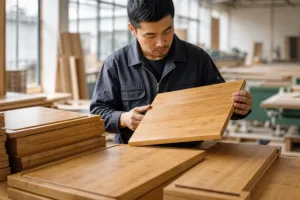
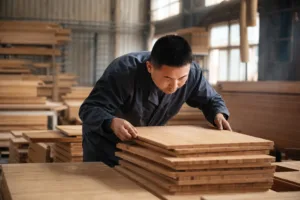
For B2B buyers, a bamboo dining table with glass top is not just a style choice; it is a market-positioning decision. The glass surface can make a collection feel lighter, more modern, and easier to merchandise in retail or hospitality settings, while a solid bamboo table top usually signals a warmer, more natural, and often more durable everyday-use profile. The right answer depends on the target channel, price tier, shipping plan, cleaning expectations, and how much customization you need at the OEM/ODM stage.
For teams mapping a new dining collection or private label line, our Bamboo and wood product sourcing overview can help frame the broader manufacturing decisions behind a tabletop program. At Bamboo Wood Art, we look at structure, finish, packaging, sample approval, and assembly compatibility together, because a table that works in a showroom still needs to survive freight, installation, and everyday use. If your project includes glass, bamboo, or mixed-material components, our production planning approach can support sizing, joinery, surface finishing, and quality control from the first sample onward.
What each tabletop design means in sourcing terms
When buyers compare a bamboo dining table with glass top against a solid bamboo table top, they are really comparing two different product architectures. In the glass-top version, the bamboo structure is usually the frame, base, or visible support system, while the top layer is tempered glass or another safety glass specification. In the solid-top version, the bamboo surface itself is the finished dining surface, so the material, lamination, edge work, sanding, and coating all become central to the look and performance.
From a manufacturing perspective, these are not interchangeable. The glass-top model shifts part of the visual appeal to transparency and reflectivity, which can help small dining spaces feel open. The solid bamboo table top emphasizes material character, grain consistency, and tactile warmth. The sourcing team should decide which story the product must tell before discussing dimensions, finishes, or branding details.
Key product differences at a glance
| Factor | Bamboo dining table with glass top | Solid bamboo table top |
|---|---|---|
| Visual effect | Light, contemporary, open | Warm, natural, grounded |
| Surface feel | Smooth, cool, reflective | Textured warmth with natural grain |
| Cleaning focus | Fingerprints and smudges are more visible | Spills and coatings matter more |
| Shipping risk | Higher due to breakage and packing needs | Lower, but still requires moisture protection |
| Custom branding | Frame, base, or metal parts often carry the logo | Laser engraving or carving can be applied directly |
| Retail positioning | Modern, design-led, often mid-to-premium | Natural, lifestyle-led, often value to premium |
Design and style differences that affect market fit
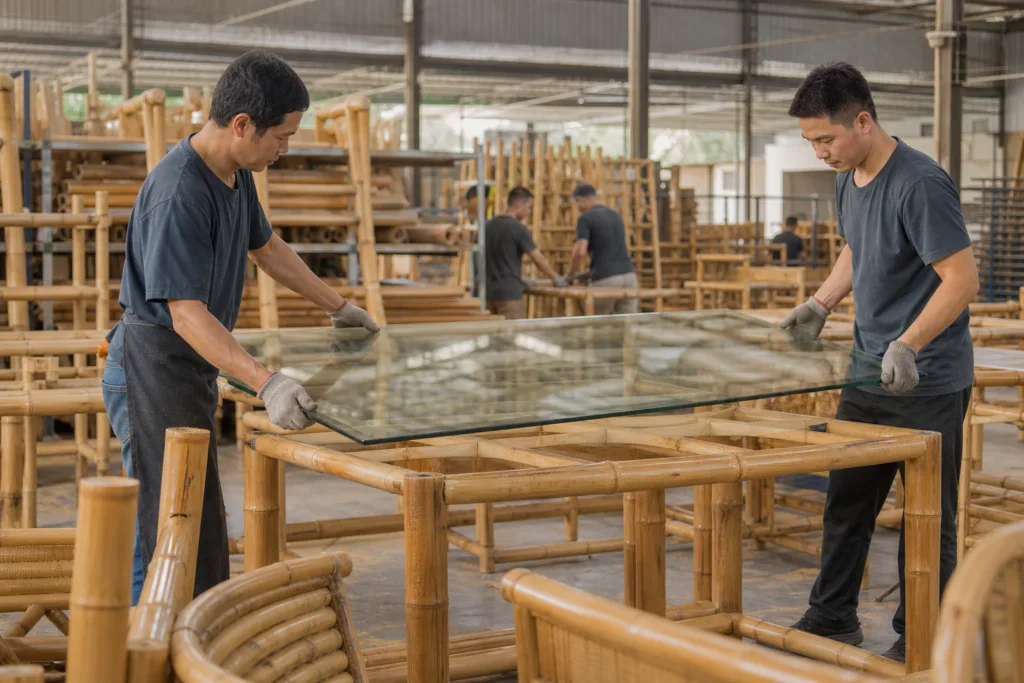
A dining table is often sold on first impression. For retailers and home decor brands, the top surface heavily influences how a consumer reads the product. A bamboo dining table with glass top usually creates visual lightness, which can make it attractive for contemporary interiors, apartments, and hospitality spaces where a cleaner silhouette matters. The transparency of glass also allows the bamboo base to remain visible, which can showcase the material underneath without visually adding bulk.
A solid bamboo table top creates a different emotional response. It feels more grounded and material-led, which can be a better fit for brands that want to communicate natural living, everyday family use, or a more handcrafted look. If the collection story centers on sustainability, natural texture, or a warmer dining atmosphere, the solid-top option often gives the buyer more room to express that message.
We often advise buyers to think about the surrounding assortment. A modern kitchenware or furniture line may use glass-top dining tables to echo metal, stone, or minimal home styling. A natural home decor line may prefer solid bamboo because it integrates more easily with benches, sideboards, trays, and accessories made from the same visual language. If the brand wants a cohesive catalog, the table surface should match the tone of the rest of the range.
For a broader manufacturing perspective on how tabletop design interacts with production methods and cost, our B2B bamboo and wood manufacturing guide explains how process choices affect both appearance and scalable output. That matters because the design a buyer likes in a sample must still be practical across mass production, packing, and repeat orders.
Market fit by customer segment
Different buyers usually need different tabletop stories. The best-selling version in one channel may be the wrong choice in another channel, even if the dimensions and frame are identical. We recommend segmenting the decision by customer profile before asking for quotations.
Home decor brands and ecommerce sellers
Home decor brands often look for products that photograph well and fit contemporary merchandising. A bamboo dining table with glass top can perform strongly in online listings because the open visual profile reads as cleaner in images. The reflected light may also make the product appear lighter and more refined. However, ecommerce sellers must balance that appeal against higher freight sensitivity and more demanding packaging requirements.
Hospitality and project buyers
Hotels, serviced apartments, and café operators often care more about maintenance and durability than about style alone. A solid bamboo table top can be easier to specify for daily use if the buyer wants a more forgiving surface without concerns about fingerprints on glass. That said, some hospitality interiors deliberately choose glass-top tables for premium suites, lounge areas, or design-forward dining spaces, especially where visual lightness is part of the interior concept.
Budget retailers
Budget-focused channels typically need a careful balance between price, presentation, and damage risk. Glass can increase perceived value, but it also adds cost in packing, handling, and replacement management. In some budget programs, a solid bamboo top may deliver a better cost-performance ratio because it reduces breakage risk and simplifies fulfillment.
Premium labels and design-led brands
Premium labels may use a bamboo dining table with glass top to create a mixed-material look that feels more architectural. If the base uses CNC shaping, carved details, or metal accents, the glass can emphasize those forms. For premium branding, the challenge is not whether the table looks good in a showroom, but whether the final delivery experience supports the same impression.
Eco-focused brands
Eco-focused brands often prefer the most honest material story. That does not automatically mean glass is wrong, but the brand should ask what the main material message is. If the goal is to highlight bamboo as the visual and tactile hero, a solid bamboo table top may communicate that more directly. If the collection is about durable mixed-material living, a glass-top configuration can still fit, provided the material rationale is clearly explained and the supply chain is well controlled.
At Bamboo Wood Art, we treat these market differences as a specification exercise, not a style debate. The same table form can be configured for retail, hospitality, or private label use, but only when the top material, support structure, finish, and packing method are aligned with the channel.
Shipping, freight, and packaging comparison
For procurement teams, shipping risk often changes the economics more than the base manufacturing cost does. A glass top adds breakage risk, more protective packaging, and a higher chance of claims if the carton design is weak or the loading plan is rushed. Even when the glass is tempered, it still requires careful handling and better corner protection than a solid bamboo surface.
A solid bamboo table top is typically less fragile in transit, but it is not risk-free. Bamboo still needs moisture control, stable lamination, and protection from edge chipping or surface abrasion. If the table includes large flat panels, the packaging should still prevent pressure marks, warping, and rubbing during container movement.
Glass-top designs may also reduce container efficiency. The packing structure often needs foam, corner guards, separators, and sometimes stronger outer cartons or reinforced crating depending on destination and order size. This can affect freight cost per unit and pallet utilization. In contrast, solid bamboo tops often ship more simply, which can help buyers with tighter landed-cost targets or frequent replenishment cycles.
The best packaging approach depends on order size and channel. Retail programs may tolerate more elaborate packaging if the perceived value is high enough. Hospitality projects often want lower damage risk and easier unpacking, while ecommerce buyers must think about parcel testing and consumer unboxing experience.
Price positioning and margin considerations
Price should not be analyzed only as a material cost line. The production cost of a bamboo dining table with glass top includes glass procurement, cutting or edging, fit-up, assembly, protective pads, and stronger packaging. If the table uses a metal frame or mixed-material structure, more assembly steps may be required as well. These extra steps can raise the factory cost, but they may also support a higher retail position if the design is strong and the brand can communicate the value clearly.
A solid bamboo table top may be simpler to produce, but it can still be premium if the lamination quality, sanding, edge finish, and coating system are well executed. In some cases, a solid bamboo design offers better margin flexibility because it lowers breakage risk and reduces packing complexity. The buyer can then decide whether to compete on accessible pricing or move the product up-market through better finish and branding.
We encourage sourcing teams to compare margin on a landed basis, not just ex-factory. Glass may look expensive at the factory level, but the real difference often appears in packing material, breakage reserve, and replacement handling. A solid bamboo top may look simpler, yet if the finish requires multiple coating passes or extended QC, the cost picture can narrow quickly.
Cleaning and daily use experience
Cleaning behavior matters because it influences customer satisfaction and reviews after the sale. Glass surfaces are easy to wipe down, and that convenience is a selling point for many buyers. However, fingerprints, water spots, and smudges tend to show more clearly, especially in showrooms or homes with strong lighting. For retailers and ecommerce sellers, that means styling and care instructions should be clear.
Solid bamboo tops have a different cleaning profile. They do not show fingerprints the same way glass does, but they do rely more heavily on the surface finish. If the coating is too soft, moisture can leave marks; if it is too glossy, scratches may be more visible. The cleaning message should therefore match the coating system. Oiled finishes, varnishes, and protective coatings each create a different end-user expectation.
For hospitality, cleaning convenience is often evaluated by housekeeping teams rather than by the guest alone. A glass surface can be very practical when it needs only quick wiping, but it may require more frequent polishing. A solid bamboo top may feel warmer and less reflective, but the team must know how to maintain the finish without damaging it.
Durability and long-term performance
Durability is not only about whether a tabletop can survive first use. It is about how the table performs after repeated cleaning, seasonal changes, and regular movement. A bamboo dining table with glass top depends on both the glass specification and the stability of the bamboo structure underneath. The glass itself may resist stains well, but it can still chip or crack if the design has weak support points, poor edge protection, or uneven load distribution.
Solid bamboo table tops are generally less exposed to breakage, but they can still warp, crack, or separate if moisture content is poorly controlled or if lamination and edge sealing are inconsistent. Bamboo is stable when processed well, yet it still behaves as a natural material. That means manufacturing controls matter: drying, pressing, glue selection, sanding, and coating all influence long-term performance.
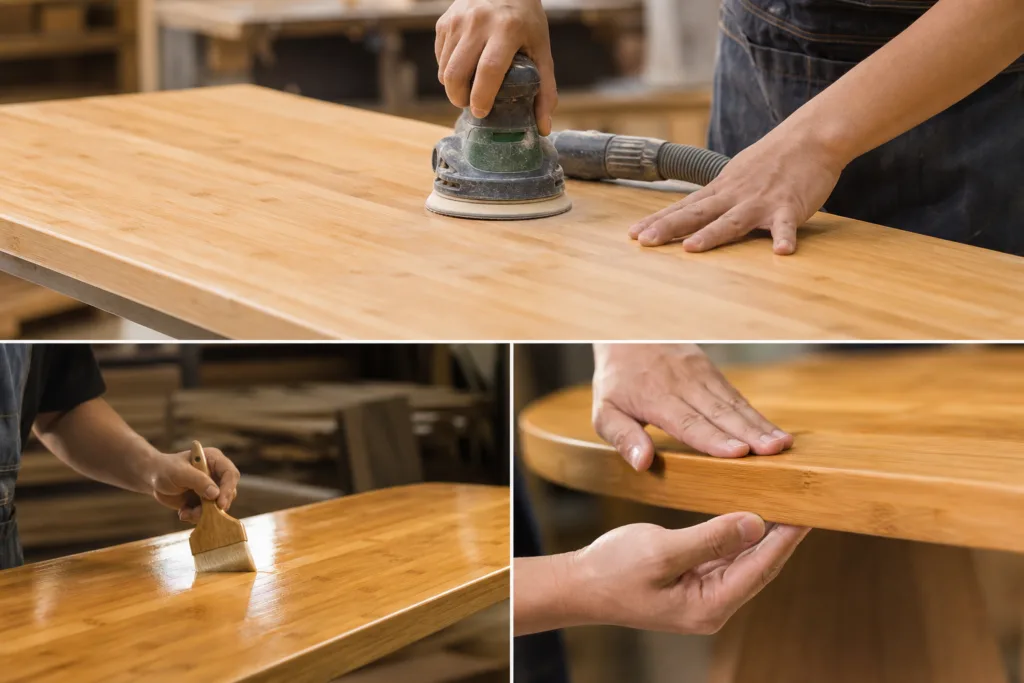
Scratch resistance is another practical issue. Glass resists many surface marks, though it can still show abrasion if hard objects are dragged across it. Solid bamboo is more dependent on the finish layer. Buyers should ask how the sample was finished, what kind of use case it was designed for, and whether touch-up or spare-part support is needed for large projects.
For buyers comparing bamboo against other natural materials, our Bamboo versus hardwood material comparison can be useful when evaluating hardness, stability, and positioning. That context helps teams understand why some table designs benefit from bamboo structures or bamboo tops, while others may require a different surface story.
Manufacturing and customization options
The customization path differs sharply between these two product types. With a solid bamboo table top, the surface itself can carry branding through laser engraving, CNC detailing, carved patterns, or subtle edge shaping. The table can also be finished in different stains, sheens, or tones to align with the brand identity. If the buyer wants the table to feel handcrafted or material-forward, the top surface becomes part of the brand language.
With a bamboo dining table with glass top, customization usually shifts to the base, frame, leg form, support structure, or hardware details. The glass can sometimes be customized in thickness, tint, edge polish, or size, but branding directly on glass is usually more limited than on bamboo. This does not make the product less customizable; it simply changes where the brand story is told.
For mixed-material assemblies, the fit between bamboo and other components becomes especially important. When glass, silicone pads, metal connectors, or fasteners are combined, the tolerances need to be planned carefully to prevent rattling, edge stress, or misalignment. Our Combining bamboo with glass, silicone, or metal parts article discusses the kind of compatibility thinking that helps avoid those assembly issues in bulk production.
Common customization choices for buyers
- Glass thickness: selected to match the table size, visual style, and expected use intensity.
- Edge treatment: polished, beveled, or softened edges can improve both safety and appearance.
- Bamboo base shape: straight, tapered, curved, or CNC-shaped forms change the brand character.
- Logo placement: base legs, stretcher bars, underside panels, or packaging can carry branding.
- Surface finish: matte, satin, or gloss changes cleaning feel and visual positioning.
If the table is part of a larger private label line, the customization plan should also include cartons, inserts, instruction sheets, and care guidance. That is where Logo decoration options for bamboo products becomes relevant, because the decoration method must match the material and the final use environment.
Sourcing and quality control checkpoints
Good sourcing decisions depend on repeatable quality. For a glass-top table, the first checkpoint is glass safety and fit. Buyers should confirm the type of glass, the thickness, the edge finish, the corner treatment, and the seating of the panel on the bamboo frame. Poor fit can create noise, movement, or long-term stress in transport and use.
The second checkpoint is bamboo moisture control. If the bamboo structure is not properly dried and stabilized, the frame may shift or the joints may loosen over time. This is especially important for tables that will ship across climate zones. The third checkpoint is joinery stability. A table can look excellent in a sample but still fail in mass production if the joints are not strong enough for repeated handling and load.
Surface consistency is another issue. Solid bamboo tops need careful sanding and coating to avoid visible patchiness, rough edges, or inconsistent gloss levels. Glass-top products need consistent frame color, fit accuracy, and packaging integrity. For both designs, sample approval should include real carton testing, not just visual inspection of the assembled table.
From our manufacturing perspective, the right checklist should include load stability, edge protection, coating appearance, carton drop expectations, and replacement-part planning. A sourcing team that asks for these details early usually reduces later frustration. For buyers comparing multiple product families, our Bamboo serving tray for table collections can also be a useful reference for how matching accessories help build a coherent furniture and decor assortment.
When a solid bamboo table top is the better choice
A solid bamboo table top is often the better choice when the brand wants a warmer material story, lower shipping risk, and more direct surface branding. It is usually the stronger option for customers who value natural texture, practical maintenance, and less fragility in transit. If the product will be used in family dining, casual hospitality, or everyday retail programs, the solid top can offer a better balance of appearance and durability.
It also tends to suit buyers who need a clear bamboo identity. If the market wants to see the material, feel the grain, and understand the sustainability message at a glance, the solid top communicates that more directly than a glass layer does. For private label projects, it also gives more options for engraving, staining, and finish variation.
When a bamboo dining table with glass top is the better choice
A bamboo dining table with glass top is usually the better choice when the target customer values visual lightness, easy wipe-clean convenience, and a more design-led presentation. It can be especially effective in contemporary living spaces, urban apartments, hospitality interiors, and showroom collections where styling impact matters. If the brand wants the bamboo base to be visible but not visually heavy, glass can help achieve that balance.
This version can also work well when the brand wants to separate the functional structure from the visual surface. That can support premium positioning, especially if the base uses strong joinery, elegant geometry, or mixed-material detailing. For buyers who want a table that feels more decorative than rustic, glass often gives the right aesthetic signal.
That said, buyers should only choose glass if the packaging, replacement plan, and QC process are ready to support it. A beautiful concept can become expensive if freight claims or breakage rates are ignored. The design should fit the sales channel, not just the mood board.
Common buyer mistakes when choosing between the two
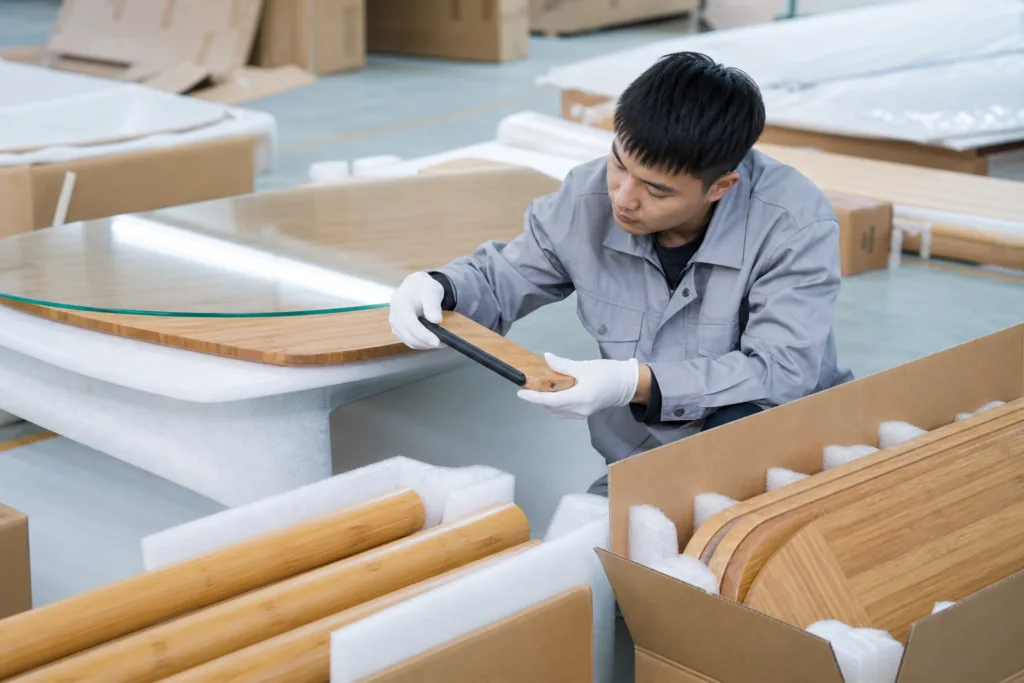
One common mistake is choosing the tabletop based only on photos. A table that looks elegant in a styled room may not be the best option for freight-heavy distribution or family-use retail channels. Another mistake is underestimating packaging. Glass can add far more logistical complexity than many first-time buyers expect.
Some buyers also overlook the relationship between finish and use case. A solid bamboo top without the correct coating may look good at sample stage but disappoint after cleaning or exposure to moisture. Others forget to specify what happens at the edges, where wear often begins. Even a good table can appear low quality if the edge sanding or glass seating is inconsistent.
Another recurring problem is mixing a premium visual design with a budget shipping plan. If the concept depends on glass, the landed cost and breakage budget need to reflect that. If the market is price-sensitive, a solid bamboo top may give the buyer more room to protect margin.
Decision framework for B2B buyers
When evaluating a bamboo dining table with glass top against a solid bamboo table top, start with the channel, not the design. Ask where the product will be sold, how it will be delivered, who will clean it, and what the customer values most. If the answer points toward modern styling, open visual space, and showroom appeal, glass may be the right fit. If the answer points toward natural texture, shipping simplicity, and material-led branding, solid bamboo may be stronger.
Next, match the tabletop to the economics of the program. Consider freight, carton count, damage tolerance, replacement policy, and the level of finish required to justify the target price. Finally, confirm that the manufacturer can support the needed structure, joinery, coating, and QC standard at scale. In our experience, the best-fit product is usually the one that is easiest to explain, package, and reorder—not only the one that looks good in the first sample.
For teams planning an OEM or private label launch, it helps to combine product choice with decoration and packaging planning from the beginning. If the line includes multiple bamboo items, the table should feel like part of a family rather than an isolated SKU. That is why sourcing teams often review a project alongside category examples such as Bamboo Wood Art’s production notes and adjacent product references before finalizing the specification.
FAQ
Is a bamboo dining table with glass top more fragile than a solid bamboo table top?
Usually yes, because the glass component adds breakage risk during shipping, handling, and installation. A solid bamboo top is generally less fragile in transit, though it still needs moisture control, edge protection, and good finishing to perform well.
Which option is easier for private label customization?
Both can be customized, but in different ways. A solid bamboo table top allows direct surface branding such as engraving or carved details, while a glass-top table usually shifts customization to the base, frame, hardware, and packaging.
Which tabletop is better for ecommerce sales?
It depends on the channel strategy. A bamboo dining table with glass top can photograph very well and look premium online, but it needs stronger packaging and damage planning. A solid bamboo top is often simpler to ship and manage at scale.
How should buyers judge finish quality on a solid bamboo table top?
Look at sanding smoothness, edge finishing, coating consistency, color uniformity, and how the surface responds to cleaning. A good sample should show even appearance, stable joinery, and a finish suited to the intended use environment.
Can glass-top tables work for hospitality projects?
Yes, especially when the interior concept values a light, modern look. The key is to confirm safety glass specification, packaging quality, and a maintenance plan that suits housekeeping workflows and high-traffic use.
What should be approved before mass production starts?
Buyers should approve the sample, dimensions, glass fit, finish standard, color tone, packaging structure, and QC checklist before moving to bulk. This is the best way to reduce disputes and avoid repeated rework during production.