12 Essential Insights for Load Testing Bamboo Trays Safely
Bamboo trays are renowned for their strength and sustainability, frequently serving in kitchens, restaurants, and hospitality venues. Yet, understanding their true performance under weight is critical for durability, safety, and service quality. This guide presents a step-by-step protocol for load testing bamboo trays, explains how geometry and construction impact performance, and reveals practical safety thresholds. Manufacturers, buyers, and hospitality managers alike will gain actionable insights to determine the ideal bamboo tray weight limit for their application.
Why Load Testing Bamboo Trays Matters
Whether for daily table service or elegant food displays, bamboo trays often carry hefty loads—plates, drinks, or products. Each scenario introduces unique stresses on the tray’s structure. Without precise load testing, trays may fail unexpectedly, risking spills, breakages, or injury. A robust bamboo tray load test routine uncovers the safe weight limit and eliminates safety hazards while boosting customer confidence in hospitality and retail settings.
Core Construction: Anatomy of Bamboo Tray Strength
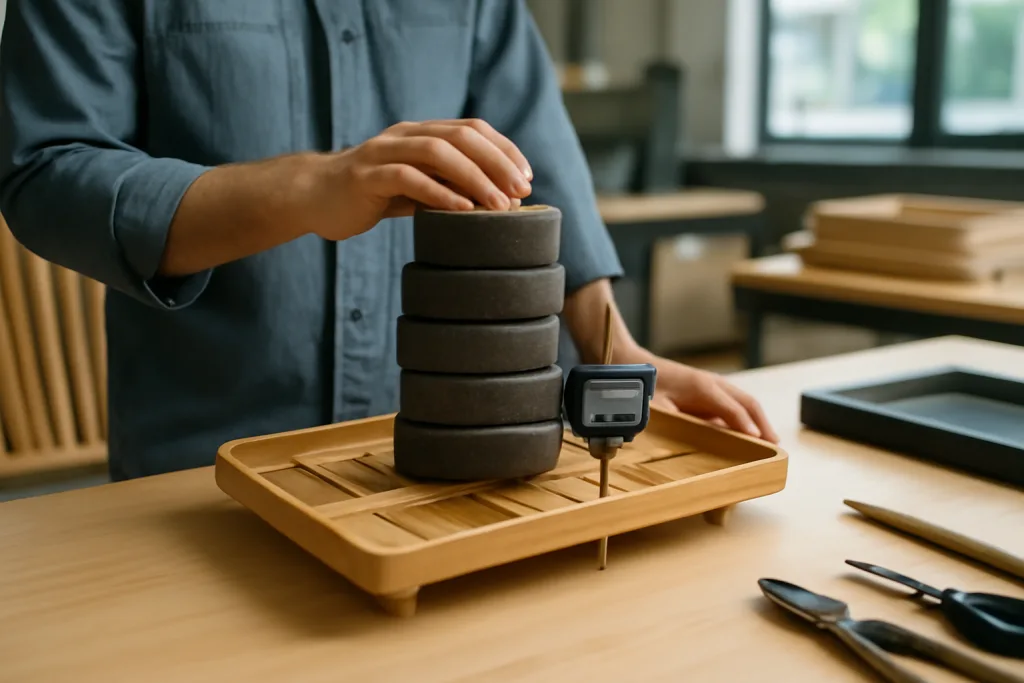
The load-bearing capacity of a bamboo tray hinges on more than thickness alone. Rib layout, handle shape, joinery, and material grades all play defining roles. At Bamboo Wood Art, skilled artisans select kiln-dried Moso bamboo slats, maintaining a moisture content between 8–12%. Precision CNC or mortise-and-tenon joints ensure robust assembly. These choices yield trays that resist warping even under heavy weights.
Common Rib and Frame Designs
- Flat laminate sole (minimal ribs): Lightweight, best for light snacks and décor.
- Cross-ribbed base: Enhanced support, suitable for heavier kitchen use.
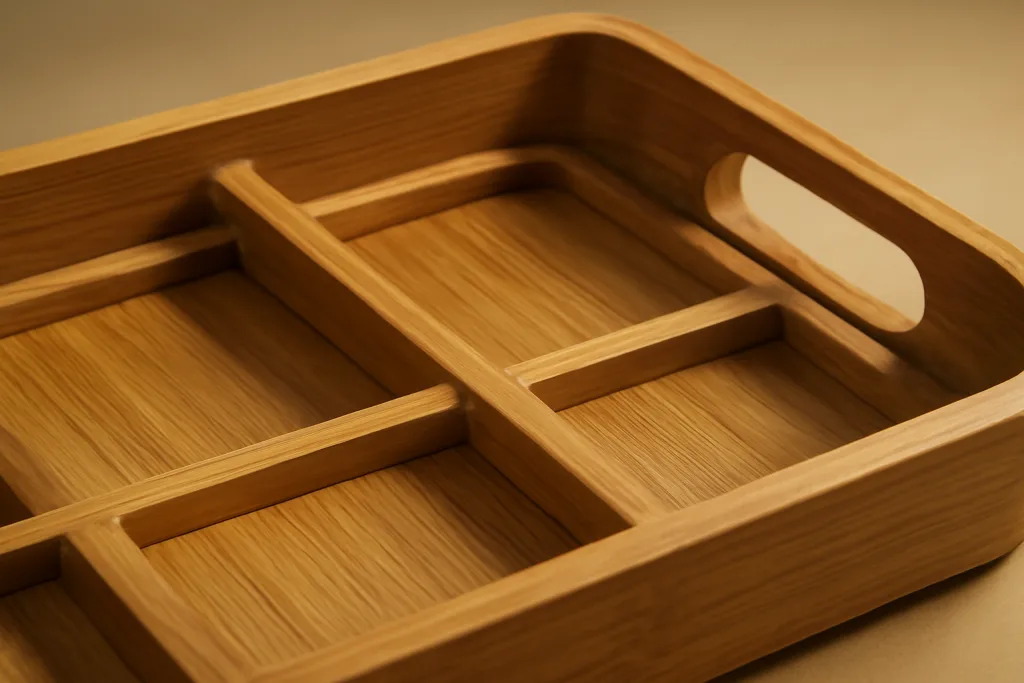
- Integrated handles: Cut-in, carved, or dowel-joined; each alters stress distribution during lifting.
Table: Material & Geometry vs. Performance
| Tray Type | Main Material | Rib/Handle Design | Finish | Best-Use Scenario |
|---|---|---|---|---|
| Standard flat | Moso bamboo ply | No ribs | Food-grade oil | Light service, décor |
| Reinforced cross-rib | Solid bamboo, optional ash frame | 2–4 underbase ribs | UV water-based | Hotel/restaurant load-up |
| Handled frame | Bamboo lamella, oak edge | Finger-jointed corners with drilled handles | Plant oil | Premium catering, heavy buffet use |
Load Testing for Bamboo Trays
Systematic load testing confirms a tray’s safe capacity and highlights potential failure modes. This process is critical, especially when trays serve in safety-sensitive environments like busy kitchens or public spaces. The following steps ensure consistency and accuracy each time you conduct a bamboo tray load test:
Step-by-Step Practical Lab Protocol
- Conditioning: Equilibrate trays in a controlled environment (20°C, 50% RH) for 24 hours to stabilize dimensions.
- Visual Inspection: Check for pre-existing defects—warps, loose joints, cracks, or surface blemishes.
- Mounting: Place the tray on a flat, non-flexing surface—ensure supports match tray handle locations if present.
- Incremental Loading: Gradually apply deadweight in 250g intervals, evenly distributed across the usable area.
- Deflection Measurement: With each step, use a digital caliper to measure central sag (mm). Note changes at bamboo tray weight limit candidates: 2mm, 5mm, and 10mm deflection thresholds.
- Failure Assessment: Continue until a structural failure: audible crack, joint separation, or deflection >10mm. Record all data points and failure type.
- Handle/Rib Stress: For trays with handles, repeat while supporting only by handles to simulate real serving conditions.
Failure Modes and What They Show
- Buckle/warp (usually in thin, unribbed bases): Indicates undersized lamella or insufficient lamination.
- Joint separation: Reveals weak finger-jointing or insufficient adhesive curing.
- Handle fracture: Highlights need for thicker edge stock or improved dowel orientation.
- Surface cracks: Suggests over-drying during kiln process or finish incompatibility.
Sample Data Log
Tray ID: BWA-0412
Material: Bamboo ply, 3-ply, cross-ribbed
Nominal Dimensions: 400x300x28 mm
Deadweight: 0.9 kg
Safe Load (Max < 5mm deflection): 8.4 kg
Failure Load: 12.3 kg (handle tear-out)
The Role of Geometry and Joinery in Load Capacity
Geometry deeply influences performance. A tray with deep sidewalls and multiple cross ribs will distribute load more evenly. Handle design matters too. For instance, cutout handles concentrate stress at two small points, necessitating reinforced corners or extra lamella layers. At Bamboo Wood Art, trays undergo finger-jointing or doweling at critical joints, further boosting rigidity and service lifespan.
Optimal Rib Spacing
For trays over 350mm in length, ribs should be spaced every 100–120mm to control sag. Cross-laminations and edge banding add further stability. When trays are extra-large or used for displays, consider an added longitudinal rib beneath the base panel.
Handle Engineering
- Closed dowel handles: Strongest, best for luxury hospitality.
- Open slot handles: Must be beveled to avoid splinters, with increased ply thickness at ends.
- Carved or cut-in handles: Look elegant but need added lamella behind the grip area.
Defining the Bamboo Tray Weight Limit
The maximum usable load is not the same as the destruction limit. Instead, a bamboo tray weight limit is set below the first visible sign of permanent deformation, usually at 65–75% of the lowest failure point observed in tests. For most high-quality, ribbed bamboo trays (dimensions 400x300mm; 10–12mm thick), this safe static load is around 7–9 kg.
Practical Considerations for Hospitality and Retail
- Set operational loads at least 20% below lab-tested safe weight—add a safety margin for movement, incidental bumps, or hand-held carrying.
- For food-contact trays, ensure finishes are FDA/LFGB compliant and check for skid resistance.
- For branding or corporate gifting (as provided by Bamboo Wood Art), confirm tray loads suit likely shipping weights plus any inserts.
Safety Thresholds and Compliance
Establishing clear safety thresholds is vital for both consumer trust and regulatory compliance. For food service trays, this includes not just physical strength but also hygiene standards and finish safety. Bamboo Wood Art sources FSC-certified bamboo and finishes trays with low-VOC, E0/E1-grade adhesives. Edges are sanded to 320 grit for customer comfort, and each batch is quality-checked for flatness and join integrity.
Export and Bulk Packaging Notes
Bulk shipments require robust packaging to avoid tray deformation during transit. Custom foam or corrugated inserts, edge guards, and moisture-absorbing pack materials help preserve tray flatness and finish integrity, especially for international orders.
How to Read a Spec Sheet: Bamboo Tray Load Test Results
Every high-quality tray should come with a load rating sheet. Here’s a template breakdown:
| Specification | Measured Value | Test Method |
|---|---|---|
| Safe Load Limit | 8 kg (uniform load) | Incremental deadweight, < 5mm deflection |
| Handle Safe Load | 6 kg (single hand lift) | Incremental, supported by handles |
| Max Deflection | 9.2 mm @ 10 kg | Caliper, digital readout |
| Finish Type | UV-cured, food-safe | Dry film thickness 35μm |
| Moisture Content | 9.7% | Oven drying, sample batch |
| Compliance | FSC, FDA | Doc. checked |
Always review load charts before placing trays into high-stress service—for sector-specific advice, Bamboo Wood Art offers direct technical consultation and prototyping for large OEM/ODM projects.
Optimizing Tray Performance: Manufacturing Best Practices
Choosing the right lamination stack-up, joint type, and finish type brings best-in-class safety and durability. Controlled kiln drying (ending 8–12% moisture) prevents later warping. All surfaces are sanded successively (180 → 240 → 320 grit) before a topcoat. Finger-jointed construction creates extra surface area for glue, reducing risk of joint failure. UV-cured coatings give a hard, non-porous finish that resists kitchen chemicals. All adhesives are E0/E1-certified to meet global standards.
Quality Assurance for Every Batch
- Dimensional checks (±1mm tolerance)
- Flatness and warp control: no tray exceeds 2mm bow after conditioning
- Adhesion and finish inspection
- Load-test sampling (per batch)
Extending Tray Life: In-Service Checks and User Tips
Best practice doesn’t end with testing. Users should periodically check for joint tightness and inspect handles for minor cracks or play. Wipe trays only with damp cloths—submersion may weaken joints or raise wood grain. For commercial operations, consider marking each tray’s weight limit on the underside for staff awareness.
Summary Table: Key Points for Load Testing Bamboo Trays
| Parameter | Best Practice | Why It Matters |
|---|---|---|
| Moisture Stability | 8–12% MC | Prevents post-use warping |
| Cross Ribs | Spacing 100–120mm | Controls sag in larger trays |
| Safe Load Limit | 65–75% of failure weight | Ensures robust daily use |
| Finish Type | Food-contact, low-VOC | User and regulatory safety |
| Quality Checks | Flatness, joint & finish | Harmonizes batch performance |
Real-World Examples and Case Studies
Fine Dining Serviceware
Bamboo Wood Art supplied 2,000 cross-ribbed trays to a boutique hotel, each tested to a 7kg safe limit for breakfast service. No tray showed measurable warping after six months of daily use.
Corporate Gifting and Branding
A corporate gifting project required custom-engraved, single-ply trays to carry books and local farm goods. Even with lighter design, these trays underwent a full bamboo tray load test protocol—specifying a marked weight limit of 4.5kg and using mortise-jointed handle inserts for reliable grip.
Frequently Asked Questions
How do you determine the safe weight limit for bamboo trays?
The safe weight limit is set by applying increments of deadweight to the tray, monitoring deflection and stopping well below the first sign of permanent deformation or structural failure.
What happens if bamboo trays are overloaded?
Overloaded trays may warp, develop cracks in the base or handles, or cause joints to come apart. This reduces both appearance and lifespan, and presents safety risks.
Are ribbed trays much stronger than flat trays?
Yes, trays with cross ribs or reinforced frames distribute weight better and resist sagging, making them ideal for higher load applications like restaurants.
How often should bamboo trays be tested or checked in service?
In commercial settings, inspect trays monthly for joint tightness, cracks, or changes in flatness—especially after exposure to unusually heavy loads or harsh cleaning.
Is there a difference between safe load for display and carrying?
Yes, trays used for carrying should have a lower limit than those just holding items on a flat surface, since movement adds dynamic loads and stresses on handles and edges.
What certifications should a quality bamboo tray have?
Look for FSC or PEFC forestry sourcing, E0/E1 adhesive use, and FDA or LFGB certification for food-contact finishes to ensure safety and sustainability.