Choosing a bamboo and wood products manufacturer is not only about finding someone who can make a sample. For B2B buyers, the real question is whether the factory can translate your use case into a stable product, repeatable quality, and a production plan that works at scale. Material behavior, finish choice, logo detail, packaging protection, and MOQ all affect whether the final item performs well in retail, hospitality, gifting, or promotional programs.
For buyers sourcing items such as chopsticks, trays, boxes, display stands, or custom kitchenware, our OEM bamboo chopsticks manufacturing support is a useful example of how a project moves from specification to production. At Bamboo Wood Art, we typically help with material selection, engraving or printing options, sample approval, food-contact finish planning, and bulk packaging so the final order fits the buyer’s channel, not just the product drawing.
What a Bamboo and Wood Products Manufacturer Does
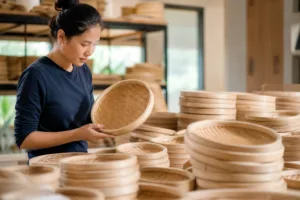
A real manufacturer does more than source finished goods. We work from raw material selection through cutting, shaping, sanding, finishing, assembly, inspection, and packing. In bamboo and wooden product manufacturing, that often means balancing appearance, strength, surface feel, cost, and consistency across a large batch.
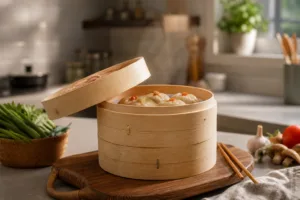
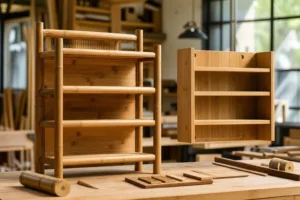
For B2B buyers, this matters because different product categories require different production logic. A wooden box for premium packaging needs crisp edges, stable joints, and a smooth finish. A bamboo tray for food service needs reliable lamination, moisture control, and sturdy assembly. A display stand may need CNC precision and load-bearing structure. A logo item may need engraving depth control and careful surface treatment so the brand mark remains clear after handling and transport.
Common product categories for business buyers
Most B2B bamboo and wood orders fall into a few broad groups:
- Kitchenware: chopsticks, spoons, spatulas, boards, bowls, and serving pieces
- Home decor: trays, candle bases, organizers, photo frames, and display items
- Packaging: wooden boxes, bamboo boxes, gift cases, and retail presentation packs
- Display solutions: countertop stands, retail risers, hospitality presentation trays, and sample holders
- Promotional items: engraved logo pieces, branded gift sets, and private label collections
As a bamboo and wood products manufacturer, we usually begin by asking where the item will be used, how it will be cleaned or handled, and whether the buyer needs retail-ready packaging or industrial bulk packing. Those details shape almost every decision that follows.
Bamboo vs. Wood: How to Choose the Right Material
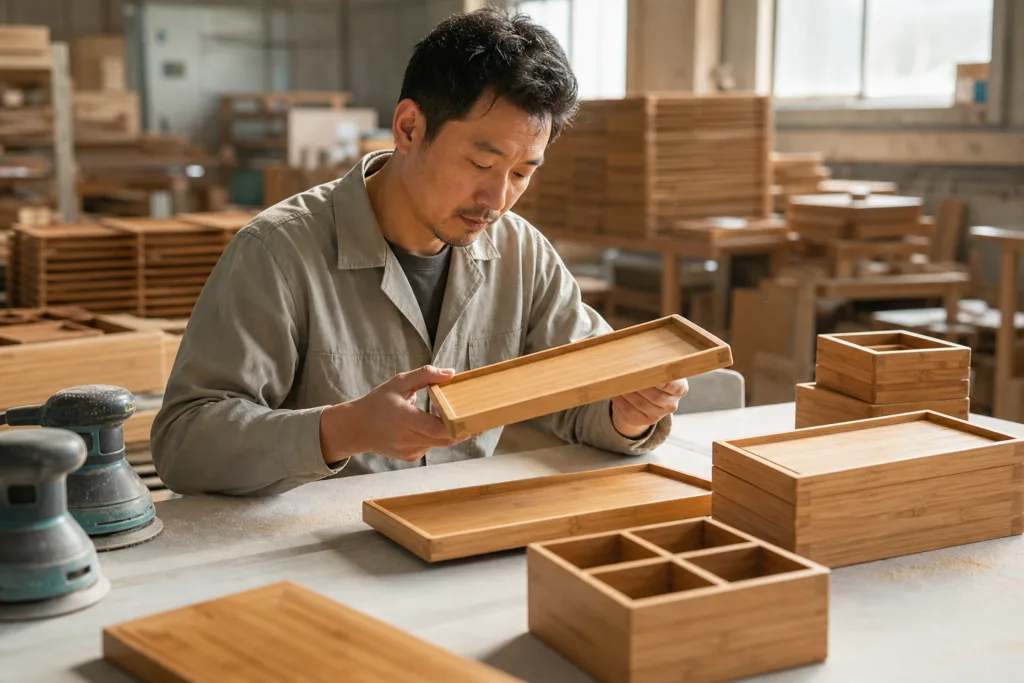
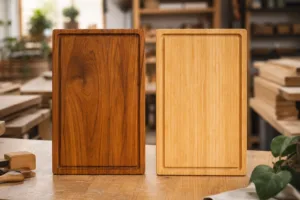
Many buyers ask whether bamboo or wood is the better choice. The answer depends on product type, desired appearance, price target, and functional requirements. Bamboo is often selected for a clean, modern, eco-conscious look and can be a strong option for repeated-use items when engineered correctly. Wood offers wider visual variety, richer grain character, and more options for premium appearance in gifting and home decor.
| Decision Factor | Bamboo | Wood |
|---|---|---|
| Visual style | Clean, uniform, contemporary | Natural grain, warmer, more varied |
| Surface consistency | Generally more uniform | More grain variation and color spread |
| Strength and stability | Good when properly laminated and dried | Depends on species and moisture control |
| Customization feel | Excellent for engraving and simple forms | Strong for carving, shaping, and premium finishes |
| Cost-performance | Often efficient for repeatable production | Can range widely by species and finish |
In practice, bamboo is often preferred for projects needing cleaner consistency from piece to piece, while wood can be better when the buyer wants a more organic, high-end, or species-specific look. That said, the final result depends less on the label and more on how the material is selected, dried, cut, and finished.
Material stability is especially important for items exposed to temperature changes or humidity during storage and shipping. Wood can shrink or swell as moisture changes, which may cause warping, cracking, or loose joints if the production process is weak. For a practical explanation of these risks, the Oregon State University guide on wood moisture, shrinkage, and warp control is a useful technical reference. From a buyer’s perspective, this is why kiln drying, acclimation, and moisture-safe packaging are not optional details; they are part of product reliability.
Material Selection Factors: Species, Density, Grain, and Sustainability
When buyers compare bamboo and wooden products, the discussion should go beyond the broad material label. In real manufacturing, species, density, grain behavior, and moisture response affect performance, yield, and finish quality.
What to evaluate before approving the material
- Species or bamboo type: Different wood species and bamboo formats behave differently in cutting, gluing, engraving, and finishing.
- Density: Denser materials often feel more premium and resist dents better, but they can be harder on tooling and may raise cost.
- Grain pattern: Straight grain can help with clean machining, while open or decorative grain may require more finish work.
- Moisture content: Too much moisture raises the risk of movement after production and during shipping.
- Color consistency: Natural variation is normal, but buyers need to define acceptable range for batch-to-batch consistency.
If your project is food-related, material selection should also account for coating and contact requirements. For kitchenware, buyers should distinguish between food-contact surfaces and decorative or exterior surfaces. The FDA’s food-contact guidance for wood and bamboo kitchenware is worth reviewing when you are deciding whether an item will be used with direct food contact, what coatings are acceptable, and how to communicate compliance expectations with suppliers.
Sustainability claims should also be handled carefully. Buyers should ask whether the material is responsibly sourced, whether any forest certification or chain-of-custody documentation is available, and what exactly the claim refers to. Government procurement guidance on sustainable sourcing and FSC verification is a practical reminder that claims should be verified, not assumed. In our experience, a buyer who asks for documentation early is much less likely to face confusion later in the supply chain.
Customization Options: Size, Shape, Logo, CNC, and Carving
Customization is one of the main reasons B2B buyers work with a bamboo and wood products manufacturer instead of buying standard stock. A product may need to fit a shelf, a plate, a storage system, a gift set, or a branding program. That means the factory must handle both the functional dimensions and the visual identity of the item.
Common customization methods include:
- Size changes: length, width, thickness, depth, and compartment layout
- Shape adjustments: rounded corners, tapered edges, handles, cutouts, and nesting features
- Logo application: laser engraving, CNC engraving, carving, screen printing, or heat marking
- Surface texture: matte, semi-gloss, polished, brushed, or natural unfinished look
- Packaging customization: sleeves, labels, inserts, gift boxes, and private label cartons
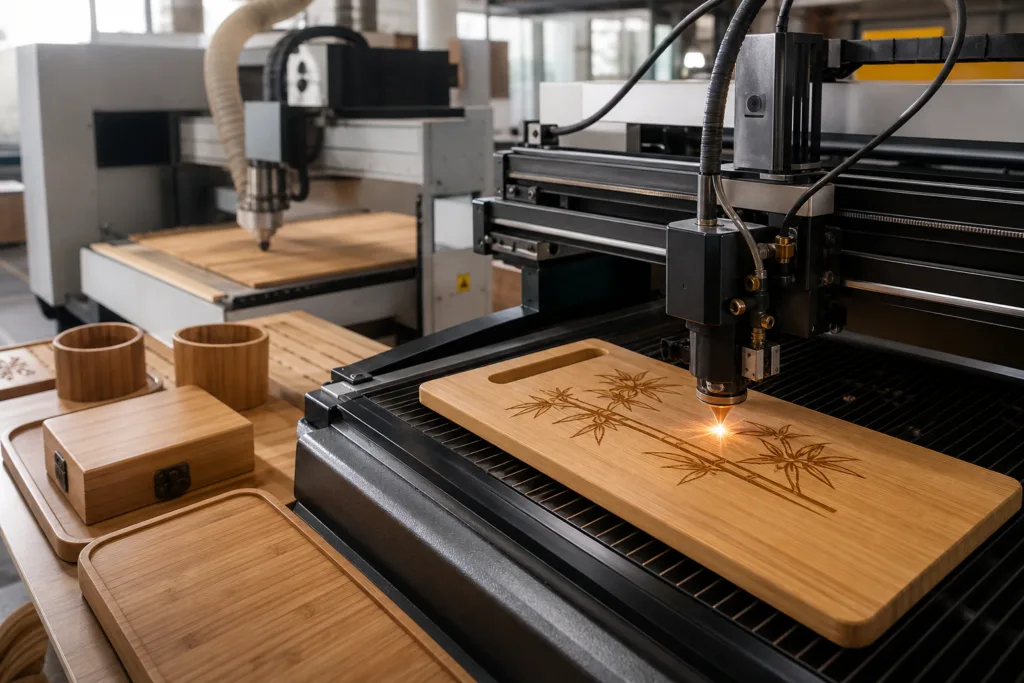
When the design includes fine artwork or a logo with small details, we usually recommend reviewing the line weight and depth before production. Laser engraving is often efficient for crisp logos and repeatable branding, while CNC cutting or carving is more appropriate when the design needs tactile relief or a deeper visual profile. The right method depends on the wood or bamboo surface, the logo complexity, and the level of contrast the buyer wants.
For hospitality and branded food-service programs, customization is often tied to presentation. A buyer may need a simple utility item for bulk use, or a gift-ready set for a guest experience. For example, premium gift-box chopsticks for hospitality programs require different structural planning from loose bulk chopsticks because the inner tray, outer carton, and visual presentation all become part of the product.
Surface Finishing Choices and Why They Matter
Finish selection affects appearance, feel, durability, cleaning behavior, and in some cases food-contact suitability. A weak finish can make a well-made product look cheap. A heavy or poorly cured finish can cause tackiness, odor, or premature wear. That is why finish decisions should be made alongside the product’s use case, not after the sample is already approved.
Common finish options
- Sanding only: suitable for natural-look items, though surface smoothness still needs to be controlled carefully
- Oil or wax finish: often used to enhance grain and create a more natural feel
- Painted finish: useful for color branding, though it reduces visible grain
- Stain and varnish: can deepen color and improve surface protection
- Clear coating: helps protect the surface while keeping the natural material visible
For products that may touch food, the finish must be chosen with extra care. Some buyers prefer natural or lightly coated surfaces, while others need a more protective coating for cleaning and durability. A practical overview of food-safe finish options for bamboo products can help buyers compare oil, wax, and water-based lacquer approaches before making a final specification.
From a manufacturing perspective, finish consistency depends on preparation. Sanding quality, dust removal, coating thickness, drying time, and cure control all influence the final result. If a buyer wants a premium look, we usually recommend confirming sample finish under the same light and handling conditions expected in real use, because natural materials can appear different under different lighting and packaging conditions.
Production Workflow From Sample to Bulk Order
Strong production planning reduces surprises. Most B2B projects move through a sequence that includes inquiry, quotation, sample development, sample approval, pre-production planning, bulk manufacturing, inspection, and shipping. The goal is to verify the product at a small scale before the full batch locks in cost and time.
Typical workflow we use with buyers
- Confirm product use, dimensions, artwork, finish, and packaging needs
- Review material options and provide a practical quotation
- Produce a sample or revised sample for approval
- Adjust specifications if the sample reveals any issue with fit, finish, or branding
- Start bulk production after final approval
- Apply QC checks during and after manufacturing
- Package and prepare goods for shipment based on the buyer’s market channel
At Bamboo Wood Art, this process is most efficient when the buyer provides clear reference photos, target dimensions, logo files, and usage notes. Even small details such as whether the product will be stored in humid conditions, displayed in a retail box, or packed loosely for institutional use can affect the final production method.
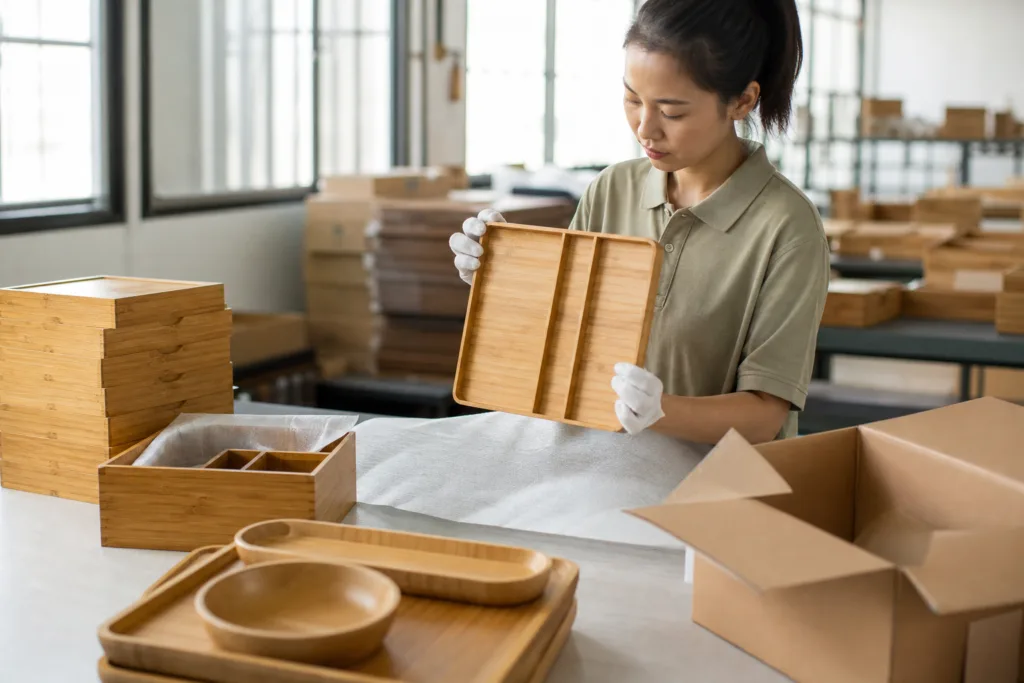
Buyers often underestimate how much packaging influences both product protection and brand presentation. A natural bamboo item can still arrive damaged if the carton structure is weak or if the inner packing allows movement. For this reason, we usually treat packaging as part of product engineering, not as a separate afterthought.
Moisture Control, Warping Prevention, and Durability
Moisture control is one of the most important hidden issues in bamboo and wooden production. A product may look perfect at the factory, then move, crack, or split after it enters a different climate. That is why drying, acclimation, storage, and packaging all matter.
In practical terms, moisture risk increases when raw material is not properly prepared, when parts are stored in a humid environment, or when finished goods are packed too tightly without enough environmental protection. Common defects include cuping, twisting, edge lifting, joint movement, surface checking, and hairline cracks around engraved or cut areas.
To reduce those risks, buyers should ask suppliers about:
- incoming material moisture checks
- drying or conditioning methods
- storage environment before machining
- recheck of moisture before packing
- shipping carton protection and humidity barriers where needed
Durability is also linked to design. Thin walls, sharp inside corners, weak glue lines, and overly deep engraving can all reduce lifespan. For any product expected to endure repeated handling, we recommend confirming structure, finish, and thickness together rather than treating each item separately.
Packaging Design for Retail, Gifting, and Shipping Protection
Packaging should match the order’s channel. Retail packaging needs shelf appeal and brand clarity. Gift packaging needs premium presentation and often tighter fit. Shipping packaging needs drop resistance, edge protection, and low movement inside the carton. The same bamboo or wooden product may require very different packaging depending on the buyer’s market.
There are three packaging questions we ask on nearly every OEM or ODM project:
- Will the product be sold in retail, used in hospitality, or shipped as bulk inventory?
- Does the packaging need to display a logo or product story?
- How much protection is needed from vibration, impact, moisture, and compression?
Some buyers need a simple outer carton because their own warehouse will do final assembly. Others want a fully retail-ready item with inserts, labeling, and private label packaging. A well-designed box can lower damage rates and improve the customer’s unboxing experience, while poor packaging can erase the value of an otherwise strong product.
For branded utensil and tableware programs, many buyers also want visible logo placement on the product itself. A useful reference point is engraved logo chopsticks for branded service, which shows how product marking and packaging design can work together for hospitality or promotional use.
MOQ, Lead Time, and Cost Drivers in OEM and ODM Orders
MOQ and lead time are often the biggest commercial questions in sourcing. Buyers need to know how much flexibility they have before investing in a new item, and how changes in design or finish will affect the production schedule.
What usually drives MOQ
- material sourcing and cutting yield
- machine setup and labor efficiency
- logo tooling or engraving preparation
- finish color or coating complexity
- packaging assembly requirements
What usually drives lead time
- sample approval speed
- availability of raw material
- complexity of shape or engraving
- drying and curing time for finishes
- packaging procurement and carton printing
Buyers sometimes compare MOQ only on the product unit cost, but that can be misleading. A low unit price may be tied to a higher MOQ, longer lead time, or less flexible customization. A better approach is to compare total landed readiness: sample success rate, production reliability, packaging quality, and how closely the factory can match your target use case.
If you are assessing a new bamboo supply program, it also helps to understand understanding MOQ in bamboo manufacturing before you commit to artwork, packaging, and launch timelines. The most efficient orders are the ones where the buyer and factory agree on the real trade-offs early.
Quality Control Checkpoints That Buyers Should Expect
Good QC is not one final inspection at the end of production. It is a series of checks that protect the order from avoidable defects. For bamboo and wooden products, this includes material inspection, in-process checks, finish checks, dimensional verification, and final packaging review.
Typical QC checkpoints
- Material check: confirm moisture, color range, defects, and thickness
- Machining check: verify dimensions, cut accuracy, and edge quality
- Assembly check: inspect glue lines, fit, and stability
- Finish check: review smoothness, coating coverage, and color consistency
- Packaging check: confirm item protection, labeling, and carton integrity
For branded orders, logo placement and readability should be checked carefully across the batch. Even a small shift in engraving depth or printing position can create inconsistency when products are packed for retail or hospitality. In our workflow, we treat the approved sample as the reference standard and compare the bulk production against it rather than against a vague description.
That is also why product category matters. A natural utility item might allow more variation than a premium gift set. A bulk chopstick order for food service needs consistent size and finish. A gift box set needs tight fit, clean presentation, and better cosmetic sorting. The same factory can produce both, but the QC target should be different.
Common Sourcing Mistakes and How to Reduce Risk
Many sourcing problems are preventable. The most common mistake is treating bamboo and wood as interchangeable without checking how the final product will be used. Another common mistake is approving samples without testing them in real conditions, such as humidity, cleaning, stacking, or transit vibration.
Frequent mistakes B2B buyers make
- approving a sample without confirming moisture or warp risk
- not clarifying whether the product is food contact or decorative use
- expecting identical color and grain in a natural material
- sending artwork that is too detailed for the chosen engraving method
- choosing packaging that looks good but does not protect the product
- asking for a low MOQ without adjusting the design or finish expectations
Risk reduction starts with better communication. Share your application, target market, packaging channel, and acceptable cosmetic variation. Ask the supplier how they control moisture, how they handle rework, and what QC documents or photos they can provide before shipment. If the supplier cannot explain their process clearly, that is often a sign to slow down and ask more questions.
At Bamboo Wood Art, we find that the best projects are collaborative. Buyers bring the market requirement, and we bring the manufacturing logic. When both sides are clear about the trade-offs, the order is much more likely to meet launch timing, quality, and budget expectations.
How to Evaluate a Manufacturer for Private Label and Bulk Orders
When evaluating a bamboo and wood products manufacturer, buyers should look beyond the catalog. The real indicators are how well the supplier handles material selection, sample revision, finish control, packaging design, and production communication.
What to ask before placing a bulk order
- Can the factory explain the material choice and why it suits the application?
- Can they show sample logic for size, logo, and finish?
- How do they control moisture and dimensional stability?
- What is the approval process for private label packaging?
- How are defects handled during bulk production?
A strong supplier should be able to describe where variation is normal and where it is not acceptable. Natural material products are never perfectly identical, but they should still meet a defined standard. Buyers who ask for that standard early usually receive better results, because the factory knows what to target during sorting and inspection.
For projects that require a branded presentation, private label packaging, or repeat orders across multiple sales seasons, it helps to work with a factory that understands both the product and the channel. That is the difference between a one-time source and a long-term manufacturing partner.
How to Build a Better Bamboo or Wooden Product Specification
A strong specification file reduces friction at every step. It should cover material, dimensions, finish, logo method, packaging, tolerance, and target use. The more specific the brief, the easier it is for the manufacturer to quote accurately and produce consistently.
At minimum, include the following in your specification:
- product purpose and target customer
- material preference and any restrictions
- dimensions and acceptable tolerance
- surface finish and gloss level
- logo file and placement instructions
- packaging style and retail requirements
- expected order quantity and replenishment plan
If the item is part of a food-service or hospitality program, add washing instructions, storage conditions, and any compliance or coating requirements. If it is a gift or retail item, include the unboxing expectation and visual positioning. A manufacturer can only quote and produce accurately when the brief reflects the real commercial use.
Conclusion
Working with a bamboo and wood products manufacturer is a sourcing decision that affects product performance, brand presentation, and supply reliability. The best outcomes come from clear material selection, realistic customization choices, careful finish planning, moisture control, and QC standards that fit the product’s real use. Buyers who think through the entire production chain usually avoid the most expensive mistakes later.
If you are building a private label program, a hospitality supply line, or a retail collection, start with the product’s function and then align the material, finish, packaging, and MOQ to that function. That approach gives you a stronger specification, smoother production, and a better chance of getting consistent results across every batch.
FAQs
How do I choose between bamboo and wood for my project?
Choose bamboo when you want a cleaner, more uniform look and efficient repeat production. Choose wood when you want richer grain character, a warmer visual style, or a more premium natural appearance. The right answer also depends on use conditions, finish requirements, and your target price.
Can a bamboo and wood products manufacturer customize size, shape, and logo?
Yes. Most custom projects can change dimensions, shape details, engraving style, carving depth, and packaging. The best results come when you provide clear artwork, reference photos, and a target use case so the factory can recommend the right production method.
What should I check in a sample before approving bulk production?
Check dimensions, surface smoothness, logo clarity, finish feel, structural stability, and packaging fit. If the product will be used in humid or food-service conditions, test it in those conditions too. A good sample should represent the final bulk order, not just the appearance.
Why does moisture control matter for wooden products?
Moisture affects shrinkage, swelling, warping, cracking, and joint stability. If the material is not dried and handled correctly, the product may change after shipping or storage. That is why a manufacturer should be able to explain drying, acclimation, and packaging protection.
What affects MOQ and lead time the most?
MOQ and lead time are usually driven by material sourcing, machine setup, finish complexity, logo processing, packaging needs, and sample approval speed. A simpler design often supports a lower MOQ and faster schedule, while premium finishes or custom packaging may increase both.
How can I reduce sourcing risk with a private label order?
Give the supplier a detailed specification, confirm sample approval before bulk, define acceptable variation, and ask about QC checkpoints and packaging protection. It also helps to verify sustainability or food-contact claims instead of assuming them. Clear communication reduces rework and shipment problems.