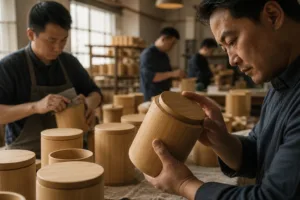
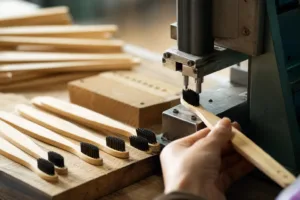
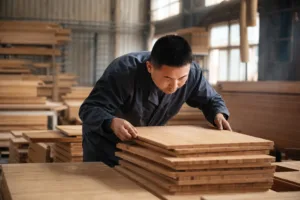
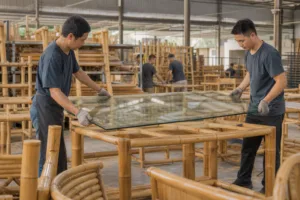
When buyers search for the best bamboo cutting boards, they are usually not looking for one universal product. They are comparing retail appeal, foodservice durability, branding space, packaging efficiency, and the risk profile of a material that can look simple but behave very differently from one factory to another. From a manufacturing perspective, a good bamboo board is not just a flat slab with a logo; it is a combination of board structure, moisture control, finish selection, edge work, and packing design that determines whether the product sells well and holds up after shipment.
For brands and importers that need a supplier-side view of board construction, our bamboo cutting board manufacturing support page explains how we approach material selection, sample development, engraving, surface finishing, and bulk production planning. At Bamboo Wood Art, we help B2B buyers align the product spec with the channel, whether the order is for ecommerce, private label retail, hospitality, or promotional programs where consistency matters as much as price.
To make a strong sourcing decision, you need to compare more than appearance. The details that most affect value are size and thickness, bamboo construction, finishing system, food-contact expectations, packaging protection, and the supplier’s ability to keep glue lines, sanding, and moisture content under control across a full production run.
What “best bamboo cutting boards” means in a B2B sourcing context
In consumer shopping, “best” often means attractive or highly rated. In B2B sourcing, the phrase should mean “best fit for the target market and use case.” A board for a boutique retail brand may need a smooth natural finish, giftable packaging, and enough logo space for laser engraving. A board for a restaurant supply program may need higher durability, easier cleaning, and a construction approach that minimizes warping under repeated washing and drying cycles. A board for hotel amenities may prioritize compact size, low breakage in transit, and simple branding.
That is why the right question is not whether bamboo is good in general. The better question is which bamboo board specification fits the channel, price point, and use pattern. A cheap board can look acceptable in photos but fail in bulk if the core lamination is uneven or the moisture level is not balanced before packing. A stronger board may cost more up front but reduce returns, claims, and replacement costs later.
Who buys bamboo cutting boards and why
We typically see four buyer groups. First are retail brands and ecommerce sellers who need a product that can support premium photography and private label packaging. Second are wholesalers and distributors who need stable supply, manageable MOQ, and a broad price ladder for different customer tiers. Third are foodservice and hospitality buyers who care about cleanability, replacement cycles, and practical handling. Fourth are promotional buyers who want a useful branded gift with enough imprint area to carry a logo clearly.
Each group values a different version of the same board. Retail buyers usually prefer refined edges, consistent color, and packaging that protects the board while still looking shelf-ready. Foodservice buyers are more likely to ask about thickness, warp resistance, and whether the finish can tolerate repeated cleaning. Promotional buyers often want dependable turnaround, a simple decoration method, and a controlled unit cost.
How to compare board size, thickness, and weight
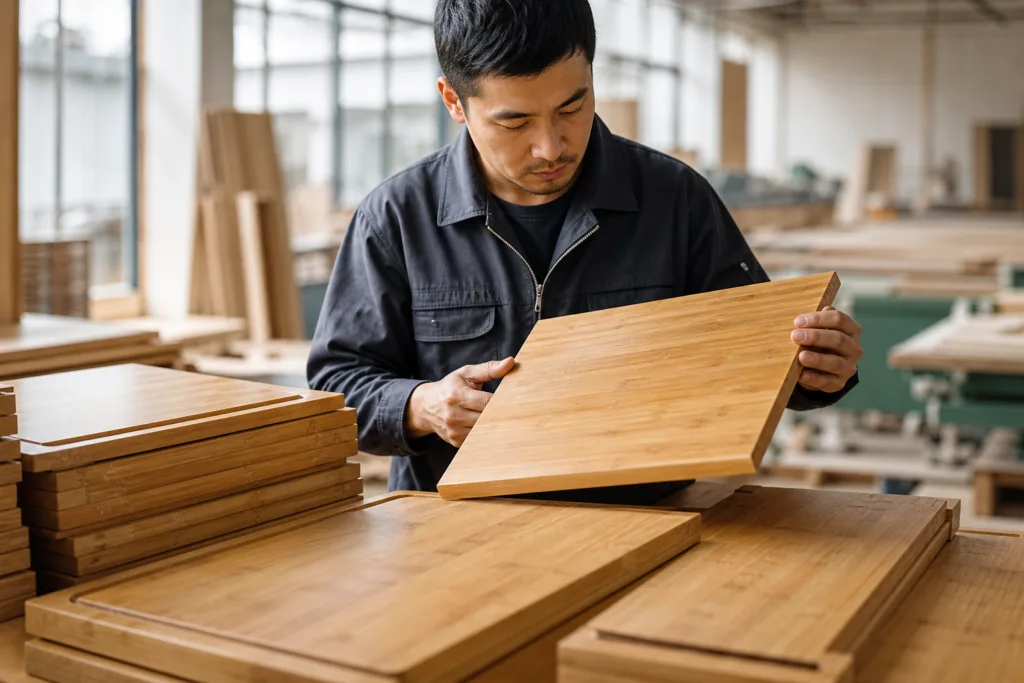
Size is one of the fastest ways to separate products, but it should never be compared in isolation. A board that is too thin can feel light and economical, yet it may warp faster or crack at the handle cutout. A board that is too heavy may feel premium, but it can increase shipping cost and raise breakage risk if the box design is weak. For ecommerce, weight also affects fulfillment fees and customer perception when the product is unpacked.
Thickness matters because it influences stiffness, engraving depth, and how the board behaves when exposed to moisture. In general, thicker boards can tolerate more use and more aggressive machining details such as deep juice grooves or routed handles. Thinner boards are better when price, packing density, and lower carton weight are the priority. As manufacturers, we usually recommend matching thickness to the user environment rather than copying a competitor’s dimensions without checking the board’s actual performance.
| Buyer Need | Typical Board Direction | Why It Matters |
|---|---|---|
| Retail gifting | Medium thickness with polished edges | Balances appearance, durability, and shipping cost |
| Foodservice | Thicker, stable construction | Helps resist movement, cracking, and frequent cleaning stress |
| Promotional use | Moderate size with clear logo area | Makes branding visible without raising price too much |
| Bulk warehouse supply | Stackable dimensions | Improves carton efficiency and pallet planning |
Before finalizing dimensions, ask for a sample that reflects the exact thickness, handle design, and surface finish you want in mass production. Even small changes can affect hand feel, cutting stability, and packaging fit.
Bamboo construction options buyers should know
Bamboo cutting boards are not all built the same way. The construction method influences appearance, strength, and price. Buyers often focus on the word bamboo and overlook how the board is assembled. That is a mistake because a laminated board with well-managed glue lines can perform very differently from a board with uneven density or poor pressing control.
Solid laminated boards and panel structures
Most bamboo cutting boards are made from bamboo strips that are laminated under pressure into panels. The strip width, glue quality, pressing control, and post-press conditioning all matter. Boards with consistent strip alignment and tight glue line control usually look cleaner and feel more stable. If lamination is rushed or moisture is uneven, edge lifting and panel movement become more likely during shipping or later use.
Some buyers also ask about edge-grain style appearances or layered panel structures. These can be visually attractive and may support a more premium retail position, but the manufacturing process must still be controlled carefully. A well-made laminated bamboo board is usually preferable to a more decorative board that cannot hold up during real use.
If you are comparing finishes and panel color styles, our natural versus carbonized bamboo finish selection article is useful because color treatment affects not only look but also market positioning and consistency across orders.
Why moisture control affects durability
Bamboo is stable compared with many solid woods, but it is still sensitive to moisture exchange. That is why conditioning before shipment is so important. Moisture content influences shrinkage, dimensional change, and warp risk, especially when boards move from a factory environment into a different climate during transport or storage. A board that is not equilibrated correctly may look fine when packed and then twist, cup, or split after arrival.
For technical context, moisture conditioning and dimensional stability are not cosmetic concerns; they are core quality variables in wood-based materials, as reflected in ASTM’s guidance on moisture conditioning and stability testing. Buyers can review moisture content and dimensional stability as a reference point when discussing conditioning expectations with suppliers.
From our production side, we pay close attention to drying, equilibration, and warehouse humidity before the final pack-out stage. This is one of the reasons a sample can look acceptable while a bulk shipment performs differently if the factory does not maintain the same moisture discipline run after run.
Surface treatment choices: what buyers should compare
The surface treatment you choose affects look, maintenance, food-contact expectations, and perceived quality. The wrong finish can create a greasy feel, a plastic-like shine, or a surface that masks board texture in a way retail buyers do not want. The right finish can make the grain look cleaner, improve stain resistance, and support a more premium presentation without making the board feel over-processed.
Natural, oiled, varnished, and coated finishes
A natural finish usually appeals to eco-positioned brands and buyers who want a lower-sheen appearance. It may also be easier to position in products where the consumer expects a more tactile, wood-like feel. Oiled surfaces can highlight grain and improve surface feel, but the oil choice must be appropriate for the intended use. If the finish is too soft or poorly cured, the board can attract dust, feel uneven, or show wear too quickly.
Varnished or coated surfaces can improve visual consistency and stain resistance, but buyers need to balance appearance against the expectations of food-contact use. A finish that looks attractive in photography may not be the best choice for a board that will be washed often or used in a commercial setting. When comparing options, it helps to review the exact use case rather than assuming one surface treatment is universally better.
For buyers who want a practical overview of finish compatibility, the food-safe oil options for bamboo boards guide can help narrow the choice between appearance, maintenance, and production consistency. In production, we usually recommend choosing the simplest finish that meets the target market, because every added coating step increases process control requirements.
Food-contact safety and compliance expectations
For many buyers, especially those selling into Europe or supplying foodservice channels, food-contact expectations must be checked before the order is approved. A cutting board is a food-contact article, so the buyer should confirm what materials, adhesives, and surface treatments are being used, and whether the product can be supported by the right compliance documentation for the destination market.
The European Commission’s overview of food-contact safety and compliance requirements is a useful starting point for buyers evaluating risk. It reminds sourcing teams that the product should not transfer harmful substances or change food quality under normal conditions of use.
We also advise buyers to verify whether the item is a genuine bamboo board or a composite product that might be marketed as bamboo without meeting the expected regulatory framework. That distinction matters especially in import programs, private label retail, and foodservice supply, where product classification can affect clearance, labeling, and customer trust.
Regulatory scrutiny around bamboo-composite items has been significant in the EU, so importers should avoid assumptions and check the structure of the product carefully. In other words, “bamboo-look” is not enough; the buyer needs the actual material and use-case fit to match the destination market.
Design features that change usability and cost
Seemingly small features can move a board from generic to market-ready. Buyers should compare whether the board includes a juice groove, hand grips, hanging hole, rubber feet, or reversible faces. Each feature adds value for some channels and cost for others.
What features matter most by channel
- Juice grooves: useful for meat and fruit prep, but they increase machining time and can trap residue if cut poorly.
- Handles or finger notches: improve handling and display value, especially for retail, but can reduce usable cutting area.
- Rubber feet: help with stability and presentation, though they add assembly steps and may not suit all pack formats.
- Hanging holes: support merchandising and display, but they should not weaken the board near the edge.
- Reversible use: can increase perceived value when one side is for prep and the other is for serving or branding.
Design should be tied to the market. A premium retail board can carry multiple features if the logo placement and packaging support a higher ticket price. A foodservice board often benefits more from simple, robust geometry that is easy to clean and less likely to fail at weak points.
When buyers ask us to compare product variants, we often map the feature set against the customer’s actual handling pattern, not just against a competitor’s catalog page. That is the most reliable way to avoid over-designing or under-specifying the board.
Retail-ready vs restaurant-ready bamboo boards
Retail-ready boards and restaurant-ready boards may share the same raw material, but they should not be designed with the same priorities. Retail programs need shelf appeal, packaging graphics, barcode placement, and visible branding. Restaurant and institutional programs need performance, cleaning practicality, and stable supply of consistent parts.
Retail buyers usually want finer sanding, more attractive grain alignment, and a surface finish that photographs well. They may also want a premium story around sustainable materials, but that story should remain grounded in the actual board structure and supply chain. Restaurant buyers are more likely to focus on thickness, replacement cycle, and whether the board can handle repeated use without rough edges or rapid surface wear.
For brands comparing board formats and pricing positions, our wholesale bamboo cutting board sourcing factors article is useful because wholesale buying often depends on how product details affect carton efficiency, unit cost, and channel-specific expectations.
At Bamboo Wood Art, we encourage buyers to think in terms of “use case first, decoration second.” If the board is being sold as a giftable retail item, the logo and packaging may justify more finishing steps. If the board is being used in a commercial kitchen, the production plan should prioritize consistency, sanitation, and durability.
Logo customization and branding methods
Bamboo cutting boards are popular in private label programs because they offer a strong branding surface without requiring complicated decoration. The right method depends on artwork complexity, brand position, and required lead time. A very fine logo may need laser engraving or CNC carving, while a simpler mark can sometimes be handled more efficiently with printing or a basic burn-in effect.
Laser engraving, CNC carving, and printing
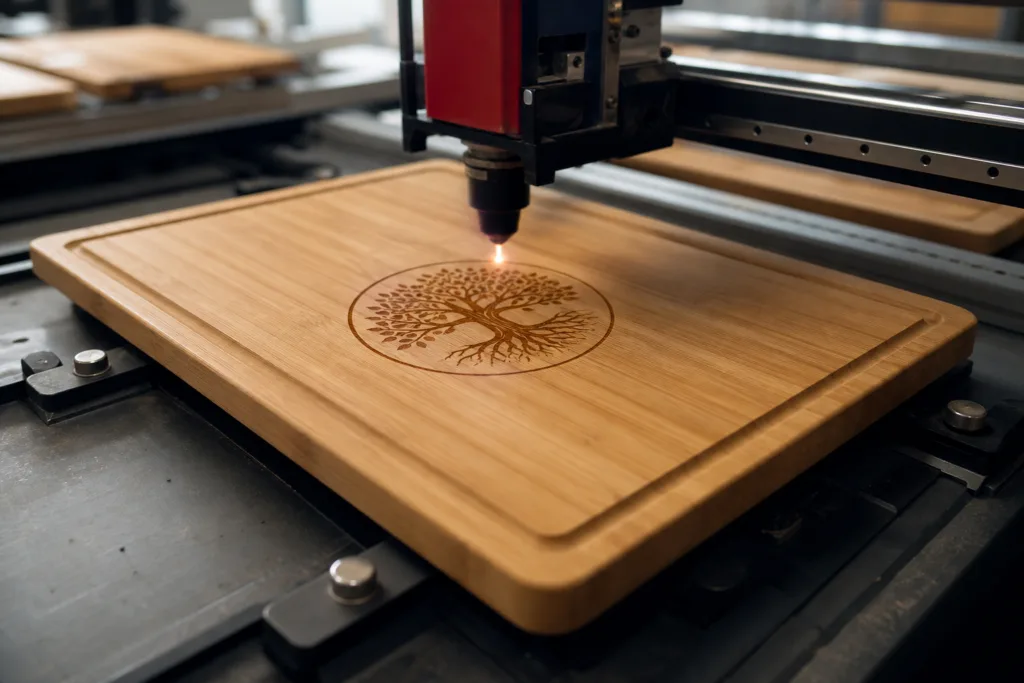
Laser engraving is often the most versatile choice for sharp logos, simple line art, and high repeatability. It produces a clean permanent mark and works well when the brand wants a modern, restrained look. CNC carving creates a deeper tactile impression and can support a more craft-oriented or premium presentation, but it needs proper depth control to avoid weakening the board or collecting residue.
Printing can be efficient when the artwork is simple and the board finish is suitable, but it may not deliver the same durability as engraving. The right method also depends on the logo’s line thickness, negative space, and the desired contrast against bamboo grain. Because bamboo grain and carbonization can alter visual contrast, buyers should confirm artwork visibility during sampling, not after mass production.
We recommend that private label buyers send vector artwork early and review a pre-production sample before approving full run printing or engraving. That reduces the risk of logo placement mistakes, unreadable small text, or branding that looks acceptable on screen but too faint on the board.
For sourcing teams that need more context on how logo treatment and finish selection interact, our manufacturing planning conversations at Bamboo Wood Art usually start with artwork, use case, and the final selling channel before we lock the engraving method.
Packaging for ecommerce, retail shelves, and bulk shipping
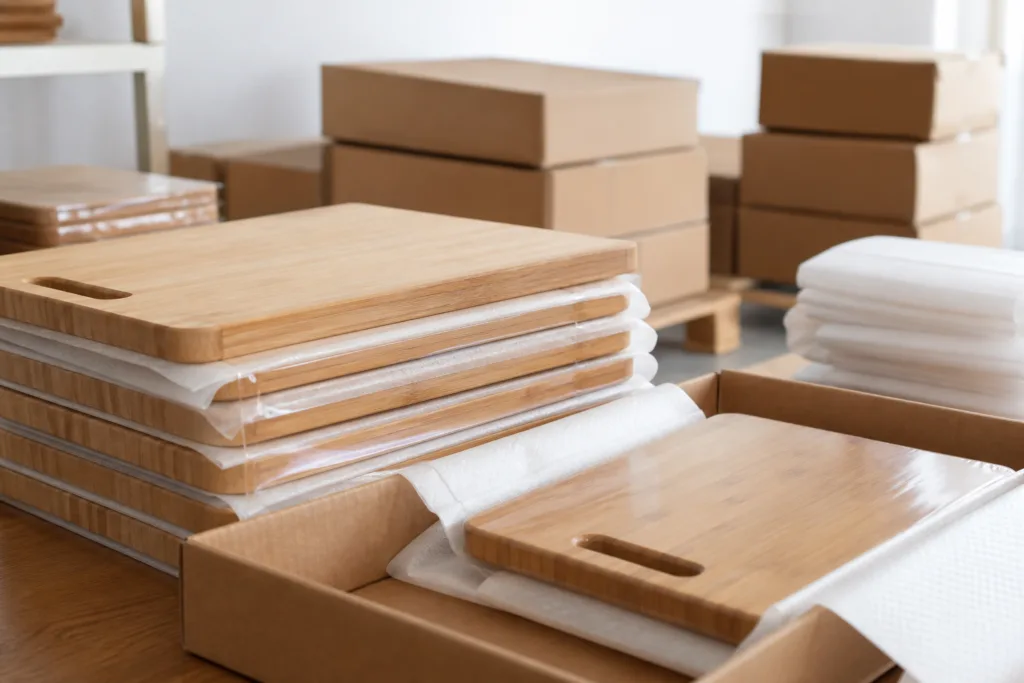
Packaging is not only about appearance. It protects the board from scratching, edge damage, and moisture changes during transit. A board that ships without enough protection can arrive with corner chips, warped edges, or surface marks that reduce sell-through and create avoidable claims.
Retail packaging often needs a hang-tab or shelf-ready layout, plus printing space for product story, care instructions, and barcode labels. Ecommerce packaging usually needs stronger internal protection, especially if the board has a handle cutout, hanging hole, or polished surface. Bulk shipping may use simpler packaging, but the carton structure must still guard against compression, shifting, and carton moisture exposure.
In private label programs, packaging should be planned together with the board dimensions, not after the sample is approved. Otherwise the buyer can end up with a box that looks good but does not protect the product efficiently. As manufacturers, we prefer to confirm the board size, decoration method, and carton configuration at the same time, because packaging changes can influence lead time and unit cost.
How to assess quality before placing a bulk order
Quality inspection for bamboo boards should be practical, not vague. Look at sanding smoothness, edge finishing, glue line consistency, flatness, surface scratches, and the likelihood of crack propagation near cutouts. Check whether the board has uneven color patches that may be normal grain variation or may indicate inconsistent material sorting. Review the sample in both dry and slightly humid conditions if possible, especially when sourcing into climates that differ from the factory environment.
Common quality risks buyers should watch
- Warping: often linked to moisture imbalance, thin construction, or poor conditioning before packing.
- Cracking: may appear near handles, grooves, or edges if machining is too aggressive.
- Rough sanding: can make the board feel cheap and may cause customer complaints after first use.
- Glue line inconsistency: can hurt appearance and may signal weak production control.
- Logo burn issues: may show if the engraving depth or heat setting is not tuned to the board finish.
If you are building a quality checklist, our buyer checklist for board construction and stability article can help structure your sample review and supplier comparison. A good sample should be evaluated not only for appearance but also for flatness, feel, and repeatability across more than one piece.
We often remind buyers that a visually attractive sample is only the starting point. Bulk quality depends on how consistently the factory can reproduce sanding, pressing, moisture control, and finishing across the full order.
MOQ, lead time, and pricing factors
MOQ is usually driven by material preparation, engraving setup, packaging print runs, and production scheduling. If a buyer requests a custom shape, a special finish, or multiple logo placements, the MOQ may rise because the factory needs to allocate setup time and raw material more efficiently. Lead time can also change when packaging must be printed, artwork needs approval, or the board design requires additional drying and conditioning time.
Pricing is affected by far more than raw bamboo cost. Thickness, shape complexity, finish type, carton structure, decoration method, and inspection steps all contribute to the final number. Buyers sometimes compare only the board unit price and ignore the packaging and freight effect, but that can lead to a misleading conclusion. A cheaper board that ships poorly or produces more claims may not be the better commercial choice.
For a broader view of how order size, customization, and channel positioning affect the final quote, our wholesale bamboo cutting board sourcing factors resource is a useful reference when planning your sourcing model.
Common sourcing mistakes in bamboo cutting board programs
One common mistake is assuming all bamboo boards age the same way. They do not. Moisture content, lamination quality, and finish selection can make one board reliable and another prone to splitting. Another mistake is choosing a design that looks good in photos but is hard to pack economically or too delicate for the target market.
Buyers also sometimes approve a sample without checking what changes are allowed in mass production. A sample might use better sanding, tighter grain matching, or a slightly different oil application than the bulk order. If those details are not documented, the bulk result may disappoint. We recommend locking the core specification in writing: dimensions, finish, logo method, packaging, and acceptable grain variation.
Another risk is overlooking the difference between genuine bamboo construction and bamboo-composite materials that may not suit the destination market. Importers should verify the exact structure and confirm compliance expectations before shipping. If sourcing is unfamiliar, our beginner guide to sourcing bamboo products from China is helpful for planning supplier communication and early-stage due diligence.
Finally, many buyers under-plan risk control. Freight humidity, carton compression, and inconsistent storage conditions can all affect the boards after production. The more complex the product, the more important it is to define packaging and inspection at the start.
Supplier evaluation checklist for OEM/ODM and private label
When evaluating suppliers, ask practical questions that reveal whether the factory understands bamboo board production beyond the catalog stage. Can they explain moisture control and conditioning? Can they show how they control sanding and edge finishing? Do they offer sample approval before bulk? Can they support laser engraving or CNC carving with accurate artwork transfer? Are they prepared to adjust packaging for ecommerce or retail display?
It also helps to review how the supplier talks about risk. A strong manufacturer will not promise perfection without seeing the design, but will explain where dimensional stability, glue line quality, and finish selection can affect the final result. That kind of communication is usually more valuable than a low quote with vague assurances.
If your buying process includes multiple product lines or mixed material programs, the broader B2B bamboo and wood manufacturing overview can help align bamboo boards with trays, boxes, display items, and other coordinated products under one production plan.
At Bamboo Wood Art, we see the most successful OEM/ODM orders when the buyer treats the sample stage as a specification lock, not a decorative preview. That approach reduces misunderstandings and improves bulk consistency.
Conclusion
The best bamboo cutting boards for B2B buyers are the ones that fit the channel, protect the brand, and can be reproduced consistently at scale. Size, thickness, lamination style, finish, branding method, packaging, and moisture control all play a role in whether the product performs well after shipping and during use. When you compare suppliers, do not focus only on the lowest unit price. Compare how each factory manages structure, surface quality, compliance expectations, and production discipline. That is how private label and wholesale buyers reduce risk and build a more reliable bamboo cutting board program.
Frequently Asked Questions
What should B2B buyers compare first when sourcing bamboo cutting boards?
Start with board size, thickness, construction method, and finish because those factors influence durability, shipping cost, and how the product fits your channel. Then compare logo options, packaging, and MOQ so you can judge the full landed cost and not just the unit price.
Are bamboo cutting boards suitable for foodservice buyers?
Yes, but foodservice buyers should focus on durability, cleanability, moisture control, and replacement cycles. A board that works for retail display may not be ideal for commercial kitchens unless the surface finish, thickness, and maintenance expectations are matched to foodservice use.
How do I know if a bamboo cutting board will warp or crack?
Ask the supplier about drying, equilibration, lamination quality, and packing conditions. Warping and cracking are often linked to moisture imbalance, thin construction, or weak edge design, so sample testing and production control are important before bulk approval.
What logo method is usually best for custom bamboo boards?
Laser engraving is often the most flexible for detailed logos and repeatability, while CNC carving creates a deeper premium effect. Printing can work for simpler artwork, but buyers should confirm durability and visibility during sampling.
How does packaging affect bamboo cutting board quality?
Packaging protects the board from scratches, edge damage, compression, and moisture changes during shipping. For ecommerce and retail, packaging design should be aligned with board size and decoration so the product arrives in saleable condition.
What is the most common mistake buyers make when ordering bamboo cutting boards in bulk?
One common mistake is approving a sample without locking the exact production specification. If dimensions, finish, logo method, and acceptable grain variation are not documented, the bulk order may not match the approved sample closely enough.