Exporting Bamboo Trays Worldwide: Certifications & Compliance
Bamboo trays offer an eco-friendly, versatile, and stylish option for hotels, retailers, and hospitality brands worldwide. Yet, exporting bamboo trays is about more than design or durability. Global buyers demand proof of sustainability, food safety, and ethical sourcing. For suppliers and brands, understanding export certifications is non-negotiable. The right certifications open doors to premium markets, reduce risk, and build trust with partners and customers alike.
Understanding Bamboo Tray Export: The Global Landscape
The appetite for bamboo trays spans high-end hospitality, homeware retail, restaurants, and corporate gifting. Quality, compliance, and traceability drive international purchasing. Countries set strict entry requirements, often enforced at customs. For bamboo tray exporters, knowing each market’s legal, ethical, and food-contact standards is vital.
- Europe: Focus on environmental impact, product safety, and responsible labor practices.
- United States: Prioritizes food-contact safety and verifies sustainable resource origins.
- Asia-Pacific: Varies by country, with increasing interest in green procurement and food safety.
Manufacturers like Bamboo Wood Art have built reputations for meeting these diverse requirements, making global trade smooth and dependable.
Key Bamboo Tray Export Certifications & What They Mean
Four certifications dominate global trade for bamboo trays: BSCI, FDA, LFGB, and FSC. Each addresses a specific pillar of responsible export.
What is BSCI?
BSCI stands for Business Social Compliance Initiative. It audits factory working conditions to ensure legal wages, safe environments, no child labor, and other fair practices. Retailers in Europe and North America often require BSCI for their private label or supplier programs. Passing a BSCI audit signals commitment to ethical sourcing and responsible supply chains.
FDA Certification: Food Safety for the US Market
The United States Food and Drug Administration (FDA) oversees all products that contact food. Bamboo trays intended for food service—such as sushi platters, cheese boards, or breakfast trays—must be made with FDA-compliant materials. This means safe adhesives, low toxicity finishes, and hygienic processing. The FDA does not issue certificates; instead, labs test products under FDA food safety protocols to ensure they meet US standards.
LFGB: The Gold Standard for Food Contact in Europe
LFGB (Lebensmittel- und Futtermittelgesetzbuch) is Germany’s strict food-safety law. EU importers often request LFGB certification, seeing it as a guarantee that bamboo trays have no harmful substances like formaldehyde or heavy metals. LFGB-certified trays undergo migration testing and contact chemical analysis. This level of scrutiny is crucial for kitchenware and serving products destined for the EU market.
FSC: Sustainable Sourcing from Forest to Table
The Forest Stewardship Council (FSC) certifies traceability and environmental stewardship from plantation to finished good. FSC-certified bamboo trays come from responsibly managed forests or bamboo plantations with transparent chain-of-custody records. Many hotel groups, retailers, and eco-conscious brands now require FSC documentation for all wood and bamboo products, reinforcing their commitment to sustainability.
Bamboo Tray Manufacturing: Materials & Export-Ready Processes
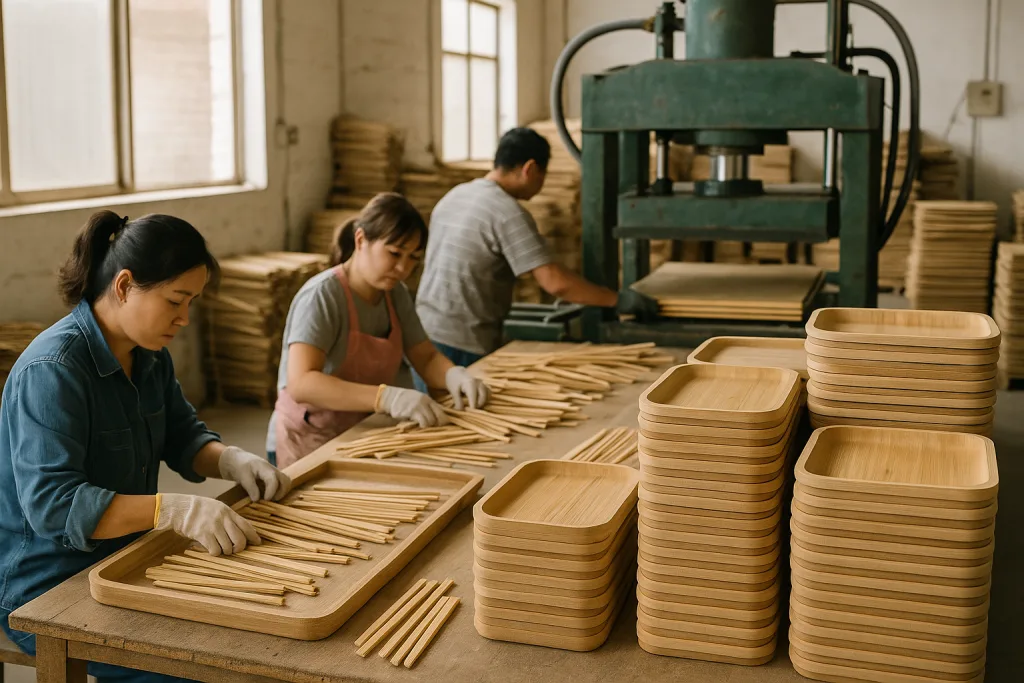
Sourcing compliant bamboo starts with recognized species like Moso bamboo, valued for its strength and rapid renewal. After harvesting, bamboo strips are kiln dried to 8–12% moisture for stability. Quality controls at Bamboo Wood Art include:
- Sorting slats by grain and color for consistent appearance
- Lamination with certified E0-E1 low-emission adhesives
- Hot press forming with high precision (±0.5 mm dimensional tolerance)
- Finger-jointing and dowel joinery for durability
- Sanding in progressive grits (180→240→320) for a smooth, splinter-free finish
- Edge profiling for safety and user comfort
- Food-safe finishing: water-based varnish, plant oils, or specialized coatings for kitchen use
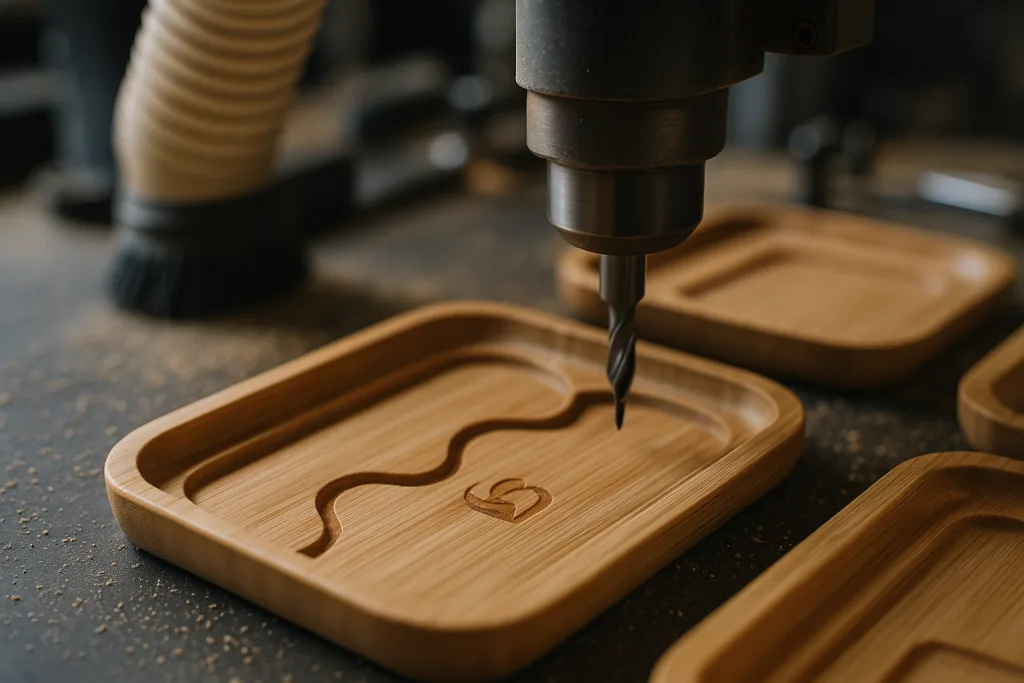
Trays may be natural or carbonized for a darker tone. Custom orders often include laser engraving, CNC-carved inlays, or veneer wrapping for premium branding.
Packing & Quality Control for Export
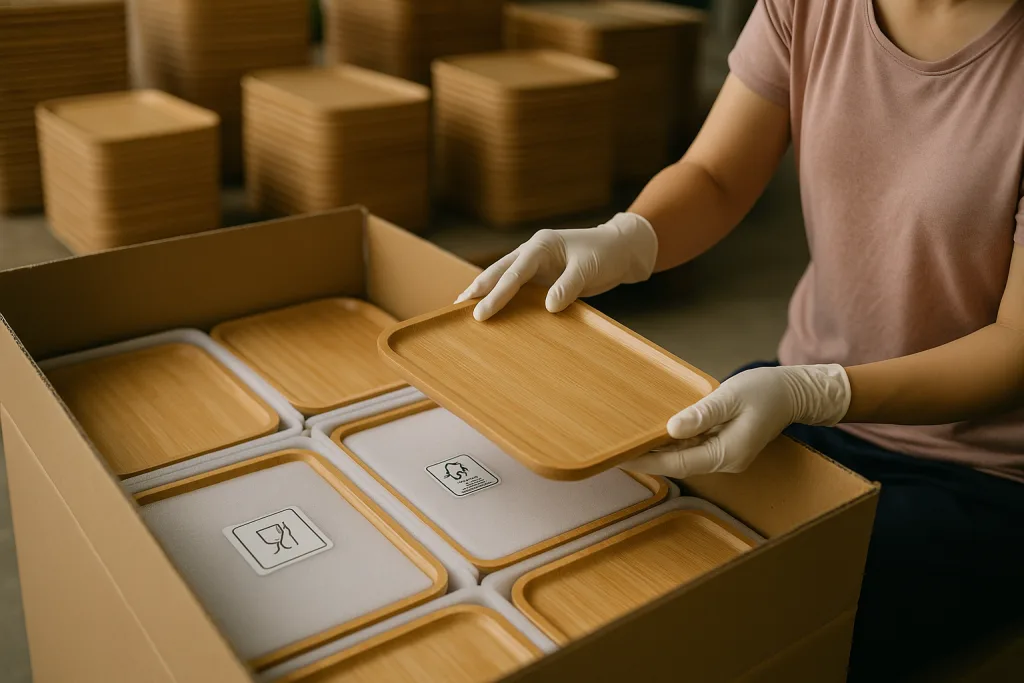
Packaging is more than presentation; it protects against moisture, shock, and deformation in transit. Exporters use multi-layered corrugated boxes, corner padding, and shrink wrap to preserve tray flatness and integrity. Carton labels show certifications, batch numbers, and barcodes for customs visibility. Export QC includes flatness checks, adhesion tests, and food-contact surface inspection.
Major Export Certifications Compared
| Certification | Focus | Best For | Testing Criteria | Who Requires |
|---|---|---|---|---|
| BSCI | Social Compliance | Private-label, retail programs | Factory audit, working conditions | EU/US retailers, global buyers |
| FDA | Food-contact Safety | Kitchenware, serving trays (US) | Materials, migration tests | US importers, food brands |
| LFGB | Food-contact Safety | Kitchenware, serving trays (EU) | Migration & chemical analysis | European importers, EU brands |
| FSC | Sustainable Sourcing | Eco-label, ‘green’ lines | Chain-of-custody documents | Eco-conscious clients, retail chains |
Exporting Bamboo Trays Worldwide: Certifications & Compliance
Seamless export hinges on proactive preparation. Bamboo tray suppliers must develop robust documentation systems. This includes maintaining up-to-date certification records, batch traceability, and transparent bills of materials.
Steps for Export Readiness
- Source bamboo and adhesives verified by recognized bodies (FSC, PEFC)
- Choose production partners with strong BSCI performance reports
- Ensure each batch passes third-party food-contact testing: FDA for US, LFGB for EU
- Maintain digital certification files for easy inspection at customs
- Label cartons and pallets clearly to minimize delays and ensure full visibility
Freight forwarders may request copies of lab test reports and MSDS sheets for adhesives or finishes. Importers rely on these documents not only for customs, but also for risk management and marketing certifications.
Bamboo Wood Art’s Export Expertise: Case Insights
Bamboo Wood Art has supplied B2B clients in over 30 countries, customizing bamboo trays for uses as diverse as hotel room service, gourmet food retail displays, and restaurant presentation. Projects typically begin with a materials audit, ensuring bamboo, adhesives, and finishes conform to target certification. The manufacturing process emphasizes tight tolerances, carbonization stability, and anti-warping innovation. The operations team coordinates closely with labs for FDA/LFGB batch tests, and FSC audits are routine in annual supply planning.
Finished trays undergo multi-point visual, tactile, and dimensional inspection. Final packing follows drop-test standards and weatherproof protocols. This thorough approach not only meets the expectations of high-value partners, but also reduces the risk of shipment delays or returns.
Material Choices and Their Impact on Export
Many business clients ask whether adding other woods or using bamboo veneer improves value. The answer depends on the application. Solid bamboo, especially Moso, offers best-in-class durability and renewability. Cross-laminated panels lower risk of warping for wide trays. Bamboo veneer over stable substrates (such as MDF or beech ply) delivers premium looks at an accessible cost—ideal for retail or branding lines targeting eco-aware consumers.
Finish Options for Food Safety & Style
- Water-based varnishes: crystal clear, low-VOC, protective, suitable for both food and decorative use
- Plant oils (tung, linseed): traditional, all-natural, enhance grain character
- Specialized food-contact coatings: certified for direct food contact as required by major markets
It’s essential to specify finish based on planned use (platters, décor, or display) and required certifications.
Custom Branding and OEM/ODM Services
For many high-end buyers, customization is a must. Bamboo Wood Art uses CNC routing, laser engraving, and inlay to apply crisp logos and specialized shapes. These technologies allow for intricate motifs, product personalization, or batch numbering for traceability. Each branded tray must still meet export certifications—extra finishes or adhesives require careful testing to maintain compliance.
Cost & Logistics: What to Budget For
Export costs include certification lab fees, document processing, and specialized packaging. Lead times vary: FSC audits can add 2–3 weeks, while food-contact testing for new finishes may delay first shipment by 12–18 days. Buyers should plan for these windows and work with partners experienced in international logistics. Volume orders typically attract lower per-unit certification costs as tests are done by batch.
Shipping includes moisture-proof and anti-warp packaging, with most trays loaded on standard pallets (carton dimensions matched to transport requirements). Pre-shipment inspection is essential to avoid issues at customs.
Buyer Guidance: Navigating Bamboo Tray Export
When sourcing bamboo trays for export, businesses should:
- Specify required certifications at RFQ (request for quotation) stage
- Request recent test reports and documentation up front
- Verify manufacturer BSCI/FSC standing with latest audit summaries
- Review samples for fit, finish, flatness, and labeling
- Insist on digital copies of all export-relevant certifications and invoices
Expert Tip: Tap experienced export manufacturers for project consultation. Early alignment on certification and packing avoids costly delays later on.
Frequently Asked Questions
What is the minimum certification required to export bamboo trays to the EU?
Most EU importers require LFGB certification for food-contact trays, with FSC preferred for eco-friendly sourcing. BSCI certification is often requested for retail programs. Confirm specific country and retailer requirements before shipment.
How do I verify if a bamboo tray has passed FDA or LFGB testing?
Ask your manufacturer or supplier for recent third-party laboratory test reports. These reports will show migration and chemical results according to FDA or LFGB protocols and are mandatory for customs clearance.
Do custom-branded bamboo trays need separate certification?
Yes, new materials, adhesives, or finishes used in the branding process require their own FDA or LFGB testing since any new elements can impact food safety compliance.
How does the FSC certification process work for bamboo?
Bamboo producers are audited for sustainable management and must document the chain of custody. Buyers receive FSC certification paperwork and codes to confirm responsible sourcing with each batch.
What packaging steps prevent damage and warping in export transit?
Multi-layered corrugated boxes, moisture barriers, and padding are used to keep trays flat and intact from factory to destination. Packing protocols are tested against international drop and crush standards.
Why choose Bamboo Wood Art for export-grade bamboo trays?
Bamboo Wood Art combines experience in international B2B exports, strict certification compliance, and flexible design services, making them a trusted choice for demanding buyers worldwide.