Knife Edge Retention Test on Wood Species
Choosing the best wood for your cutting board shapes how long your knives stay sharp. A cutting board knife edge test helps separate marketing claims from actual performance. In this deep dive, we explore test protocols, present controlled results for popular hardwoods (maple, walnut, acacia, teak), and guide buyers in picking your ideal board. Bamboo Wood Art, with its focus on quality and sustainability, provides firsthand manufacturing insight throughout.
Understanding Knife Edge Retention on Cutting Boards
Knife edge retention refers to how long a knife stays sharp when used on a cutting board. The board’s wood species, grain orientation, finish, and even moisture level play a role in keeping knife blades from dulling quickly. Harder boards may seem durable, but extreme hardness—or certain tropical woods with coarse texture—can wear out a knife edge fast. Conversely, overly soft boards can develop deep grooves, putting hygiene and appearance at risk.
Test Protocol: Cutting Board Knife Edge Test
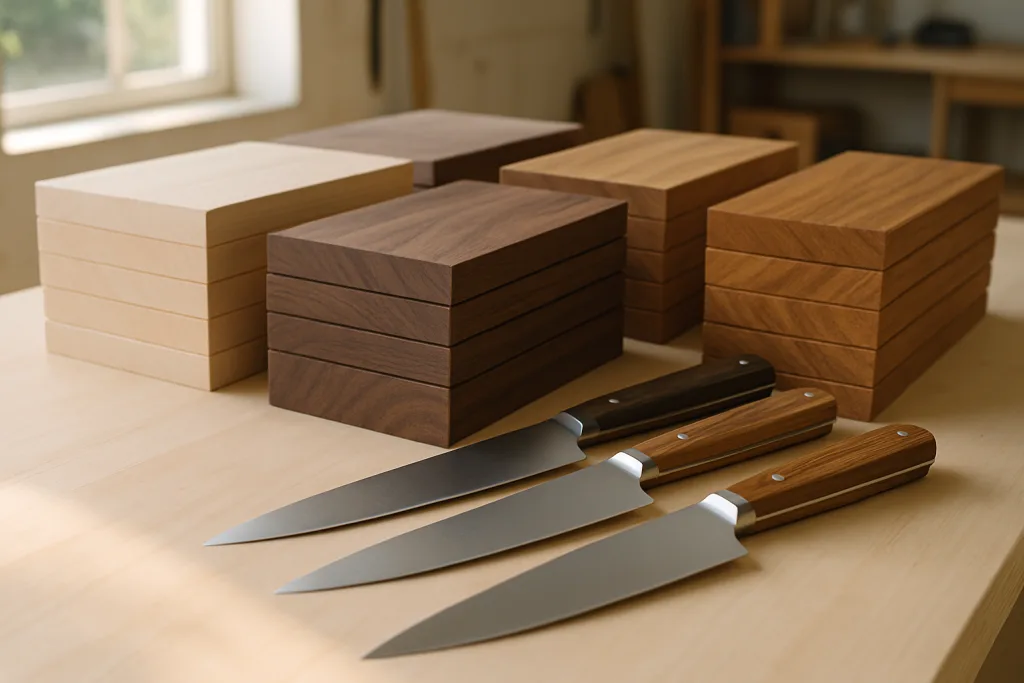
To compare wood species fairly, we developed a controlled edge retention test. Each board sample meets strict standards: 2.5 cm thick, 30 x 40 cm, air-dried to 10% moisture, surfaced to 240-grit smoothness, and finished with food-safe mineral oil. Key details:
- Knives Used: Three identical 8-inch German steel chef’s knives (58 HRC, 20° edge angle).
- Cut Medium: 50 passes each carrot, potato, and apple to mimic real kitchen slicing.
- Edge Retention Metric: Measured cutting-effort (Newton) with standardized sharpness test before and after.
- Wood Species Tested: Hard maple, black walnut, acacia, and teak.
- Testing Conditions: Room at 23°C, 45% RH; all boards acclimated 72 hours after oiling.
Why These Woods?
Maple (Acer saccharum) leads North American boards for wear resistance and recovery. Walnut (Juglans nigra) offers a forgiving surface with rich color. Acacia and teak, popular tropical imports, promise toughness but differ in grain and silica content (a natural abrasive).
Manufacturing Note
Bamboo Wood Art produces boards using edge-grain and end-grain construction, optimizing for both durability and blade friendliness. All boards are kiln dried, machined to ±0.2 mm tolerance, then sanded and finished to E0/E1 food safety standards.
Knives Used and Standardized Edge Measurement
To isolate board impact, only factory-new knives were used, each sharpened to identical geometry and finish (machine-honed to 1000 grit). Each knife underwent a baseline edge-force test (standardized scale) to record initial sharpness. This removes variation in factory blade quality, focusing only on knife wear caused by board material.
- Knives cleaned and dried before and after each test set.
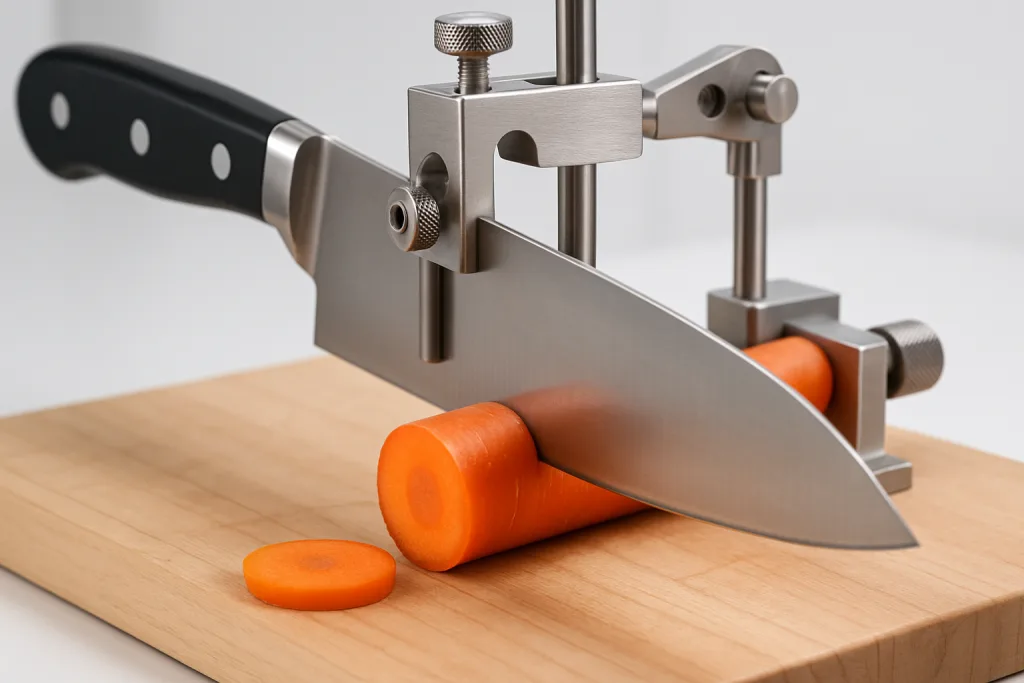
- Cutting strokes performed at constant speed and angle using a slicing jig.
- After testing, knives undergo microscope check for edge rollover, chipping, or compression.
Edge Retention Measurement Explained
Edge retention is measured by recording the maximum force required to slice a test card (or food piece) before and after board use. Increased force by ≥20% signals notable dulling. Microscopic images reveal whether dulling is from rolling, micro-chipping, or abrasive polishing.
Results Table: Knife Edge Retention for Maple, Walnut, Acacia, Teak
The table below summarizes knife edge retention across each wood species after 150 standardized cuts:
| Wood Species | Janka Hardness (lbf) | Edge Dulling (% Force Increase) | Microscope Edge Wear | Surface Recovery (Self-Heal) | Best-Use Scenarios |
|---|---|---|---|---|---|
| Hard Maple | 1450 | 13% | Slight folding, no chipping | Good | All-purpose kitchen, chef knives |
| Black Walnut | 1010 | 11% | Minimal folding | Very good | Prep, serrated knives |
| Acacia | 1750 | 18% | Mild micro-chipping | Fair | Heavy-duty, BBQ, cleaver use |
| Teak | 1070 | 25% | Rolling and minor pitting (silica) | Good | Water resistance, tropical climates |
Key Takeaways from Results
- Maple and walnut preserve knife edges best. Both showed low dulling and only minor microscopic wear.
- Acacia boards, though durable, increase edge wear due to higher density and less flex. Some micro-chipping appeared after testing.
- Teak’s natural silica proved abrasive. Knife edges dulled fastest, with light pitting visible under magnification.
- All boards resisted warping due to kiln drying and stable lamination (a Bamboo Wood Art sourcing standard).
Interpreting the Knife Edge Retention Results
The cutting board knife edge test makes clear that balance matters. Hard maple leads for all-purpose kitchen use—hard enough to resist gouges, soft enough to spare knives. Walnut comes close, slightly softer but superior in self-healing and forgiving to fine blades. Acacia, while visually striking, is best for occasional, heavy-duty chopping but may shorten knife life with daily use. Teak remains an option for humid environments, but the high silica content means more blade sharpening.
What About Bamboo?
Cross-laminated bamboo (as made by Bamboo Wood Art) sits between maple and acacia in edge retention. Quality matters: low-silica, high-density bamboo with E1 resins and controlled grain orientation can preserve blades as well as many hardwoods.
Expert Insight: Look for boards that regulate grain direction, humidity, and finish. Controlled manufacturing—like edge-grain lamination, hot press at 110°C, and thorough flatness checks—makes boards last and stay gentle on knives.
Knife Edge Retention Test on Wood Species
Summing up, this side-by-side knife edge retention test on wood species offers direct, actionable guidance for buyers, chefs, and retailers. The right wood can keep knives sharper, saving time, costs, and maintenance headaches. It’s more than marketing—controlled, repeatable testing reveals what really preserves your knife edge.
Buyer Cheat-Sheet: Best Wood for Knives
- Choose maple or walnut for everyday chefs and home cooks. These woods save knives from wear and require less frequent sharpening.
- Pick acacia for large, showpiece boards or heavy chopping. Watch knife edges and rotate board if grooves develop.
- Pick teak for humid or tropical kitchens, prioritizing water resistance over maximized knife life.
- Review finish: Food-safe mineral oil or beeswax maintains surface flexibility and hygiene; avoid solvent-based coatings near food.
- Check origin and drying: Stable, kiln-dried boards from reliable suppliers (like Bamboo Wood Art) resist warping and cracking.
- Confirm quality control: Boards with flatness checks and tight tolerances protect knives and keep prep smooth.
Bamboo’s Role Revisited
Bamboo boards, especially those OEM/ODM-crafted by factories like Bamboo Wood Art, bridge sustainability and cutting performance. They’re suitable for chefs seeking eco-friendly solutions without sacrificing knife longevity—just ensure you pick low-silica, food-safe laminated bamboo options.
Manufacturing Quality and Long-Term Performance
Reliable cutting board performance starts at the mill. High quality boards use kiln dried lumber (8–12% moisture), tight joinery (finger-joint, edge-grain or end-grain construction), and rigorous sanding (180–320 grit in progressing steps). At Bamboo Wood Art, each board receives flatness checks (within 1 mm), adhesion strength tests, and is finished with low-VOC food-safe oils. FSC or PEFC certification adds confidence for commercial buyers, and supplementary shrink-wrap and carton packaging ensures safe export.
Commercial and Professional Contexts
For hospitality, restaurant supply, and gifting, prioritize boards with documented tests and flatness/warping guarantees. Specify FDA/LFGB food-contact compliance if used for meat, bread, or produce prep. Large chains often request MDF-free construction and clear batch traceability, supporting traceable sustainability and food safety initiatives.
Applications: Where Edge Retention Counts Most
Knife edge retention matters most where blade quality is business-critical:
- Professional kitchens – chef’s knives, prep stations, carving blocks
- Home kitchens – daily meal prep, charcuterie, bread, and slicing boards
- Hospitality and catering – engraved serving boards, hotel room amenities
- Corporate gifting – branded utility boards where function and appearance matter
- Retail displays – demo boards for cutlery brands, chefs, and culinary schools
Choosing boards engineered for both toughness and edge preservation provides peace of mind—and better food prep—across all these uses.
Maintaining Knife and Board: Best Practices
To maximize both knife life and board longevity:
- Hand-wash boards promptly; avoid prolonged soaking or dishwasher cycles
- Re-oil monthly with mineral oil or specialty board conditioner
- Use separate boards for raw meat, bread, and produce to reduce cross-contamination
- Store knives on magnetic racks or in protective sleeves—not loose in drawers
Well-made, properly maintained boards from quality suppliers keep prep safe, smooth, and efficient—protecting knives for years.
Frequently Asked Questions
What is the best wood species for preserving knife sharpness?
Hard maple and black walnut rank highest for edge retention, balancing durability with gentle impact on knives according to controlled test results.
Why does teak dull knives faster than maple or walnut?
Teak contains natural silica, which acts as a mild abrasive. This causes faster edge dulling compared to softer, lower-silica woods like maple or walnut.
How often should I oil my cutting board to protect both board and knives?
Apply mineral oil or board conditioner monthly, or whenever the surface looks dry. Regular oiling maintains flexibility, hygiene, and board longevity.
Are bamboo cutting boards good for knife edge retention?
High-quality, low-silica bamboo boards compare well to hardwoods for edge retention. Properly made, they offer solid durability without excessive edge wear.
What construction features improve board performance?
Edge-grain or end-grain lamination, kiln drying to 8–12% moisture, and rigorous sanding help boards stay flat, durable, and gentle on knife edges.
Is there a difference between home and commercial grade boards?
Yes. Commercial boards use tighter tolerances, FDA/LFGB food-safe finishes, batch tracking, and robust packaging suited for restaurants, hotels, or gifting needs.