Introduction: The Importance of Load Testing for Bamboo Trays
Bamboo trays serve hotels, restaurants, corporate events, and homes. They must safely carry food, drinks, or products. Load testing for bamboo trays sets clear weight limits and exposes design weaknesses before trays enter service. Rigorous testing protects users and brands by preventing cracks, warping, and unsafe failures.
Bamboo Tray Load Test Protocols

A reliable load test measures a bamboo tray’s true weight limit in controlled conditions. Consistent lab protocols allow manufacturers and buyers to compare products and verify claims. A standard test sequence typically includes:
- Visual Inspection — Confirm no existing cracks, chips, or warping.
- Moisture Measurement — Ensure tray moisture is within 8–12%; high moisture can undermine strength.
- Incremental Loading — Place weights in the tray center, increasing in 1–2 kg steps.
- Duration Assessment — Hold each load for a standardized period, such as 60 seconds.
- Deformation and Sound Monitoring — Observe for bending, hear for creaks or pops.
- Handle Stress Test — Grip handles with weighted contents, gently lift and twist.
- Failure Recording — Document mode and point of failure: tray base, ribs, joinery, or handles.
Bamboo Wood Art applies such protocols for hospitality and corporate supply partners, using calibrated weights and flat surfaces to remove guesswork. Precise testing guards against accidental overloads in restaurants, hotels, and retail settings.
Load Testing for Bamboo Trays
The heart of tray safety lies in how a tray absorbs and distributes pressure. Bamboo tray load test results depend on raw material, joint design, and geometry. Trays made with Moso bamboo slats—kiln dried to stable 8–12% moisture—bear more weight and resist warping compared to cheaper softwoods or high-moisture pieces.
During a load test, issues appear where forces concentrate. Handles and ribs (the structural supports running under or around the base) matter most. A tray with thick, cross-laminated ribs and secure mortise-and-tenon joints can routinely hold 8–15 kg. In contrast, a tray with finger-jointed ribs and thin side frames may struggle under 5–7 kg before flexing. Proper bamboo tray weight limit tags rely on these verified realities.
Comparing Tray Materials and Designs
| Material/Joinery | Typical Weight Limit | Best-Use Scenario | Failure Mode |
|---|---|---|---|
| Moso bamboo + mortise-and-tenon | 12–15 kg | Hotel, catering, heavy table service | Base flex, handle shear |
| Bamboo ply + finger-joint ribs | 7–10 kg | Home, retail service, light goods | Rib failure, corner split |
| Solid ash/oak + dowel joinery | 15–18 kg | Luxury, display, maximum load | Joint gap, edge crack |
| Bamboo veneer over MDF | 6–8 kg | Promotional, gifting, decor | Bottom sag, veneer delam |
Lab Setup Essentials
- Flat testing surface, room temperature (18–25°C).
- Shop-calibrated weights (steel or lead, covered for safety).
- Moisture meter for checking product and ambient humidity.
- Video or photo recording for documentation and claims.
- Caliper or rule for measuring tray flex during loading.
Tray Rib and Handle Geometry
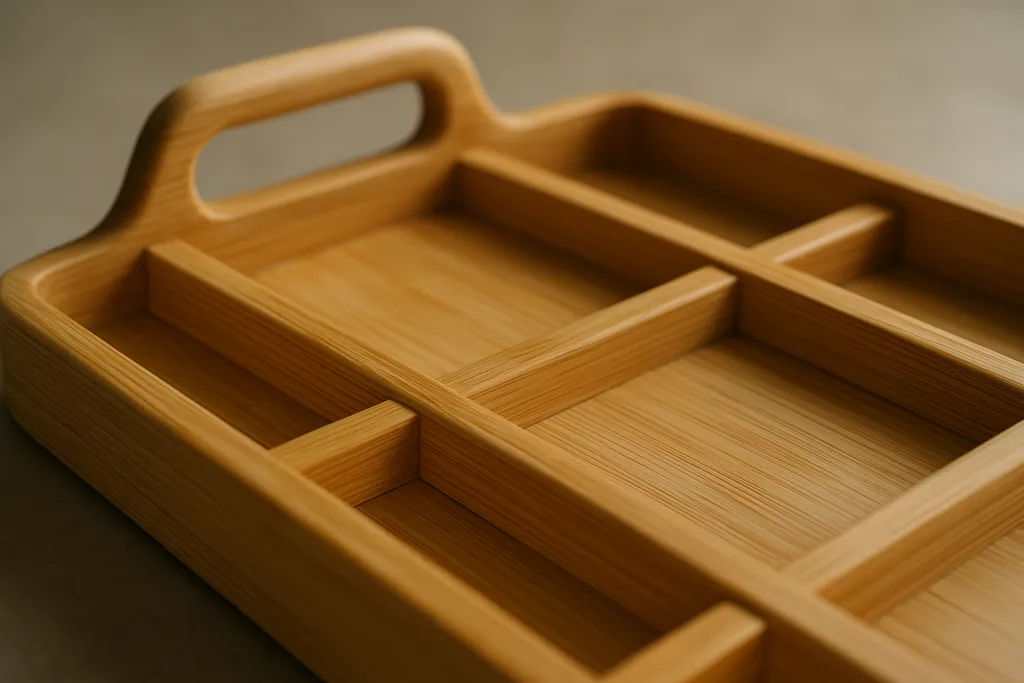
Geometry drives tray strength. Rib thickness, number, and arrangement directly affect weight capacity. Well-designed ribs, spaced evenly and joined with mortise-and-tenon or dowel methods, enhance stiffness and prevent sagging. Handle design is another critical factor. Wide CNC-machined handles with gentle curves distribute stress; glued-on handles or thin cutouts localize force, risking sudden breaks.
Handle Testing Parameters
- Grip width: At least 35 mm for safe grasp.
- Wall thickness: 15–20 mm to prevent tear-out.
- Finish: Rounded edges sanded at 240–320 grit reduce hand fatigue and increase safety.
Rib Strength Benchmarks
- Depth: Minimum 18 mm for trays up to 10 kg; 22–25 mm for heavy-duty trays.
- Joinery: Mortise-and-tenon holds 25–40% more weight than plain glue or nails.
- Spacing: Uniform gaps, 8–14 cm apart, ensure load distribution and prevent weak spots.
Failure Modes in Bamboo Tray Load Testing
Load tests reveal failure modes that guide design improvements and buyer decisions. Typical tray failures include:
- Base Flex — Tray bottom bows or cracks under weight.
- Handle Shear — Handles snap or detach from the frame.
- Rib Separation — Internal supports break at the joint, reducing load capacity.
- Edge Splits — Sides split due to poor moisture conditioning or weak joinery.
- Veneer Delamination — Decorative surface peels away, making the tray unsafe or unsightly.
Testing every tray type and design identifies the most common risk points. Manufacturers like Bamboo Wood Art prioritize kiln-dried Moso bamboo, robust joinery, and edge profiling to reduce failures. Regular batch testing, especially for high-impact hospitality or retail orders, is essential.
Establishing Bamboo Tray Weight Limits and Safety Thresholds
True safety comes from tested, published weight limits. A credible bamboo tray weight limit must include:
- Maximum recommended load per tray (kg/lb).
- Safe handle-lift load (the weight a user can comfortably lift by the handles).
- Peak hold time (how long a tray can sustain its listed load without damage).
- Recommended usage (food service, display, storage, etc.).
Suppliers should mark these limits on packaging and spec sheets. Hospitality buyers, catering managers, and retail teams can then train staff appropriately, lowering injury and breakage risks.
Sample Bamboo Tray Weight Limit Label
Model: BW-MT800
Max Load: 12 kg (26.4 lb)
Safe Handle Lift: 10 kg (22 lb)
Test Standard: In-house load test, ASTM D1037 alignment
Suitable For: Restaurant food service, retail display
Spec Sheet Template for Bamboo Tray Load Tests
An honest spec sheet clarifies risks and builds trust. Bamboo tray buyers should expect data on:
- Material type (species, seasoning/kiln details).
- Joint style (mortise, finger joint, glued).
- Rib arrangement and thickness.
- Finish type (VOCs, food-contact safety).
- Moisture content at testing.
- Maximum tested weight and failure point.
- Certifications (FSC/PEFC, FDA/LFGB if needed).
- Packaging & export prep (drop-test, stack rating).
Sample Spec Sheet Table
| Field | Specification |
|---|---|
| Material | Moso bamboo, 10% MC |
| Rib Geometry | Cross-lam, 22 mm × 25 mm, 4 ribs |
| Handle Design | CNC-formed, 40 mm wide, rounded |
| Finish | Water-based UV, E0 resins, food safe |
| Load Test Result | Max 13 kg, handle shear at 15 kg |
Bamboo Wood Art provides custom spec sheets for OEM/ODM partners, backing claims with first-hand testing and traceable batch results. These records matter most for hospitality, retail, and gifting applications, where liability and reputation are at stake.
Recommended Manufacturing Practices for Load-Resistant Bamboo Trays
The strongest bamboo trays use a sequence of technical steps proven to boost durable load capacity:
- Source Moso bamboo from FSC/PEFC-certified forests.
- Kiln dry slats and components to strict 8–12% moisture.
- Sort and match slats by grain and density for uniformity.
- Assemble ribs with mortise-and-tenon joinery, reinforced with water-resistant adhesives (E0/E1 grade).
- Profile edges and handles with CNC machining for smoothness and grip safety.
- Sand through stages (180→240→320 grit) to eliminate splinters.
- Apply water-based or plant-oil finishes; avoid high-VOC coatings.
- Batch test trays regularly, document and publish failure thresholds.
Testing Standards and Compliance for Bamboo Trays
Reliable bamboo tray testing aligns with global furniture and food-contact regulations. Important compliance frameworks include:
- ASTM D1037 — Mechanical testing of wood-based panels and trays.
- FSC/PEFC certification — Responsible bamboo sourcing.
- FDA and LFGB — Food-contact safety for trays used in kitchens and restaurants.
- E0/E1 labeling — Low-formaldehyde, safe for handling.
Manufacturers should provide paperwork on request and include visible marks on cartons and spec sheets. For export orders, robust packaging with tested drop/stack ratings prevents tray damage en route.
Buyer Guidance: Choosing the Right Bamboo Tray for Your Needs
Not every tray suits every job. Consider these factors for your next order:
- Intended Load — Everyday use (coffee, tea, snacks) may only need a 6–8 kg tray. Restaurant service calls for up to 15 kg.
- Handle Type — Look for thick, ergonomic handles for high-load use; sleek cutouts for display purposes.
- Joinery Style — Strong joinery supports heavier weights; finger joints suffice for lighter retail or gifting.
- Finish Quality — Opt for food-safe, water-repellent finishes for catering or kitchen use.
- Compliance — Check for batch testing, certifications, and documented weight limits.
Bamboo Wood Art stands ready to discuss your custom requirements and supply tested trays crafted with sustainability and precision. For B2B buyers, requesting spec sheets and explicit test reports is essential—especially for high-turnover environments.
Frequently Asked Questions
How do I perform a bamboo tray load test at home?
Place flat weights on the tray, add weight slowly, and watch for flex or handle movement. Stop at the first sign of strain to avoid damage.
What is the safe bamboo tray weight limit for restaurant service?
Most quality bamboo trays with strong joinery can safely carry 10–15 kg, but always refer to the manufacturer’s tested limit.
Which tray geometry gives the highest strength?
Trays with thick, cross-laminated ribs and mortise-and-tenon joinery hold more weight and resist bending.
What happens if I overload a bamboo tray?
Overloading may cause the tray to bend, split, or the handles to break—posing risks to users and nearby items.
Are water-based finishes safe for food-contact bamboo trays?
Yes, water-based finishes marked food-contact safe and with low VOC levels protect the tray and end users.
Do bamboo trays comply with export standards?
Top manufacturers provide tested, certified trays that meet export standards for safety, strength, and packaging durability.