For B2B buyers, a teak vs bamboo cutting board decision is rarely just about looks. It affects landed cost, perceived quality, maintenance expectations, channel fit, and how confidently a brand can position the product at retail or online. Teak usually reads as premium and warm, while bamboo is often chosen for value, consistency, and an eco-forward story. The right choice depends on the target price point, the required finish, the expected user care level, and how the board will be packaged and sold.
bamboo cutting board manufacturing solutions are especially useful when a buyer needs custom sizing, engraving, juice grooves, or private label packaging without turning the board into a generic commodity. At Bamboo Wood Art, we support material selection, surface finishing, sample approval, and bulk production planning so procurement teams can match the board to a clear brand position rather than choosing only by appearance or first cost.
What This Teak vs Bamboo Cutting Board Comparison Is Really About
In sourcing, comparing teak and bamboo is not only a material exercise. It is a decision about product story, expected customer use, cleaning habits, and margin structure. A teak board may justify a higher shelf price because many buyers associate teak with furniture-grade warmth and durability. A bamboo board, by contrast, often wins when a brand wants a cleaner cost structure, a lighter visual profile, and a more accessible retail price.
That difference matters because the same cutting board can succeed in one channel and struggle in another. A premium homeware boutique may accept the higher visual and price position of teak. A volume kitchenware line, gift set, or promotion program may need the faster cost recovery and easier retail math of bamboo. For planners, the question is not which material is universally better; it is which one supports the product’s intended market position.
Teak and Bamboo at a Glance: Core Material Characteristics
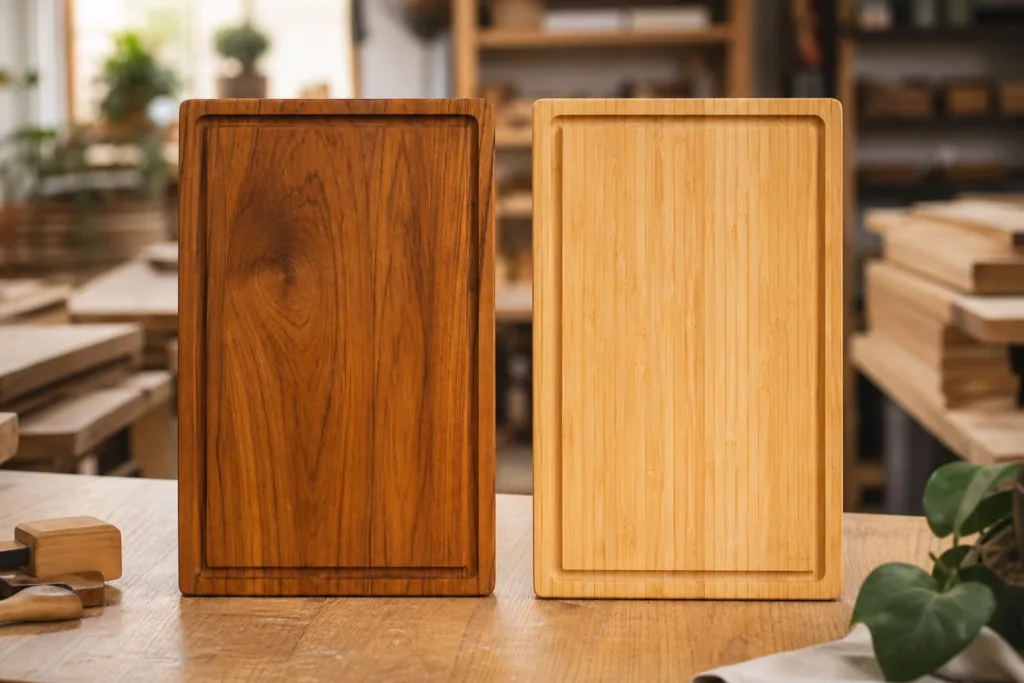
Teak is a dense hardwood valued for its rich color variation, natural oil content, and strong premium perception. Bamboo is technically a grass, but in cutting boards it behaves like a stable engineered material when properly processed, laminated, and finished. The look is brighter and more uniform, which can be helpful when a brand wants a clean and modern presentation.
| Factor | Teak Cutting Board | Bamboo Cutting Board |
|---|---|---|
| Visual impression | Warm, dark, premium, furniture-like | Light, clean, modern, value-friendly |
| Market perception | Higher-end, refined, giftable | Practical, eco-forward, accessible |
| Material behavior | Dense hardwood with natural oils | Dense layered structure with strong dimensional control when made well |
| Typical positioning | Premium retail, hospitality, upscale private label | Everyday kitchenware, eco-value lines, promotional programs |
From a manufacturing perspective, both can be made into attractive cutting boards, but they do not start from the same cost base or the same branding expectation. That is why a sourcing team should evaluate each board not only for function, but also for how it supports the overall assortment architecture.
Why Teak Feels Premium: Grain, Color, Hardness, and Brand Perception
Teak often feels premium because it combines a rich brown tone with visible grain character and a naturally substantial hand feel. Buyers frequently associate it with high-end furniture and outdoor use, which helps the material carry a stronger perceived value in the kitchen. The density and hardness profile also contribute to that impression. According to teak’s density and Janka hardness profile, teak has the physical characteristics that help explain its reputation for durable, premium applications.
For a brand, this matters because market acceptance is not driven only by function. The material story influences giftability, photographed appearance, and whether the board can sit comfortably next to higher-priced knives, cookware, or serveware. A teak board can support a premium narrative, but it also raises expectations. If the finish is rough, the edges are inconsistent, or the color varies too much from unit to unit, buyers notice quickly because the price point implies a stronger standard.
Teak also brings manufacturing trade-offs. Because it is dense and naturally oily, it can be more resistant to moisture-related issues than many softer woods, but it can also make finishing decisions more sensitive. The board must be sanded well, edges must feel refined, and coatings should be chosen carefully so the surface does not appear patchy or over-processed. For some buyers, this is exactly why teak works: it looks and feels substantial. For others, the higher material cost is difficult to justify when the end customer is primarily shopping by price.
Why Bamboo Signals Value and Sustainability: Density, Appearance, and Market Positioning
Bamboo cutting boards are often positioned as efficient, modern, and environmentally conscious. Many retail buyers like bamboo because it presents a clear value story: visually appealing, relatively lightweight, easy to merchandise, and suitable for a wide consumer base. The surface appearance is usually cleaner and more uniform than many natural hardwood boards, which can help when brands want consistency across batches.
Bamboo also fits well into a sustainability-oriented assortment, but it is important to keep that claim precise. Buyers should avoid vague green language and focus instead on verifiable sourcing, efficient material use, and responsible production practices. In market terms, bamboo performs well when the brand wants a practical kitchen product that can be priced below premium hardwood while still looking more refined than low-cost plastic alternatives.
From our manufacturing point of view, bamboo works well for private label programs because it is easier to standardize in size, profile, and engraving layout. It can be machined cleanly, paired with a simple logo, and packaged in a way that supports e-commerce or retail shelf presentation. When product teams want a board that looks clean in listings and feels easy to explain at the point of sale, bamboo is often a strong candidate.
For buyers evaluating performance claims, we also recommend reviewing a practical view of bamboo board performance for everyday cutting so expectations stay aligned with how consumers actually use the product.
Performance Comparison for Cutting Boards
Performance is where material theory meets real buyer complaints. Cutting boards are expected to be stable, easy to clean, and resistant to early wear. Both teak and bamboo can meet those needs, but they do so in slightly different ways.
Knife friendliness and surface feel
Teak’s natural oil content and hardwood character can create a pleasant, substantial cutting feel, especially when the board is well sanded and properly finished. Bamboo boards can also perform well, but the way the laminate is built matters more. If the board is too hard, too dry, or too aggressively surfaced, some users may feel that the knife edge does not sink in comfortably. That does not make bamboo unsuitable; it simply means the buyer should test the board with the intended use case and not assume all boards perform the same.
Water resistance and drying behavior
Water resistance is often discussed too loosely in the market. Neither teak nor bamboo should be treated as maintenance-free. Teak’s natural oils can make it more forgiving, while bamboo’s layered structure can be stable when manufactured correctly. However, both boards still need proper drying after washing, and both can suffer from repeated soaking or dishwasher use. Wood is hygroscopic, which means moisture content influences dimensional behavior and long-term performance; the USDA Forest Service explains this relationship in its research on wood moisture and physical properties.
Stability and wear
For long-term use, stability depends on more than the raw material. Board thickness, lamination quality, grain orientation, adhesive control, and drying all matter. A well-made bamboo board can stay dimensionally consistent in a program that needs predictable supply. A well-made teak board can deliver excellent wear resistance and a premium tactile impression. In both cases, poor processing can override material advantages.
For project teams that need a deeper product-fit perspective, we recommend pairing this comparison with solid wood and laminated kitchenware materials because board construction often affects performance as much as species choice.
Maintenance Requirements: Oiling, Cleaning, Drying, and Long-Term Care
Maintenance is a critical part of the buying decision because it affects customer satisfaction and review quality. Teak boards are often perceived as easier to maintain because the natural oils can help the surface feel more resilient. Bamboo boards may need more disciplined care instructions, especially if the board has a lighter finish or a more visibly laminated structure.
For both materials, the core care rules are similar: hand wash, dry promptly, avoid long soaking, and store in a ventilated place. Periodic oiling is often recommended for wood-based boards to help maintain appearance and reduce surface drying. That care process is not just a consumer detail; it is a product planning issue. If your target buyer expects low maintenance and rarely reads care instructions, the board must be selected and finished accordingly.
When we advise private label buyers, we usually match the maintenance story to the brand promise. If the product is aimed at gift buyers or higher-end consumers, a teak board can support a premium care ritual and a richer unboxing experience. If the product must be simple, affordable, and easy to explain in marketplace listings, bamboo can be easier to position with a short care card and basic instructions. For wooden board care details, this wooden board care and oiling guidance article is a useful reference when planning care cards or post-purchase instructions.
Cost Structure Breakdown: Raw Material, Processing, Yield, and Finished Product Pricing
Cost comparison should start with the full structure, not only raw material price. Teak often costs more at the species level, and that cost can carry through to the finished board because the market expects a higher visual and tactile standard. Bamboo usually has a more efficient cost base, but the final price still depends on lamination quality, board thickness, edge treatment, finishing, and packaging.
| Cost Driver | Teak | Bamboo |
|---|---|---|
| Raw material cost | Typically higher | Usually lower to moderate |
| Processing complexity | Careful sanding and finishing required | Strong control of lamination and surface consistency required |
| Yield efficiency | Can be affected by grain variation and board layout | Generally efficient, but glue line and laminate quality matter |
| Packaging impact | Premium packaging often expected | Simple, practical packaging is often acceptable |
| Retail positioning | Higher shelf price | Competitive mid or value pricing |
Manufacturers also watch waste and rework. Teak boards may require tighter grading to maintain visual consistency, which can increase sorting effort. Bamboo boards can be cost-effective in volume, but only if the boards are made with good press control and stable moisture management. A lower raw material cost does not automatically produce a lower finished cost if rejection rates rise or packaging damage increases.
Procurement Perspective: MOQ, Lead Time, Sample Cost, and Supply Consistency
For sourcing teams, the best material is the one that can be repeated consistently. Teak may require more attention to grain matching and color consistency. Bamboo may require more attention to lamination quality and board flatness. In both cases, the first sample should not be treated as the final story; it is a checkpoint for structure, finish, branding, and packaging fit.
MOQ and lead time usually reflect material availability, board size, engraving complexity, and packaging requirements. A simpler bamboo board with standard size and limited decoration can often move faster through sampling and production than a highly specified teak board with custom finishing. However, there are situations where a premium teak program is still efficient if the design is stable and the buyer commits to a clear specification early.
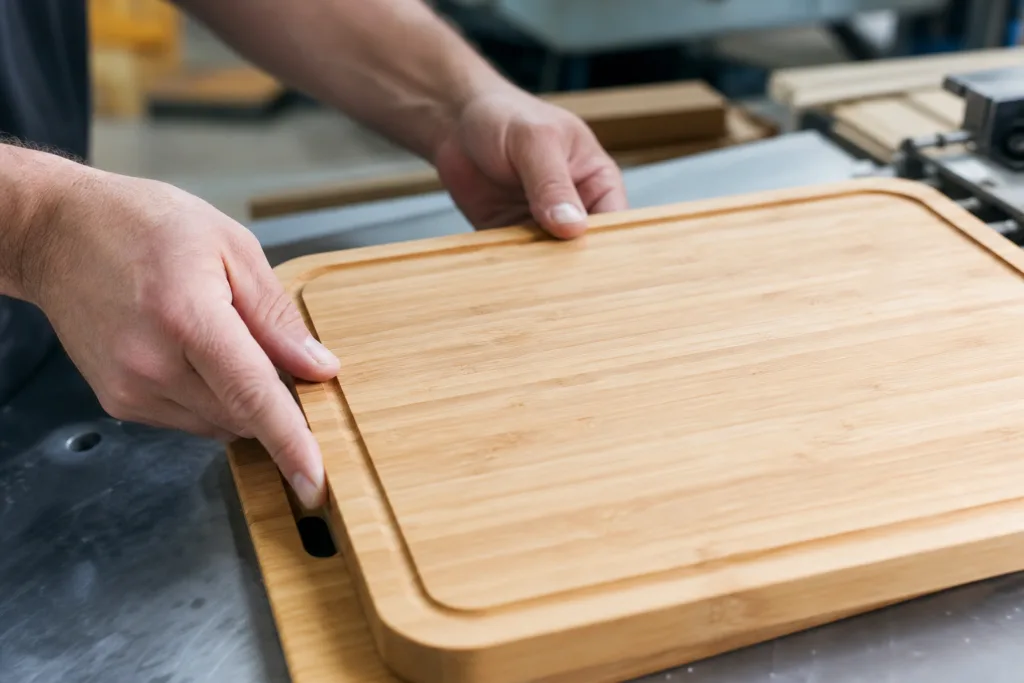
This is where a manufacturing partner matters. At Bamboo Wood Art, we help buyers compare not just material names but actual production risk: board thickness, logo depth, edge profile, moisture balance, and carton protection. That kind of planning reduces surprises in bulk orders and supports more predictable replenishment.
Brand Positioning Scenarios: When Teak Fits Premium Retail and When Bamboo Fits Eco-Value Lines
Teak and bamboo each fit a different commercial story. Teak is a strong fit when the brand wants the board to signal warmth, substance, and premium craftsmanship. It works well for upscale kitchenware assortments, hospitality gifting, and private label collections where the customer is willing to pay for a richer material expression.
Bamboo fits when the brand wants a clean, modern, and approachable product with a clear value message. It can also support an eco-conscious angle, provided the material and sourcing claims are handled responsibly. Bamboo is often easier to merchandise in large ecommerce assortments because the product photography is bright, the board looks neat on screen, and the value proposition is straightforward.
In practice, some brands use both materials strategically. Teak may be reserved for hero SKUs or gift sets, while bamboo serves core assortment volume. That can help a company protect margin while keeping the brand ladder coherent. The key is to avoid mixing them without a pricing rationale, because customers quickly notice when similar-looking boards are separated only by a large price gap.
Market Acceptance by Channel
Channel strategy often decides the winning material more than the board itself. Ecommerce buyers tend to react strongly to visual appeal, review risk, and price comparison. Teak photographs beautifully and can justify a premium listing if the brand story is strong. Bamboo may convert better when the listing emphasizes practicality, sustainability, and easy care.
In brick-and-mortar kitchenware retail, bamboo can support accessible entry pricing, while teak can help create a more elevated shelf presence. In the gift market, teak often performs well because it feels more substantial and more giftable. In promotional products, bamboo is usually easier to control on cost, lead time, and packaging simplicity.
When product planners want a board with added utility, such as a juice groove, the construction details become part of the channel strategy too. For example, a juice groove bamboo cutting board options page is useful for buyers who need a functional feature that improves everyday use without changing the whole product architecture.
Customization and Manufacturing Options
Customization can change both the perceived value and the unit economics. For teak boards, laser engraving often looks elegant because the dark, rich material gives the logo a refined contrast. For bamboo boards, laser engraving and CNC routing can both work well depending on the desired visual effect. A shallow engraving can keep the logo subtle, while deeper carving can create a more premium tactile identity.
Size and shape also affect market fit. A compact board may suit ecommerce bundles or gift sets, while a larger board can support premium kitchen retail. Juice grooves, handles, rounded corners, chamfered edges, and reversible formats all influence both manufacturing time and perceived value. Packaging should be planned alongside the product, not after the product is finished. Inserts, sleeves, corner protection, and master carton strength all matter if the board has polished edges or engraved faces that could scuff in transit.
Good customization work starts with artwork clarity. Logos should be prepared with clean vector files, and the placement should respect grain direction, edge radius, and usable printing or engraving area. For buyers considering branded features, a product page like reversible bamboo chopping boards can help frame how a functional feature supports the design brief before decoration is finalized.
Quality Control Factors That Matter in Bulk Production
Quality control is where many apparently similar boards become very different in customer perception. Moisture content must be controlled so the board does not warp, crack, or open at joints after packing. Surface finish should be smooth but not slippery, with no raised fibers, visible glue squeeze-out, sharp edges, or inconsistent stain absorption. If the board has grooves or recessed logos, those areas should be checked for residue and clean edge definition.
For laminated bamboo boards, glue line quality and flatness are important. Buyers should inspect whether seams are tight, whether panels are aligned, and whether the board remains flat after conditioning. For teak boards, color variation and grain differences may be expected, but they should still fall within an agreed visual range. A premium board can tolerate natural variation; it cannot tolerate poor finishing.
Food-contact expectations should also be discussed early. Buyers should confirm what finish, oil, or coating is used, how the board will be cleaned by the end user, and whether any compliance documentation is needed for the intended market. These points are not only technical; they affect retailer confidence and customer returns.
Common Buyer Mistakes When Choosing Between Teak and Bamboo Cutting Boards
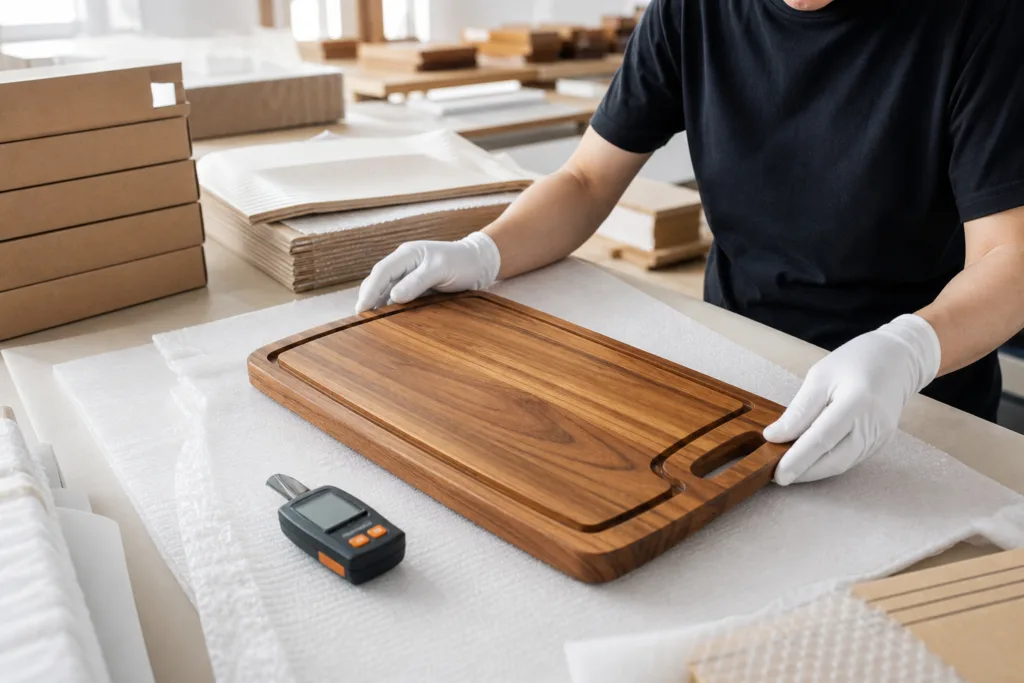
One common mistake is assuming teak automatically means better performance and bamboo automatically means lower quality. In reality, construction quality matters more than material stereotypes in many mid-market use cases. A poorly made teak board can warp, stain unevenly, or disappoint in packaging. A well-made bamboo board can deliver stable, attractive, and commercially reliable performance.
Another mistake is underestimating maintenance communication. If the board needs oiling, drying, or hand washing, those instructions must be planned into the listing, packaging, and after-sales support. Buyers often focus on shelf appeal and forget that user care directly affects reviews. A third mistake is ordering a sample without clarifying the final finish, edge profile, or packaging. That can lead to approvals based on a prototype that does not match the intended bulk version.
Finally, some teams choose by landed cost alone. That can be risky. The right choice depends on the brand’s price ladder, the channel’s expectations, and the repeatability of supply. A board that is cheap to buy but inconsistent to sell is not a good procurement win.
Decision Framework: How to Choose the Right Material for Your Price Point and Brand Story
If your brand needs a premium story, richer color, and a more substantial tactile impression, teak is often the better fit. If your brand needs a clear value proposition, visual consistency, and a practical path to scale, bamboo usually has the advantage. Neither is universally better. The right board is the one that matches the target customer, channel, and margin structure.
A simple way to decide is to ask four questions. First, what price point do you need to hit? Second, how much maintenance will your customer accept? Third, how important is premium material perception versus clean functional design? Fourth, how much production consistency do you need across multiple shipments? The answers usually point strongly in one direction.
For teams still deciding, our advice is to compare samples side by side under the same lighting, with the same packaging target, and the same branding plan. That is the most reliable way to judge whether teak or bamboo better supports the line you are building.
FAQ: Teak vs Bamboo Cutting Board for B2B Sourcing and Private Label Orders
Which material is better for a premium cutting board line?
Teak is usually better when the goal is a premium look and feel. Its darker tone, denser hand feel, and stronger perceived value help it fit upscale retail, gifting, and hospitality programs. Bamboo can still look refined, but it usually supports a value or eco-forward positioning rather than a luxury one.
Which board is easier to sell online?
Both can sell well online, but bamboo often works better for clear, practical value messaging, while teak works better when the listing emphasizes premium appearance and craftsmanship. The more important factor is whether the photos, care instructions, and price point match the shopper’s expectations.
Does bamboo require less maintenance than teak?
Not necessarily. Both materials need hand washing, prompt drying, and care instructions that are easy for the end user to follow. Teak may feel more forgiving because of its natural oils, but bamboo boards also perform well when manufactured correctly and used as intended.
What should buyers check in samples before bulk order approval?
Check flatness, surface smoothness, edge finishing, engraving clarity, glue line quality, moisture behavior, and packaging protection. If the board has a juice groove or other feature, verify that the dimensions and tool marks match the approved spec. Sample approval should always reflect the final production standard, not only the prototype.
How do MOQ and lead time usually differ between teak and bamboo?
MOQ and lead time depend more on size, finishing, and packaging than on material alone, but bamboo often fits faster standard production when the design is simple and repeatable. Teak can take longer if the visual grading or premium finishing requirements are strict. Early specification alignment reduces delays for both materials.
Can both materials support private label branding?
Yes. Teak often pairs well with elegant laser engraving and premium packaging, while bamboo is highly suitable for clean logos, CNC details, and scalable private label programs. The best branding approach depends on whether the product is intended to feel upscale or accessible.