When buyers complain that a bamboo toothbrush sheds bristles, cracks at the neck, or feels rough after only a short period of use, the issue is usually not “bamboo being bamboo.” It is typically a manufacturing and specification problem. In our work with custom personal-care products, we see that bamboo toothbrush quality problems often come from a mix of material treatment, handle finishing, bristle tufting, humidity exposure, and packaging decisions that were not matched to the real storage and use environment.
For brands and sourcing teams comparing product structures, OEM bamboo toothbrush manufacturing support can be useful early in development because it connects the handle material, bristle anchoring, finish level, and packaging approach before bulk production starts. If you are evaluating an OEM bamboo toothbrush manufacturing support path, the right questions are not only about appearance and price, but also about drying control, sanding consistency, and how the finished brush will survive warehouse storage, humid bathrooms, and shipping. At Bamboo Wood Art, we approach these projects by balancing durability, comfort, and production repeatability so buyers can reduce complaints before orders scale up.
Common Bamboo Toothbrush Problems and What They Usually Mean
The most common field complaints are easy to describe but harder to diagnose. Bristle shedding may point to weak tufting or poor adhesive performance. Cracking can indicate unstable moisture content, weak grain areas, or stress around drilled holes and thin necks. A rough handle usually means sanding was incomplete or the final seal was too light. Odor or discoloration can suggest storage humidity, insufficient drying, or contamination during packing.
From a buyer’s point of view, these symptoms should be treated as quality signals, not isolated defects. A toothbrush that feels fine on day one but fails quickly in use often reveals a process gap somewhere earlier in production. That gap may be in raw bamboo selection, heat treatment, finishing, bristle implantation, or packaging protection. In other words, the surface complaint is often only the last visible step in a chain of manufacturing decisions.
| Visible problem | Most likely production cause | Buyer risk |
|---|---|---|
| Bristles shed early | Weak tufting, poor staple setting, unsuitable adhesive, or loose hole tolerance | Bad user experience and immediate product returns |
| Handle cracks | Moisture imbalance, poor bamboo selection, thin cross-section, or storage shock | Broken stock, complaint volume, and packaging damage |
| Rough feel | Insufficient sanding, edge burrs, or incomplete sealing | Perceived low quality and reduced repeat purchase |
| Odor or spotting | Humidity exposure, unfinished surface, or poor warehouse control | Inventory risk and brand trust issues |
What Bamboo Toothbrush Quality Problems Tell You About the Product

In our experience, the fastest way to judge a bamboo toothbrush is to read the failure pattern. If the handle breaks near the neck, the design may be too thin or the bamboo may not have been seasoned properly. If the handle feels fuzzy, the sanding grit sequence may have stopped too early. If bristles pull out with light force, the tufting process likely needs better control. If the brush looks fine in the carton but arrives warped or stained, then the packaging and humidity management are probably not strong enough for the shipping route.
The important point is that the defect should be traced back to the process, not just the material. Bamboo can perform well when it is selected, dried, machined, and finished correctly. It can also fail early when any one of those steps is rushed. For buyers, this means the right supplier conversation should move beyond “is it eco-friendly?” and toward “how do you control moisture, finish, and bristle retention in production?”
Why moisture control matters so much
Bamboo is naturally hygroscopic, which means it absorbs and releases moisture based on the surrounding environment. Scientific research on bamboo’s water vapor sorption behavior shows that moisture content affects dimensional stability and mechanical performance, which helps explain why poorly controlled handling can lead to swelling, cracking, or surface changes over time. For a practical overview of the material behavior, see this discussion of bamboo moisture absorption and cracking. For toothbrush buyers, that means drying, storage, and packaging are not optional details; they are part of the product design.
A handle that leaves the factory at an unstable moisture level may look acceptable at first, then crack later after moving between dry storage, humid transit, and warm bathroom conditions. The same risk can also cause a rougher surface if fibers lift or if the finish does not properly protect the outer layer.
How Handle Material Treatment Affects Durability
Handle durability starts long before polishing. We look at bamboo density, node placement, grain direction, and visible defects because those details affect how the handle behaves under repeated wet-dry cycles. A good handle blank should be straight enough for consistent machining, dry enough to resist movement, and free from hidden damage around drilled zones and thin transitions.
For toothbrushes, the neck area is one of the highest-risk zones. It is slimmer, receives more bending stress, and is close to the bristle head where drilling can weaken the material. If the handle design is too aggressive, the product may feel elegant but fail sooner. If the material is too soft or insufficiently seasoned, cracks may appear even without heavy force. This is why we often recommend a design review before production instead of only approving a visual sample.
The treatment process can include controlled drying, surface inspection, shape machining, and a protective finish that slows moisture exchange. That finish should not be so heavy that it feels plastic-like, but it should be consistent enough to reduce fuzzy grain and improve grip comfort. For some projects, buyers compare a straight handle with an ergonomic bamboo toothbrush design because hand shape can improve comfort while also spreading stress more evenly across the handle.
What buyers should ask about raw bamboo selection
- How are raw bamboo strips dried before shaping?
- What moisture range is targeted before drilling and polishing?
- How are visible knots, cracks, or soft spots removed?
- Is the handle geometry adjusted near the neck to reduce breakage?
- What finish is used to slow humidity uptake without making the surface slippery?
How Bristle Tufting and Adhesive Control Affect Shedding
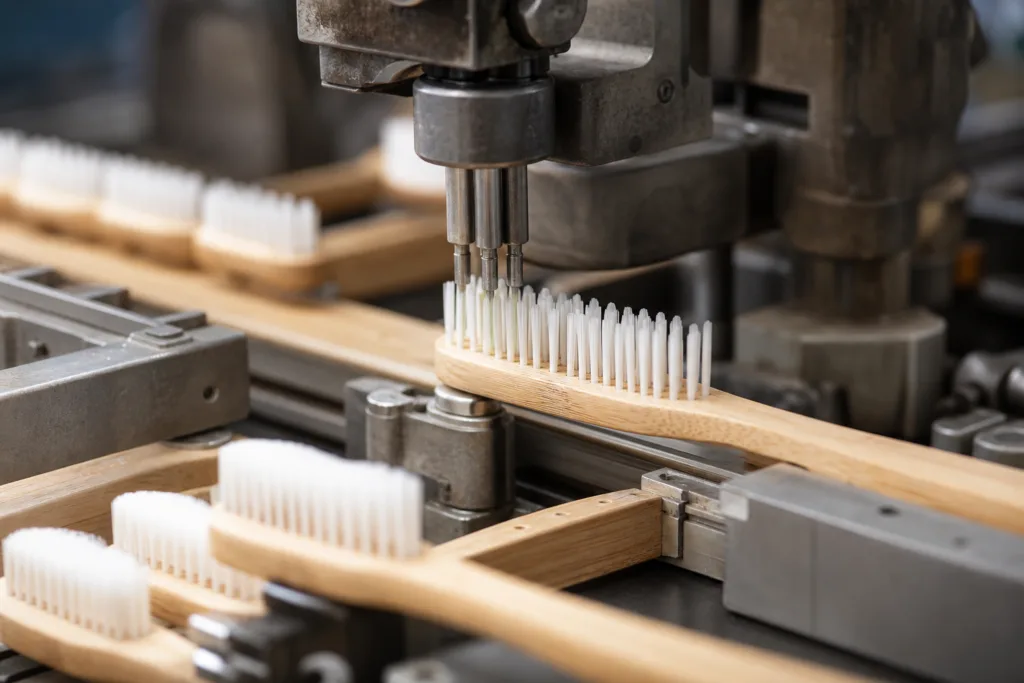
Many complaints about bamboo toothbrush quality problems begin at the bristle attachment point. If the tufts are not anchored correctly, the user can experience early shedding even when the handle itself is sound. The underlying factors include hole tolerance, insertion depth, staple quality, adhesive selection, and the curing or setting time allowed before packing.
Buyers sometimes focus on bristle softness only, but softness is not the whole story. A soft brush can still be durable if the tufting is strong. Likewise, a brush with a nice-looking head can fail if the mechanical retention is weak. The best specification work should define the bristle fiber, tufting method, pull-out resistance target, and inspection method for the finished head.
Different brush models can also behave differently depending on their intended use. Some buyers want charcoal-filled filaments, while others prefer standard smooth bristles or a customized combination. If you are comparing performance options, it helps to review bamboo toothbrush options with bristle variations to understand how filament type, user feel, and retention requirements may influence the final product.
Signs the tufting process may be weak
- Bristles pull out with a light tug during sample testing
- Tuft holes look uneven or chipped around the rim
- Head surfaces show glue residue or poor cleanup
- Bristles lean in different directions after packing
- Several heads in one batch fail at nearly the same point in use
Why Surface Sanding, Edge Finishing, and Sealing Affect Hand Feel
A toothbrush can be structurally acceptable but still feel cheap if the handle is rough. Buyers often describe the problem as “scratchy,” “dry,” or “fuzzy.” Those are usually sanding and finishing issues. Bamboo fibers can lift if the sanding sequence is incomplete, if the finishing step does not close the surface properly, or if the product absorbs moisture after sanding.
We usually think about finish in three layers: smoothness, edge safety, and moisture resistance. Smoothness affects comfort in the hand. Edge safety affects whether the handle feels sharp near transitions or stamped logo areas. Moisture resistance affects how the product behaves after shipping or bathroom storage. A well-finished handle should feel refined without becoming overly glossy or sealed in a way that hides the natural material character.
For branding projects, decoration can also expose finishing quality. Laser engraving may look crisp on a well-prepared surface, but it can look burnt or uneven if the substrate is inconsistent. That is why a brushed or polished surface should be stable before artwork is added. When branding and handling are important, some teams evaluate custom engraved bamboo toothbrush production to check whether the logo method matches the finish level and the intended price point.
Common finish-related mistakes
- Stopping sanding too early and leaving visible fiber lift
- Skipping edge rounding at the neck or base
- Using a finish that feels smooth in the factory but changes after humidity exposure
- Applying engraving before surface preparation is complete
- Ignoring consistency between front and back sides of the handle
How Humidity, Storage, and Shipping Conditions Trigger Damage
Even a well-made toothbrush can be damaged if logistics are neglected. Humidity changes are especially important for bamboo because the material reacts to moisture exchange. A brush stored in a damp warehouse may swell slightly, feel rougher, or develop a musty odor. A brush that moves quickly from humid packing rooms to dry air conditioning may also shift in dimension. Add shipping vibration and carton compression, and the risk becomes more obvious.
That is why packaging should be treated as part of the product system. Inner sleeves, carton strength, ventilation decisions, and warehouse rotation all matter. We often advise buyers to review packaging protection together with inspection routines, especially for export orders that may spend weeks in transit. From a manufacturing-quality perspective, packaging and handling controls are closely connected to inspection discipline. The FDA’s packaging and manufacturing quality control guidance is not toothbrush-specific, but it reinforces the general principle that contamination prevention, storage control, and inspection processes matter to the final user experience.
For multi-SKU programs or family-oriented assortments, organized identification can also reduce mix-ups during packing and distribution. Some buyers consider bamboo toothbrush models for organized family use because color-coded base details can help teams manage assortments while keeping product variation easy to understand at a glance.
Packaging questions worth asking
- Is the product packed in a way that limits humidity exchange?
- Are cartons tested for compression and transport damage?
- Is the packing room dry and clean enough for finished personal-care products?
- Are retained samples kept from each production batch?
- Can the supplier explain how the product is protected from warehouse moisture?
How User Habits Can Shorten the Life of a Bamboo Toothbrush
Not every complaint is caused by manufacturing, and buyers should understand this before drawing conclusions from isolated feedback. A toothbrush left standing in a wet cup may wear faster than one stored in a ventilated holder. A user who bites the head or scrubs too aggressively may shed bristles earlier than expected. A brush exposed to constant soak conditions will behave differently than one that dries fully between uses.
That said, a good product should tolerate normal bathroom use. The point is not to blame the user for every failure, but to define reasonable expectations. If a product fails under ordinary use, it is probably under-specified. If it only fails under clearly abusive use, the supplier may still have done the job correctly. Buyers should build a product brief around realistic use patterns and not around best-case storage only.
For brands targeting soft-feel personal-care products, handle ergonomics and bristle selection should be matched carefully. Some teams test a more comfortable grip before scaling because it can reduce over-pressing during brushing. If you are comparing grip styles, an ergonomic bamboo toothbrush design can be useful for evaluating how shape influences comfort and perceived quality.
What to Check Before Buying Bamboo Toothbrushes in Bulk
Bulk sourcing should start with a simple rule: do not approve a toothbrush only because the sample looks attractive. Instead, review the full manufacturing logic. We recommend checking material treatment, head construction, bristle retention, finish quality, packaging strength, and repeatability across multiple samples from the same batch.
At Bamboo Wood Art, we usually separate the review into product, process, and logistics questions. Product questions cover the handle, bristles, and user feel. Process questions cover drying, machining, sanding, and tufting. Logistics questions cover packing, labeling, and storage. When those three areas align, the chance of field complaints drops significantly.
| Area | What to inspect | Why it matters |
|---|---|---|
| Material | Moisture level, grain quality, and visible defects | Helps prevent cracking and warping |
| Handle finishing | Smoothness, edge rounding, and coating consistency | Improves comfort and moisture resistance |
| Tufting | Pull-out strength, alignment, and hole integrity | Reduces bristle shedding |
| Packaging | Protection, cleanliness, and carton strength | Protects product during storage and transit |
| Batch consistency | Variation in color, feel, and fit across samples | Helps control complaints and returns |
Why sample approval should be more than visual approval
A sample should be tested under conditions that resemble real use and shipping as closely as practical. That means checking whether the handle stays smooth after damp handling, whether the bristles remain secure after moderate brushing force, and whether the packaging protects the product over time. It also means confirming that the final decoration, whether printed or engraved, still looks clean after the finishing process is complete.
This is also where a brand can define the acceptable range of natural variation. Bamboo is a natural material, so some color and grain differences are normal. What should not vary excessively is the feel, the structural strength, or the quality of the finish. If those elements drift, the line is not stable enough for scale.
Quality Control Checklist for More Reliable Orders
To reduce bamboo toothbrush quality problems, QC should happen at more than one stage. Incoming raw material checks help catch bamboo defects early. In-process checks help catch machining and tufting problems before the batch is complete. Final inspection helps catch packaging, cleanliness, and finish issues before cartons close.
We also recommend retention samples and a simple complaint review system. When a buyer reports repeated cracking, shedding, or roughness, the supplier should be able to compare the complaint against previous samples and process records. That comparison often reveals whether the issue is linked to a certain handle thickness, a change in bristle specification, or a packaging change that allowed moisture exposure.
Practical QC checkpoints
- Measure handle moisture and allow stabilization before assembly
- Check each tooling run for clean drilling and consistent head dimensions
- Perform bristle pull checks on a representative batch
- Inspect sanding quality under light and by touch
- Verify that cartons and inner packs protect the surface from rubbing
- Review sample-to-bulk color and feel consistency before release
If a program requires private label coordination, supplier communication should also cover artwork file readiness, logo positioning, and packaging hierarchy. Simple design changes can affect production speed and rejection rates. A clean specification saves time later and helps the line stay stable across repeats.
How to Reduce Risk Before Bulk Production
The safest sourcing approach is usually a staged one. First, confirm the material and structure. Second, approve a sample based on both look and function. Third, test packaging in conditions that approximate transport. Fourth, lock the process spec before mass production. This sequence reduces the chance that one hidden weakness gets multiplied across a large order.
When brands want a custom product rather than a generic brush, the conversation should include logo method, handle shape, bristle preference, color coding, packaging format, and target shelf life. A team planning a retail assortment might compare different models, such as a standard brush and a bamboo toothbrush options with bristle variations, to decide whether the brand message is about comfort, appearance, or functional differentiation. The more clearly the use case is defined, the easier it is to choose the right process controls.
At Bamboo Wood Art, we treat sampling as a risk-reduction tool rather than a formality. A good sample can show whether the handle is too thin, whether the finish is too rough, or whether the bristles are anchored strongly enough for expected use. It can also reveal whether the packaging protects the product from humidity and friction. When those issues are identified early, the bulk order is much easier to manage.
When a Bamboo Toothbrush Should Be Rejected

Not every defect can be fixed with “better handling.” Some samples should simply be rejected or redesigned. If bristles shed during basic handling, if the handle cracks at low stress, if the surface remains scratchy after finishing, or if the product arrives with odor or visible moisture damage, the specification is not ready.
Buyers should also reject samples if the supplier cannot explain the root cause in practical terms. A reliable manufacturer should be able to describe how the bamboo is dried, how the handle is machined, how the tufting is secured, and how the product is packed for transit. If those answers are vague, the same problems may repeat in bulk production. Clear process control matters more than a low unit price.
Conclusion
Bamboo toothbrush quality problems are usually the result of weak process control rather than an unavoidable material weakness. Bristle shedding points to tufting and adhesive issues. Cracking points to moisture control, handle geometry, or storage problems. Roughness points to sanding and sealing gaps. When buyers diagnose these failures correctly, they can specify a better product instead of simply replacing one bad batch with another.
The most reliable sourcing decisions are made before mass production starts: choose stable material, verify finish quality, test bristle retention, review packaging protection, and confirm the supplier can repeat the result across batches. That is the practical path to a bamboo toothbrush that feels comfortable, holds together well, and supports brand trust in real-world use.
FAQ
Are bamboo toothbrushes supposed to shed bristles?
No. Some loss during extreme abuse is possible with any brush, but normal use should not cause early shedding. If bristles pull out too soon, the likely causes are weak tufting, poor adhesive control, inaccurate hole sizing, or a process that was not stable enough before packing.
Why do some bamboo toothbrushes crack faster than others?
Cracking usually reflects differences in drying, bamboo selection, handle thickness, or humidity exposure during storage and shipping. A well-treated handle should be dried and finished in a way that limits sudden moisture movement and reduces stress around the neck and drill zones.
Why does a bamboo toothbrush sometimes feel rough after a short time?
Roughness often means the sanding process was incomplete or the surface finish does not hold up well in a humid bathroom. If fibers lift after use or the edges feel sharp, the finishing sequence needs to be improved before the product is approved for bulk production.
What should buyers test before placing a bulk order?
Buyers should test moisture stability, bristle retention, handle smoothness, packaging protection, and batch consistency. It is also useful to compare multiple samples from the same production run so you can see whether the factory can repeat the same result, not just make one good sample.
Can packaging really affect bamboo toothbrush quality?
Yes. Packaging can protect the brush from rubbing, contamination, and humidity changes during transport and storage. Weak packaging can allow surface damage, odor, or moisture-related movement even when the brush itself was made correctly.
How can a brand reduce complaints before launch?
The best approach is to approve samples based on function as well as appearance, define clear specifications for the handle and bristles, and confirm packaging performance before mass production. It also helps to work with a supplier that can explain the process clearly and keep QC records from sample to bulk.