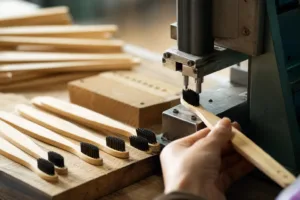
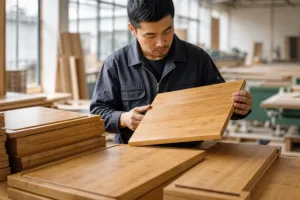
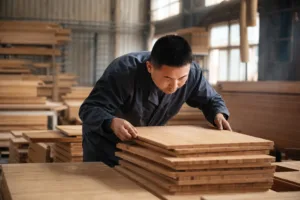
A custom bamboo laptop table is often a small product with a large sourcing impact. For retail buyers, it sits at the intersection of comfort, functionality, shelf appeal, and shipping efficiency. The right specification can make the difference between a low-return, easy-to-merchandise item and a product that creates avoidable complaints about wobble, finish inconsistency, or packaging damage. From our bamboo and wood manufacturing perspective, the most successful programs start with a clear brief: who the table is for, which features matter, how the logo should appear, and how the finished carton will move through retail or e-commerce channels.
For buyers comparing bamboo laptop table manufacturing solutions, the real value is not just in making one sample look good. It is in planning a product that can be repeated in bulk with consistent dimensions, stable structure, reliable branding, and packaging that protects the item from factory to shelf. At Bamboo Wood Art, we approach custom projects by aligning material selection, structure, surface finish, and private label packaging before mass production, so the order is designed for retail performance as well as product appearance.
What a Custom Bamboo Laptop Table Is and Who It Is For
A custom bamboo laptop table is a small furniture-style accessory designed to support laptops, tablets, books, or breakfast use on a bed, sofa, or low desk. For retail buyers, it is usually sold as a multi-purpose product with a strong visual story: natural material, compact design, practical features, and a premium eco-friendly appearance. Unlike a generic stock item, a custom version can be shaped to fit a specific market, channel, or brand position.
We usually see demand from home office brands, gift companies, promotional product distributors, e-commerce sellers, hotel buyers, and lifestyle retailers. Each channel has different priorities. A gift brand may want decorative presentation and laser branding. An office brand may want ergonomic function and a more neutral finish. A promotional buyer may care about logo visibility and MOQ flexibility. E-commerce brands often prioritize lightweight packaging, lower breakage risk, and clear product photography. This is why the same product family can be adapted in several ways without changing the core manufacturing logic.
Why bamboo works well for this product category
Bamboo is a strong fit for laptop tables because it can offer a clean natural appearance, stable panel performance, and efficient machining for small product parts. It also supports a polished retail presentation when the grain, edge finish, and coating are controlled correctly. For buyers, bamboo is especially attractive when they want a product that looks more premium than plastic, but still ships more efficiently than many solid wood alternatives.
That said, bamboo is not a “set and forget” material. It still responds to moisture, factory drying conditions, coating choice, and assembly quality. For buyers who need a deeper technical view of bamboo moisture content and load-bearing stability, the key point is simple: material control matters. If the moisture level is not managed well, the tabletop can warp, crack at joints, or lose consistency in batch production. That is why we treat moisture, sanding, and finish specification as part of the product design, not just the final appearance stage.
Which Parts Can Be Customized
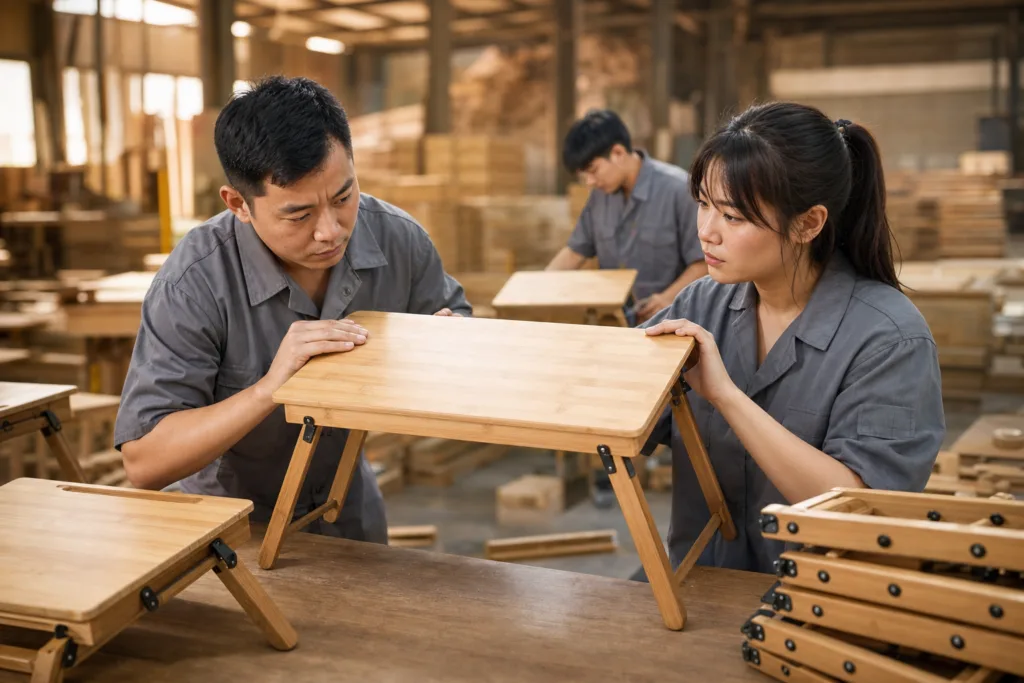
Most retail buyers want more than a logo. A successful custom bamboo laptop table project usually involves a set of coordinated decisions: size, structure, features, branding, surface finish, and packaging. When these elements are planned together, the product feels intentional and brand-aligned. When they are decided separately, the result is often a mismatched sample that looks fine in isolation but performs poorly in real retail use.
| Customization Area | Buyer Decision | Manufacturing Impact |
|---|---|---|
| Size | Tabletop length, width, height, and thickness | Changes material usage, weight, carton size, and stability |
| Structure | Foldable legs, fixed legs, tilt angle, drawer, slots | Affects hardware, assembly steps, and QC complexity |
| Branding | Laser engraving, print, label, or packaging art | Impacts logo clarity and decoration cost |
| Finish | Natural, stained, matte, glossy, coated | Influences color consistency and scratch resistance |
| Packaging | Retail box, mailer box, insert, carton strength | Determines shipping protection and shelf presentation |
One practical rule we use in custom development: if the buyer changes one major feature, we review the whole product again. For example, adding a drawer or phone slot may look small, but it can change internal clearance, leg folding geometry, carton thickness, and even the brand photo angle. The earlier these changes are reviewed, the fewer surprises appear at sample stage.
Retail, Gift, and Promotional Versions: How Requirements Differ
Retail buyers usually want a product that can stand on a shelf or in an online listing with minimal explanation. That means the structure should be intuitive, the surface should look consistent under photography, and the package should communicate value quickly. Retail cartons also need to survive repeated handling, so the insert and outer box must be designed together.
Gift buyers often care more about visual impact, premium feel, and unboxing presentation. They may accept a slightly higher production cost if the logo placement, print quality, or finish tone feels elevated. Promotional buyers, by contrast, usually need reliable branding placement and controlled cost. They often prefer a simple structure with a clear logo and practical packaging that supports volume distribution.
From a manufacturing perspective, this is where channel strategy matters. A retail version may justify upgraded coating, better hardware, and a stronger printed box. A promotional version may use a simpler surface finish and more economical packaging. Neither is inherently better; the right choice depends on the sales channel, target price, and order volume.
Standard Size Options and How to Choose the Right Dimensions
There is no single universal size for a bamboo laptop table. The most suitable dimensions depend on the target market, product positioning, and how the item will be used. Some buyers want a compact lap desk for casual use. Others want a larger surface that can hold a laptop, mouse, and phone together. In home office channels, larger tabletop dimensions usually feel more useful, but they can also raise packaging costs and increase shipping risk.
When we help buyers choose dimensions, we look at four practical questions:
- Will the table be used mainly on a bed, sofa, or desktop?
- Does it need to fit common laptop sizes with extra accessory space?
- Should it fold flat for display and shipping efficiency?
- Is the target customer more concerned with portability or surface area?
A compact table can be easier to ship and price competitively, but it may feel too small for users who want a mouse area or notes space. A larger table improves utility, but it adds weight and carton volume. The best choice is usually not the largest option; it is the one that aligns with the intended use and retail price point.
Feature planning for functional appeal
For e-commerce sales, the features that matter most are often the ones buyers can understand at a glance. Foldable legs help with storage and shipping. Adjustable angles help with comfort claims. Phone slots and cup holders add convenience. Ventilation cutouts can support cooling and also make the table appear more purpose-built. Anti-slip details matter because they help reduce movement on smooth bedding or sofa surfaces.
If a buyer wants one of the most function-forward configurations, a bamboo laptop table with cooling vents is a useful example of how small structural details can support the product story. Vent slots can improve airflow visually and practically, while also giving the product a more technical, work-focused identity. We usually evaluate whether the vent pattern still leaves enough top-surface rigidity and whether the cutout edges can be finished cleanly in production.
Branding Methods for Private Label Buyers
Branding is not only about adding a logo. It is about deciding how the brand should be perceived when the customer first sees the product. For bamboo laptop tables, the most common branding methods are laser engraving, printed logos, label application, and branded packaging.
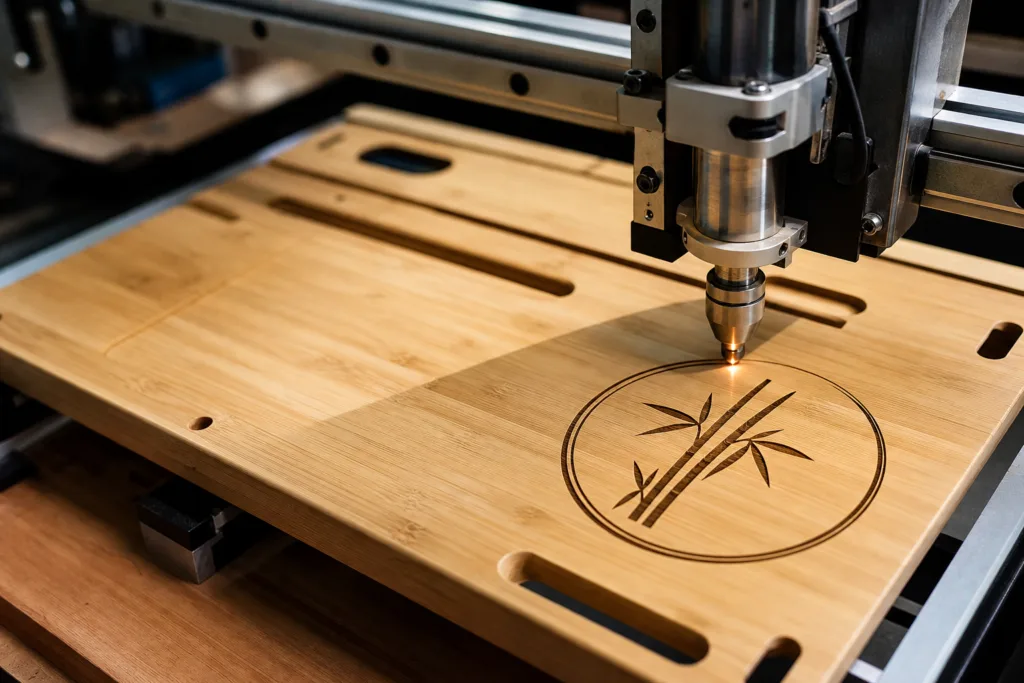
Laser engraving works well when the buyer wants a subtle, durable mark that suits natural bamboo. It is often preferred for premium, understated branding. Printed logos can be brighter and more visible, but they require more attention to surface preparation and ink adhesion. Labels are useful for some promotional or mixed-SKU programs, especially when the buyer wants to keep decoration cost lower or test a market quickly.
In private label projects, packaging may be just as important as the product itself. A strong outer carton and a branded inner box can improve shelf appeal and reduce return risk. If the product is sold through U.S. retail channels, packaging and label details should also be reviewed carefully; for example, consumer package presentation may need to align with retail packaging and labeling compliance expectations. That is not a decorative detail. It affects how the product is received by retailers, distributors, and end customers.
How to decide between OEM and ODM development
Some buyers want to start with an existing platform and change only branding, finish, or packaging. Others need a more distinctive structure with new accessories, altered proportions, or added functional features. In practice, this is the difference between an ODM-style adaptation and a more complete OEM project. If you are comparing OEM and ODM options for bamboo products, the main question is how much of the structure is already defined before you start. A stronger brief leads to fewer sample revisions and better control over MOQ and lead time.
Material and Structure Choices That Affect Stability
For a bamboo laptop table, structure matters as much as appearance. The tabletop thickness, leg design, joint method, hardware quality, and fastening points all affect how the product feels in use. Buyers sometimes focus only on the visible top panel, but the real quality difference is often in the hidden construction.
We pay close attention to support design because a table that flexes too much under load will quickly feel cheap, even if the surface looks attractive. If the product includes moving parts such as folding legs or angle adjustment, we check the pivot strength, screw holding, and repeated movement wear. A small part count can still create quality problems if the load path is weak or if the assembly tolerance is too loose.
Material selection also influences finishing behavior. Bamboo panels can machine cleanly, but edge quality, glue lines, and surface absorption vary by board construction. For buyers who want a drawer version, the extra component can change the center of gravity and the shipping protection needs. A representative example is a bamboo laptop table with drawer, where drawer fit, slide smoothness, and front-panel alignment all become part of the final QC checklist.
Surface Finish and Appearance Control
Retail buyers often underestimate how much finish consistency shapes the perceived quality of a bamboo laptop table. Even when the structure is sound, a finish that looks uneven, too glossy, or too dark can make the product appear lower quality than it is. Appearance control starts with sanding and continues through coating, curing, and visual inspection.
A natural finish usually works well when the buyer wants to show bamboo grain and position the product as warm and modern. A stain tone can help create color consistency across batches, especially when raw bamboo variation is visible. Matte coatings often feel more refined for office and home-use products, while glossier finishes may be easier to wipe clean but can also reveal surface defects more easily.
For products sold in mixed lots or repeated reorders, finish consistency matters more than one perfect sample. That is why we lock down the sample approval standard early: one approved tone, one approved sheen level, one approved edge condition, and one approved engraving depth. We also review the appearance under lighting that is closer to how it will be photographed or displayed, because a finish that looks acceptable in the workshop may read differently in retail images.
Moisture protection is part of surface planning as well. A good coating can help slow moisture exchange, which supports dimensional stability over time. For a broader technical view of surface finishing for moisture resistance, the important manufacturing takeaway is that finish choice should match the storage and use environment, not just the color target. This is especially true for bamboo and wood products that may move between humid warehouses, dry retail floors, and consumer homes.
What a Sample Approval Checklist Should Include
Sample approval is where many private label projects succeed or fail. A beautiful sample is not enough if the dimensions are off, the logo is misplaced, or the table feels unstable in use. We recommend reviewing the sample against a practical checklist that covers both visual and functional points.
- Tabletop dimensions and thickness match the specification.
- Leg opening and folding action feel smooth and stable.
- Logo position, size, and depth or print clarity are correct.
- Finish tone and sheen match the approved reference.
- Surface edges are sanded cleanly with no sharp points or splinters.
- Load feel is acceptable for the intended laptop and accessory weight.
- Packaging fit is tight enough to protect but not so tight that it damages the product on removal.
We also recommend checking the sample in realistic conditions, not only on a desk. If it is meant for bed use, test it on soft surfaces. If it is meant for e-commerce, package and unpack it several times. If it will carry a mouse or phone, check whether those accessories remain usable in the approved layout.
Packaging Design for Retail and Shipping
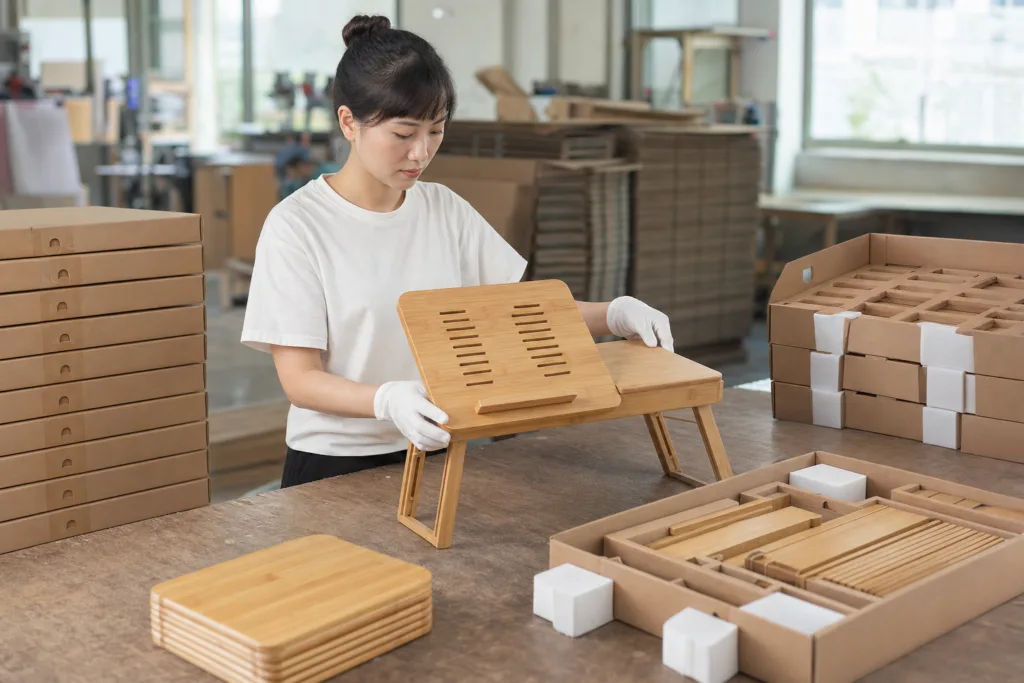
Packaging is often treated as a finishing task, but for a bamboo laptop table it is a core part of product development. The package has to do three jobs at once: protect the product, present the brand, and fit the shipment model. Retail-ready packaging may need better graphics and shelf appeal, while e-commerce packaging may need more protective inserts and better carton strength.
We design packaging around the likely failure points. Corners, folded legs, and moving hardware are the areas most likely to rub or shift during transit. Internal inserts should prevent movement without stressing the product. Outer cartons should resist compression and handling damage. For transit validation, it is common to use a drop-test approach similar to carton drop testing for shipping protection when evaluating how the packaged item performs under realistic handling conditions.
Packaging also affects warehouse efficiency. A slimmer carton can reduce freight cost and improve pallet density, but if it is too tight it may increase damage during packing or opening. In private label projects, we usually balance presentation, protection, and cost together rather than optimizing only one of those factors.
How to choose a packaging format
If the buyer is selling through retail shelves, a printed box with clear product imagery and structured messaging is often the right starting point. If the buyer is selling online, the outer carton may need stronger shock protection and simpler branding. If the product is part of a gift set, insert design and unboxing sequence matter more than box economy. The right choice depends on the channel, not just the decoration budget.
What to Include in a Complete Custom Brief
A strong custom brief saves time and prevents misunderstandings. Before requesting a quote, buyers should provide the intended sales channel, target customer, size preference, feature list, branding method, finish reference, packaging requirements, and estimated order quantity. If there is a target retail price, include that too, because it helps the manufacturer choose a structure and material combination that is commercially realistic.
Useful brief details include:
- Primary use case and customer segment
- Target dimensions and any size limits
- Logo method, size, and placement
- Preferred finish, color tone, and sheen
- Feature list such as drawer, phone slot, cup holder, or vents
- Packaging type, carton quantity, and shipping destination
- Expected MOQ, reorder plan, and desired lead time
When the brief is complete, quotation is faster and sample revisions are fewer. More importantly, the production risk is lower because the manufacturing team is solving the right problem from the start.
MOQ, Lead Time, and Cost Drivers
MOQ and lead time depend on how much the product differs from a factory’s existing structure. If a buyer is only changing branding and packaging, MOQ can often be more manageable than for a new mold, new hardware set, or new structural layout. If the order requires a new drawer layout or customized angle mechanism, the setup cost and lead time usually rise.
The main cost drivers are material usage, machining complexity, hardware count, finishing steps, packaging quality, and inspection time. A simple flat-top bamboo laptop table with minimal decoration will usually be easier to price than a model with multiple cutouts, moving parts, and premium box printing. Buyers should also consider freight impact. A product that is slightly larger or heavier may have a surprisingly different landed cost once carton volume is included.
We often advise buyers to compare not just unit price, but total product value: appearance, stability, branding quality, packaging protection, and reorder consistency. A lower initial quote can become expensive if it creates damage claims, photo inconsistencies, or delayed launch schedules.
Common Production and Sourcing Mistakes to Avoid
One common mistake is approving a sample based on appearance only. Another is specifying too many features without understanding how they affect stability or packing. Buyers also sometimes choose a finish that looks attractive but is hard to keep consistent in batch production. In private label orders, it is also risky to leave logo details vague and assume they can be “fixed later.” They usually cannot be fixed cheaply later.
Humidity and storage conditions can also create problems if the buyer does not plan ahead. Bamboo and wood products need proper moisture control before finishing and packing, otherwise they can move after shipment. That is why a manufacturer should review raw material handling, drying, assembly timing, and final packaging together. For this reason, buyers who plan to use a custom bamboo laptop table in retail should always ask how the supplier controls incoming material, in-process drying, and final inspection.
At Bamboo Wood Art, we treat QC as a chain of decisions rather than a single final step. The better the input specification, the easier it is to keep the order consistent from sample through bulk production.
Quality Control Points Before Bulk Production and Shipment
Before bulk production, we confirm approved dimensions, logo files, finish references, hardware samples if applicable, and packaging dielines or artwork. Before shipment, we recheck appearance, assembly function, carton strength, quantity, and packing completeness. For products that include moving parts, we also check whether repeated folding or angle adjustment creates looseness, noise, or uneven movement.
Typical QC checkpoints include:
- Material moisture and visual defects
- Panel flatness and edge finishing
- Logo accuracy and placement consistency
- Hardware tightness and folding action
- Surface scratches, dents, glue marks, and stain variation
- Packaging fit, labeling, and drop-risk protection
For a category like this, bulk consistency is more important than one showpiece sample. Retail buyers need a product that can be reordered without reworking the whole specification each time. That is why we document the approved version carefully and build the production standard from it.
How to Match the Product to the Channel
Not every custom bamboo laptop table should be designed the same way. If you are selling to office buyers, a more functional and minimal version may perform better. If you are targeting gift retail, a warmer finish and stronger presentation may matter more. If your channel is promotional, logo clarity and price control may take priority over extra features. The right configuration is the one that supports your sales motion, not the one with the most features on paper.
For buyers evaluating feature combinations, product architecture matters. A model with a phone slot may work well for casual use, while a wrist-rest style or angled surface may be more comfortable for longer sessions. When the aim is ergonomic utility, a product such as a bamboo lap desk with wrist rest shows how added comfort details can change the product’s market position. The same principle applies to accessories like cup holders or media slots: they are not just extras, they change how the buyer perceives the product category.
Conclusion
A well-developed custom bamboo laptop table is a balance of design, structure, branding, packaging, and manufacturing control. For retail buyers, the most successful programs are the ones that define the use case early, select the right dimensions, choose a finish that can be repeated in bulk, and build packaging that protects the product without overcomplicating the supply chain. When the brief is clear, the sample is easier to approve, the MOQ is easier to manage, and the bulk order is easier to keep consistent.
If you are sourcing a custom bamboo laptop table for private label or retail, think beyond the surface appearance. Ask how the table will be used, how it will be branded, how it will ship, and how it will hold up after repeated production. That is the level of planning that turns a small accessory into a dependable product line.
FAQs
Can a custom bamboo laptop table be made in different sizes for different markets?
Yes. We can adjust tabletop length, width, thickness, and overall height to match different sales channels and user expectations. The key is to balance usability with carton size, product weight, and structural stability so the final version still works efficiently in bulk production and shipping.
What branding methods work best for private label bamboo laptop tables?
Laser engraving is often the most durable and natural-looking option for bamboo. Printed logos can provide stronger color impact, while labels and branded packaging are useful for promotional or cost-sensitive orders. The best method depends on the brand position, logo detail, and finish type.
How long does sampling usually take for a custom order?
Sample timing depends on how much customization is required. If the project is mainly branding and packaging, sampling is usually simpler than for a new structure or added feature set. Faster approval happens when the buyer sends complete artwork, clear dimensions, and a specific finish reference from the start.
What packaging options are available for retail buyers?
Retail buyers can usually choose from printed color boxes, protective inner inserts, mailer-style cartons, or gift-ready packaging depending on the channel. We plan packaging around protection, shelf presentation, and shipping efficiency so the product arrives in good condition and is easy to merchandise.
What features are most popular for e-commerce bamboo laptop tables?
Foldable legs, adjustable angles, phone slots, ventilation cutouts, and anti-slip details are among the most requested features. Buyers tend to favor options that are easy to understand in product photos and that improve real everyday use without making the product too bulky or expensive to ship.
What should buyers check before placing a bulk order?
Before bulk production, buyers should confirm dimensions, logo placement, finish tone, hardware behavior, packaging structure, and the approved sample standard. It is also wise to check moisture control, carton strength, and load stability so the order stays consistent from production to shipment.