A high quality bamboo tea canister should do more than look premium on a shelf. For B2B buyers, the real test is whether it protects aroma, opens and closes smoothly, stays dimensionally stable, and holds up through repeated handling in retail, hospitality, or private label programs. When we evaluate tea canisters from a manufacturing perspective, we look at fit, finish, odor control, sealing performance, and how consistently the product can be made in bulk.
If you are comparing options for custom projects, our bamboo tea canister manufacturing support page shows the type of production considerations that matter before sampling starts. At Bamboo Wood Art, we help buyers balance material choice, finish selection, inner-lid structure, sample approval, and packaging protection so the final canister matches the actual use case, not just the product photo.
Why a High-Quality Bamboo Tea Canister Is More Than a Nice Container
Tea storage is a small product category with a surprisingly large quality gap. A canister can look elegant on day one and still fail in practical use if the lid loosens, the inner wall carries odor, or the finish feels sticky after repeated opening. For wholesale and private label buyers, that means the evaluation should go beyond appearance and cover the whole user experience.
A truly reliable canister needs to support three things at the same time: product protection, daily convenience, and manufacturing consistency. If a tea canister is too loose, tea aroma can escape and ambient moisture can enter. If it is too tight, the user may struggle every time they open it. If the finish is inconsistent, the product may pass a visual check but still disappoint in use. This is why we treat tea canister sourcing as a structural and surface-quality decision, not just a decorative one.
For buyers comparing a simple display jar with a more controlled storage format, an airtight bamboo tea canister design is often the better benchmark for evaluating lid geometry, fit tolerance, and sealing intent. Even when a canister is not fully airtight in the strict technical sense, the design should still reflect deliberate control of airflow, closure strength, and repeatability.
What Buyers Should Inspect First: Lid Fit, Alignment, and Opening Feel
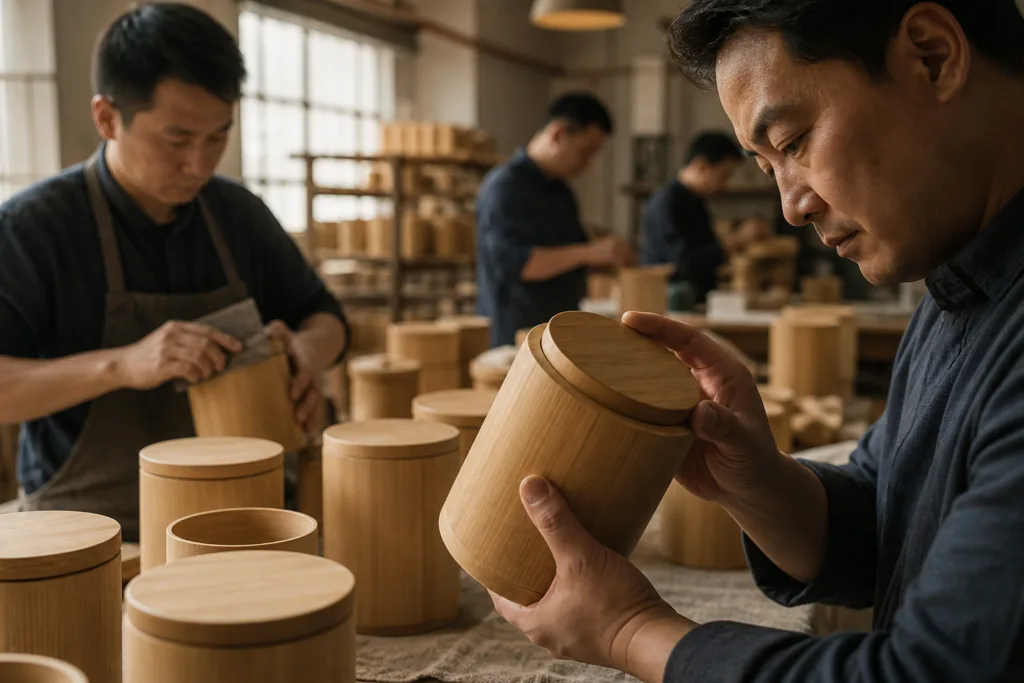
The first tactile inspection should focus on the lid. This is where many quality differences become obvious within seconds. A lid that sits unevenly, wobbles, or scrapes along the rim usually indicates tolerance issues, moisture movement, or uneven sanding. In bulk buying, even a small lid variance can create a mixed user experience across the same order.
What a good lid feel tells you
- The lid should enter the body smoothly without sticking at one point and loosening at another.
- Opening force should feel controlled, not overly tight or too easy.
- The lid should align visually with the container body, with no obvious tilt.
- Repeated opening and closing should not produce a gritty feel or noticeable abrasion.
When we make tea canisters, we pay close attention to whether the opening is designed for daily use or for a tighter preservation function. A more controlled fit can improve aroma retention, but it must still be practical for the end user. Buyers should think in terms of use frequency. A tea boutique customer who opens a canister several times a day has different expectations from a gift purchaser who uses it occasionally.
The lid structure also matters. A single-piece lid is simpler, but an inner-lid construction can improve closure performance and make the canister feel more intentional. If your project requires a more protected storage experience, a tea storage jar with inner lid can help you compare how the inner seal element changes fit, user feel, and aroma retention without relying on the outer shell alone.
How to Judge Interior Treatment and Odor Control Before Purchase
Tea is highly sensitive to smell transfer. That means the interior surface of a bamboo canister is just as important as the exterior finish. Buyers often focus on visual quality and forget that a strong coating odor, excess adhesive smell, or poorly cured treatment can interfere with the tea itself. If the canister has a noticeable chemical or resin smell when opened, that is a warning sign that needs investigation before bulk approval.
From a manufacturing standpoint, odor control is not solved by adding more finish. In many cases, a heavier coating can make the product feel more sealed, but it may also create unwanted odor retention if curing is incomplete. The right approach is to control material dryness, select suitable coatings, and allow enough curing time before packing. Buyers should ask what is applied inside the canister, whether there are glues or liners in contact with tea, and how long the product rests after finishing.
For food-related storage products, it is also reasonable to check food-contact status for every component, not just the bamboo body. The food-contact compliance, coatings, liners, adhesives, and regulatory status guidance from the U.S. Food and Drug Administration is useful when buyers want to confirm that all material components are suitable for intended food-contact use. In practice, this means asking whether the finish, adhesive, or lining has been selected with the final application in mind, rather than assuming the outer material alone determines safety.
Odor control and finish safety are closely connected. The FDA also explains why substances that contact food must be evaluated for intended use and exposure, which is relevant when you assess odor migration, surface finish safety, and chemical migration testing. For tea containers, the buyer’s goal is straightforward: the canister should not add its own smell, taste, or contamination risk to the product inside.
Surface Finish, Edge Sanding, and Overall Craftsmanship Checklist
Even a functional canister can feel low grade if the surface is rough, the edges are sharp, or the coating is uneven. A strong sourcing checklist should include close visual and tactile review under good light, not just a general impression from a catalog photo.
What to inspect on the outside
- Sanding consistency: The body should feel smooth all around, including the underside, rim, and lid edge.
- Edge finishing: Corners should be eased properly, with no splintering, knife marks, or sharp transitions.
- Surface uniformity: Stain, oil, lacquer, or matte coating should not pool, streak, or appear cloudy.
- Grain presentation: Natural variation is normal, but the overall appearance should still match the intended collection style.
With bamboo, surface quality is especially dependent on processing consistency. Bamboo is stable when well prepared, but it can still show visible differences if lamination, pressing, sanding, or coating are not controlled. Buyers sometimes think that a few rough edges are acceptable because the product is natural. In reality, rough edges usually indicate one of three things: insufficient sanding, hurried assembly, or a coating system that was not matched to the substrate.
For custom orders, we usually recommend that buyers ask for a sample that represents the actual finish level of the bulk run. A hand-finished sample is useful, but it can hide production realities if the order volume is large. The sample should show the same sanding target, edge break, color tone, and closure feel expected in mass production.
If the project requires a very specific visual or tactile result, finish choice matters as much as base material. Our article on food-safe finish options for tea containers is a helpful reference point for evaluating the trade-off between natural feel, protection level, and cleaning tolerance. A matte oil-wax look can feel warmer and more natural, while a water-based lacquer may offer stronger surface uniformity. The right answer depends on the buyer’s market, handling frequency, and compliance expectations.
Balancing Sealing Performance with Daily Usability
Many buyers say they want an airtight tea canister, but in sourcing discussions we usually find that they want the right level of sealing. If the seal is too light, tea aroma escapes too easily. If it is too strong, users may struggle to open the canister, especially in retail or hospitality settings where convenience matters.
The most effective canisters strike a balance between closure force and easy access. That balance is influenced by wall thickness, inner diameter consistency, lid geometry, and whether the design includes an inner-lid or lining structure. A good sample should be tested several times, not just once. Ask how the lid behaves after repeated opening and closing, because many closure systems feel fine on the first try and then become too loose or too tight after minor wear.
For buyers comparing format options, consider whether the canister is meant for loose leaf tea, blended tea, matcha, or retail display. Each use case changes the ideal balance. Matcha packaging, for example, tends to prioritize tighter protection and cleaner interior surfaces, while a loose-leaf canister may value easier access and better shelf presentation. Choosing the right structure at the start prevents later dissatisfaction with the same part number.
Structural Stability: Body Shape, Wall Thickness, and Lid Construction
A high quality bamboo tea canister should feel stable in hand and remain stable over time. That stability comes from more than just the outer shape. It depends on how the material is dried, cut, laminated, assembled, and stored before shipping. Bamboo products can warp or shift if moisture content is not controlled, and tea canisters are especially sensitive because fit tolerances are relatively tight.
We look at structural stability in three layers. First is the body shape: the container should stand straight, with no visible bowing or uneven base contact. Second is wall thickness: the walls should feel substantial enough for durability without becoming unnecessarily heavy. Third is lid construction: the lid should resist cracking, separation, or distortion in transit and during daily use.
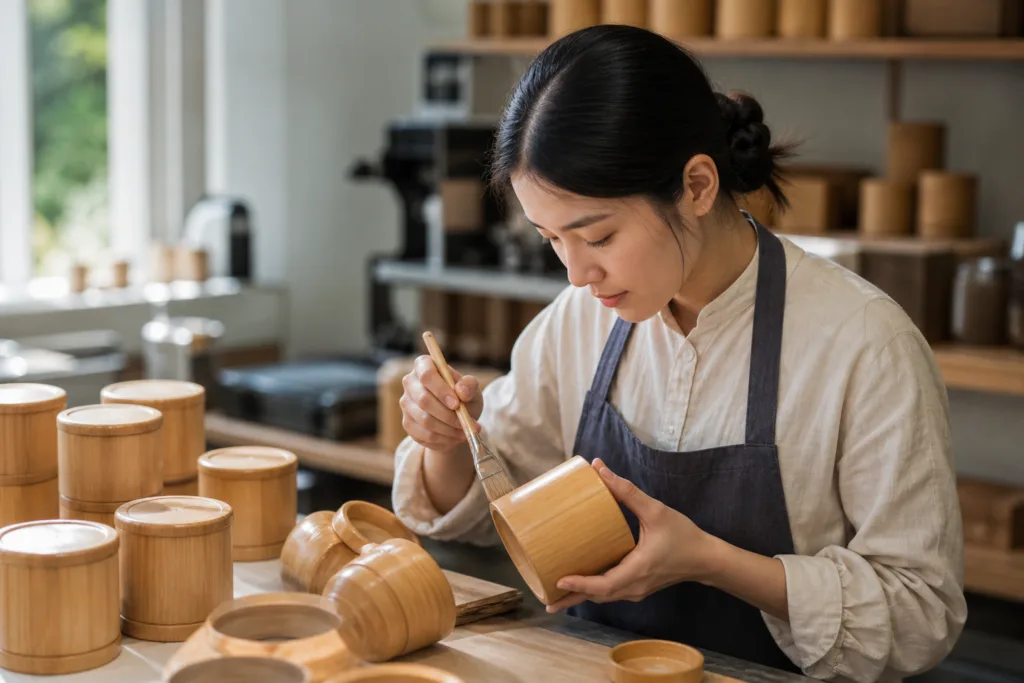
For production planning, it is worth understanding how moisture affects fit and long-term stability. Our moisture control and drying basics article explains why drying and moisture balance matter before cutting, finishing, and assembly. In tea canisters, inadequate moisture control can lead to opening issues, surface movement, or slight deformation that only appears after the product has been packed or shipped into a different climate.
At Bamboo Wood Art, we also monitor how the lid and body interact under shipping vibration and temperature change. A canister that fits beautifully in the sample room can still become troublesome if the wood or bamboo was not conditioned properly before assembly. This is one reason we encourage buyers to review both the sample and the production method rather than approving on appearance alone.
Material and Process Factors That Affect Bamboo Tea Storage Quality
Not all bamboo tea canisters are made with the same material build. Some use solid bamboo components, while others combine bamboo with wood, plywood, or other structural elements. The exact construction affects cost, appearance, stability, and how the product behaves over time.
| Factor | Why It Matters | Buyer Check |
|---|---|---|
| Material selection | Affects weight, stability, appearance, and cost-performance balance | Ask what is bamboo, what is wood, and what is structural versus decorative |
| Drying and conditioning | Controls warping, cracking, and fit changes after shipment | Confirm moisture management before machining and assembly |
| Cutting and shaping | Influences wall uniformity and lid alignment | Review body symmetry and rim accuracy on samples |
| Finishing | Impacts odor, feel, cleanability, and food storage suitability | Check cure time, smell, and finish consistency |
| Assembly | Determines long-term durability and opening experience | Test repeated open-close cycles and inspect joints |
If you are sourcing from a custom manufacturer, you should also clarify whether the canister is intended as a decorative piece, a practical storage product, or both. That question affects how much attention should be placed on structural reinforcement, seal quality, and finish durability. On the Bamboo Wood Art homepage, we often encourage buyers to think in terms of end use first, because the right build for a gift set may differ from the right build for retail refill packaging.
Common Quality Problems in Bamboo Tea Canisters and What They Usually Mean
When a sample fails, the failure usually points to a process issue rather than a random defect. Knowing what a defect means helps buyers ask better questions and avoid repeating the same mistake across future orders.
Typical issues and likely causes
- Loose lid: Often caused by tolerance drift, humidity change, or a design that was not matched to the material movement.
- Sticky opening: May indicate over-tight fit, uneven sanding, or finish buildup in the closure area.
- Strong odor: Often linked to incomplete curing, excessive coating, or materials that were not selected for storage use.
- Uneven color: May come from mixed batches, inconsistent staining, or different absorption rates across bamboo sections.
- Splinters or rough rim: Usually a sanding or edge-finishing issue that can be corrected before bulk production.
Buyers should not assume that one defect disqualifies a supplier. Instead, ask whether the issue is fixable through process adjustment, spec clarification, or better sample control. A reliable factory should be able to explain the root cause, the corrective action, and how future production will be checked. That conversation is often more valuable than simply asking for another sample.
How to Quickly Inspect Samples on Arrival
When samples arrive, do a fast but structured review. A ten-minute inspection can reveal more than a casual look. We recommend keeping the sample process consistent so that each supplier is judged with the same criteria.
A practical arrival checklist
- Check whether the canister stands level on a flat surface.
- Open and close the lid at least five times.
- Smell the inside immediately after opening, then again after a few minutes.
- Run a finger along all edges and the inner rim.
- Look for coating streaks, dust marks, glue traces, or color mismatch.
- Review packaging to see whether the sample was protected as it would be in bulk transit.
Sample inspection should also include a short note on user behavior. Does the lid feel premium, neutral, or frustrating? Would the opening motion work in a shop, cafe, hotel room, or home kitchen? Would the product still feel dependable after a month of daily use? These questions help buyers compare products from a functional angle instead of relying only on visual appeal.
Buyer Checklist: The Questions to Ask a Bamboo Products Manufacturer
Before you approve a bulk order, ask direct questions about manufacturing control. A good supplier should answer clearly and consistently.
- What bamboo or wood structure is used in the canister, and why?
- How is moisture controlled before machining and finishing?
- What finish is applied, and how is odor managed before packing?
- Is the lid designed for tighter storage or easier daily access?
- How are edge sanding and rim tolerances checked during production?
- What happens if the sample and bulk production differ in fit or color?
- How is the product protected during packing and shipping?
For custom development, we also recommend asking whether the supplier can support artwork review, logo placement, sample revisions, and private label packaging. At Bamboo Wood Art, these are standard parts of the conversation for B2B buyers because the final product must match the commercial channel, not just the prototype photo.
Spec Sheet Items That Reduce Sourcing Risk
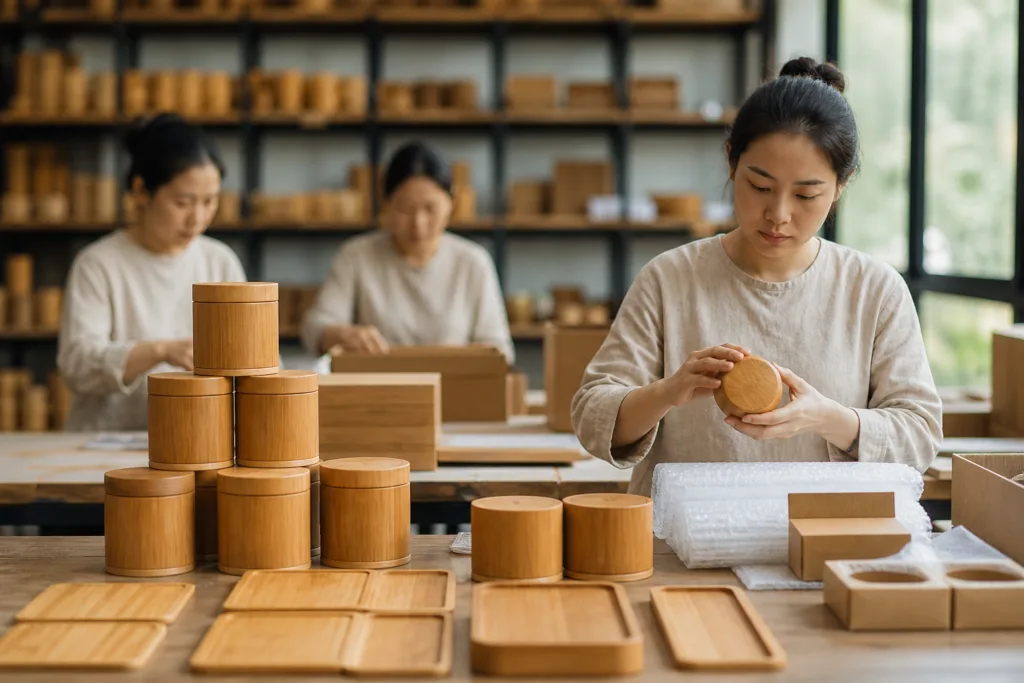
A clear spec sheet prevents misunderstandings, especially when the order includes custom branding or a new closure design. The more measurable the specification, the easier it is to maintain consistency across repeats and replenishment orders.
Key details to include
- Exact dimensions for body, opening, and lid
- Material breakdown and finish type
- Target opening force or fit description
- Logo method such as laser engraving, CNC carving, or print
- Packaging method and shipping protection requirement
- Sample approval standard and acceptable variation range
- Intended application, such as loose leaf tea, matcha, or gift packaging
Buyers sometimes focus only on dimensions and forget the product intent. But a canister for premium tea retail may need a different visual tone than one used in hotel room amenities or office pantry programs. If the use case is unclear, the factory may optimize for the wrong priority, such as appearance over durability or seal force over ease of use.
Final Evaluation Framework: When a Canister Is Truly Ready for Long-Term Use
We consider a bamboo tea canister truly ready for long-term use when it passes four questions. First, does it protect the tea without introducing unwanted odor or surface concerns? Second, does it feel pleasant and dependable after repeated opening and closing? Third, does it remain stable enough to survive shipping, storage, and daily handling? Fourth, can it be reproduced consistently across the full order?
If the answer is yes to all four, you are likely looking at a product that is suitable for repeat business. If one of those answers is weak, the product may still be acceptable for a one-off gift set, but not for a scalable retail or hospitality program. That distinction matters because sourcing success is not just about the sample in front of you. It is about whether the same quality can be made again next season.
For buyers comparing formats across a product line, you may want to review different shapes and storage styles before locking the final spec. Our square bamboo tea canister options, round bamboo tea canister options, loose-leaf tea canister design, matcha powder canister format, and buyer guide to choosing a tea canister can help you match product structure to tea type, user behavior, and price point without over-specifying the build.
FAQ
What is the most important quality sign in a bamboo tea canister?
The most important sign is balanced lid performance. A good canister should open smoothly, close with controlled resistance, and keep that feel after repeated use. If the lid is uneven, too loose, or too tight, the overall product quality is usually compromised even if the exterior looks attractive.
Should a high-quality bamboo tea canister be completely airtight?
Not always. Some buyers need a tighter closure for aroma retention, while others prefer easier daily access. The right standard depends on the tea type, use environment, and customer expectation. What matters most is that the design clearly matches the intended use and performs consistently.
How can buyers check if the finish is suitable for tea storage?
Smell the inside of the sample, inspect whether the finish is fully cured, and confirm that the coating or treatment was selected with food-adjacent use in mind. A tea canister should not carry a strong chemical odor or leave a residue-like feeling. Buyers should also confirm what touches the tea directly, including any adhesive or liner.
What causes bamboo tea canisters to warp or lose fit?
Warping is often linked to moisture imbalance, poor storage conditions, or insufficient conditioning before cutting and assembly. Bamboo is stable when properly prepared, but it can still shift if drying and moisture control are not managed well. This is why sample fit should be checked after the product has settled, not only right after production.
What should be included in a custom tea canister spec sheet?
Include dimensions, material structure, finish type, logo method, packaging requirements, intended tea type, and acceptable variation limits. The more clearly you define the opening feel, surface finish, and packaging standard, the easier it is to control bulk consistency and reduce sourcing disputes later.
How many samples should a B2B buyer review before placing a bulk order?
At minimum, review one approved production sample and one comparison sample if the project is new or technically sensitive. If the canister involves a tighter seal, custom finish, or private label packaging, it is often worth reviewing revisions as well. The goal is to confirm both appearance and repeatable manufacturing behavior before committing to bulk production.