For brands, importers, distributors, and ODM buyers, a bamboo coffee table with glass top is rarely a simple style choice. It is a small furniture program with several commercial decisions hidden inside it: how the frame is built, how the glass is retained, how much movement the bamboo may show in transit or in use, and how much packaging protection the item needs before it reaches retail or hospitality channels.
If your project needs custom bamboo furniture manufacturing and OEM services, Bamboo Wood Art can help turn those decisions into a production-ready specification by reviewing frame structure, material selection, logo placement, sample development, and export packaging before you commit to bulk orders.
Executive summary for buyers
The buying process becomes much easier when procurement teams make three decisions early. First, define the style and market fit: the same table can be positioned as eco-luxury, Scandi, coastal, or hotel-grade depending on the glass, edge profile, and finish. Second, choose the structural approach: the frame must support the glass without creating pressure points or allowing unwanted movement. Third, choose the sourcing model: an OEM program, an ODM adaptation, or a private label run will affect tooling, MOQ, lead time, and quality control expectations.
- Style and market fit: clear glass, low-iron glass, frosted glass, or tinted glass can shift the product from light residential to premium hospitality positioning.
- Structural approach: buyers should decide whether the table uses a recessed ledge, standoffs, silicone bumpers, or a mechanical retention method.
- Sourcing model: the more the design changes from a standard platform, the more attention it needs on sampling, tolerances, packaging, and pre-production sign-off.
Who this product is for and where it sells
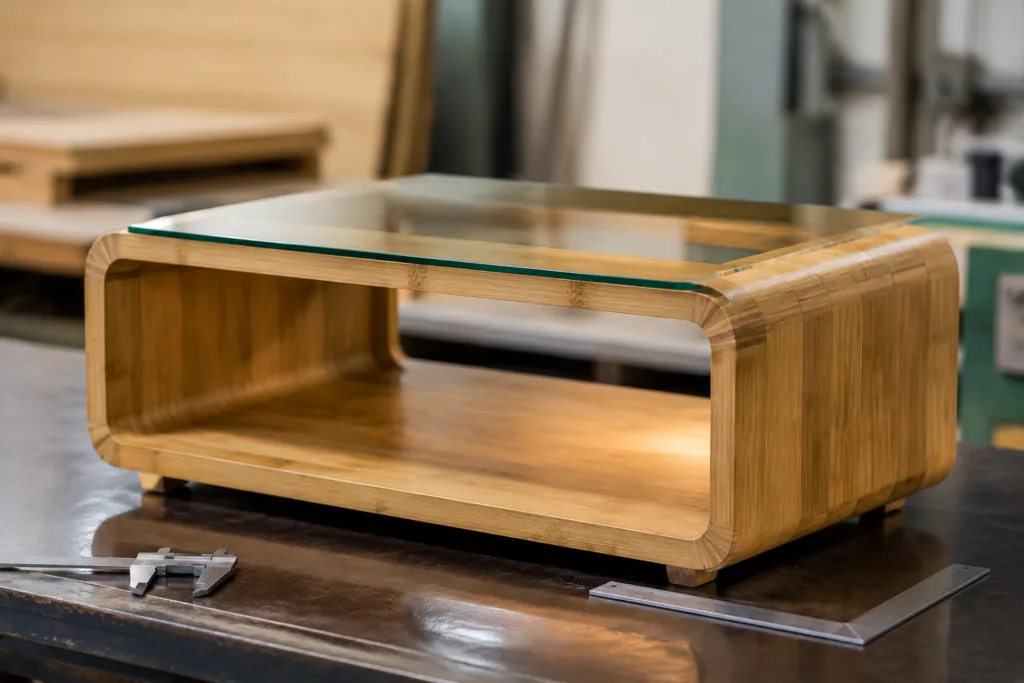
A bamboo coffee table with glass top works best when the target channel values visual lightness, easy styling, and a material story that feels natural but still commercial. For e-commerce home brands, the product often sits in the mid-range category where appearance, packaging, and photo readiness matter as much as raw material cost. For hospitality, the table needs better resistance to vibration, repeated handling, and service replacement of the glass top. For promotional or project buyers, the value may be in custom sizing, branded packaging, and a consistent frame finish rather than a highly decorative structure.
| Buyer type | Typical use | Assembly model | Main durability priority | Commercial focus |
|---|---|---|---|---|
| Home brand | Living room retail SKU | Flat-pack or semi-assembled | Scratch resistance and appearance consistency | Photo appeal and carton efficiency |
| Distributor | Catalog or wholesale program | Assembled or quick-assembly | Stable repeatability across batches | Margin, lead time, and replenishment planning |
| Hospitality buyer | Lounge, suite, or lobby use | Usually assembled | Serviceability and glass replacement | Durability and spare-part availability |
| ODM client | Custom design launch | Depends on concept | Engineering validation before scale-up | Speed to sample and controlled tooling cost |
Typical formats and assembly models
The most common formats are low coffee tables, nesting table sets, and side tables with a glass insert or floating glass panel. Low tables are the easiest to position in a living room line because they balance visual openness with practical surface area. Nesting sets can improve perceived value and give retailers multiple merchandising options, but they require tighter consistency in leg height and frame geometry. Side tables are simpler to ship but can be less forgiving when glass retention is weak, because a smaller footprint gives less margin for error in joint layout.
Design choices that change market fit
Glass clarity, edge profile, and surface treatment
Clear glass gives the most open look and shows the bamboo frame clearly, which is useful when the material story is part of the sell. Low-iron glass improves edge clarity and reduces the green tint that standard glass can show, especially in premium programs. Frosted glass reduces visibility of the frame beneath the top and can hide minor surface variation, while tinted glass creates a more dramatic, hospitality-oriented feel. The edge profile matters as much as the glass color: a polished edge usually feels cleaner and safer for consumer handling, while a beveled edge can make the product look more decorative but may raise cost and scrap sensitivity.
Market positioning by style
Scandi and coastal buyers often prefer lighter finishes, straight forms, and clear glass because the product needs to feel airy. Eco-luxury programs usually ask for more texture control, better sanding, and a richer carbonized or warm-toned finish. Modern hotel projects often lean toward darker tones, slightly thicker glass, and a frame that looks more architectural. In every case, the visual relationship between the glass and the frame should be decided before the first sample, because changing the apparent height, transparency, or edge detail later can alter the entire retail story.
Bamboo frame material choices and implications
Strand-woven, laminated panels, and solid bamboo
| Material option | Strength and stability | Surface consistency | Typical cost trade-off | Best fit |
|---|---|---|---|---|
| Strand-woven bamboo | High density and strong feel | Very consistent look | Usually higher processing cost | Premium programs and robust retail use |
| Laminated bamboo panels | Stable when engineered correctly | Good grain rhythm and clean lines | Balanced cost-performance | Mainstream OEM and ODM furniture |
| Solid bamboo components | Can be attractive but more movement-prone | Natural variation is higher | Lower material cost but more risk | Smaller decorative parts or niche designs |
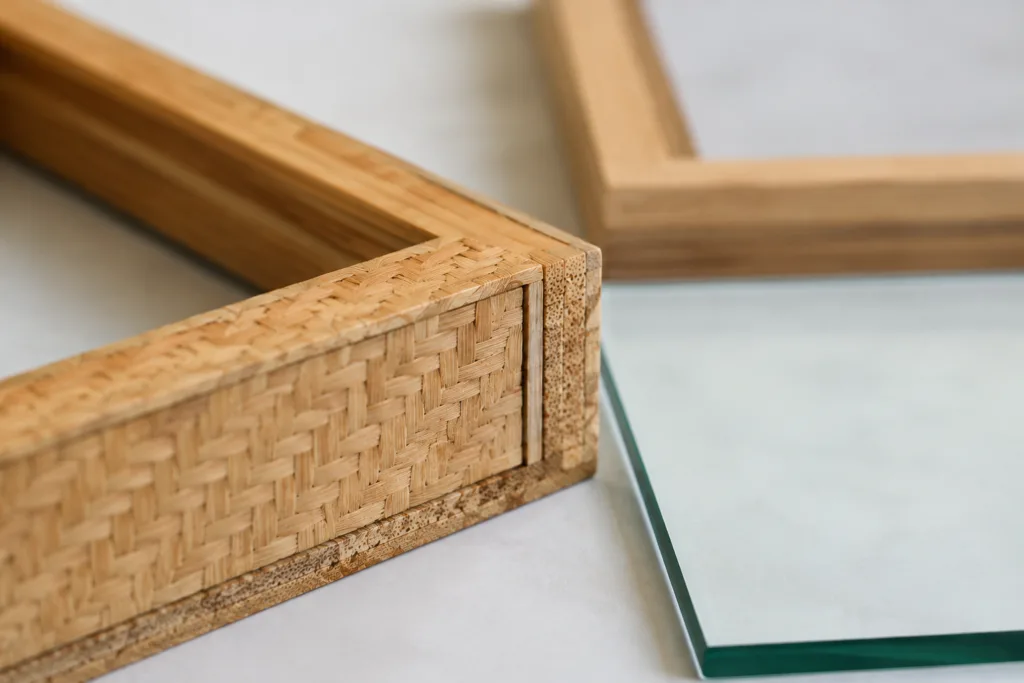
From a manufacturing perspective, laminated bamboo panels are often the most practical starting point for a bamboo coffee table with glass top because they give a good balance of appearance, dimensional stability, and machinability. Strand-woven bamboo can offer a more substantial feel and better resistance to surface wear, but it may need more tooling attention. Solid bamboo can work well for visible accent parts, yet it usually brings more movement risk and greater variation in machining response. Buyers should ask whether the supplier controls moisture content, panel flatness, and edge sealing as part of the normal process, not as an afterthought.
Natural versus carbonized finish
Natural bamboo usually reads lighter and more modern. Carbonized bamboo creates a warmer tone that can help the table sit in a hotel, premium residential, or earth-toned collection. The choice is not only visual. Carbonization changes the color through heat treatment, which can affect consistency across lots if the process is not controlled. For that reason, procurement teams should review master samples under the same lighting used for product photography and retail approval. The same finish can look acceptable in the factory and too dark, too red, or too uneven when it arrives in a warehouse or showroom.
Engineering a bamboo coffee table with glass top
The key engineering question is simple: where does the glass rest, and how does the frame prevent pressure, chatter, or accidental shift? A table can look elegant yet fail in service if the support points are too small, too sharp, or too dependent on adhesive alone. The frame should distribute weight evenly, allow for minor material movement, and keep the glass serviceable if replacement is needed later.
Frame geometry and joinery strategy
Common approaches include a frame with an inset lip, raised standoffs, or a recessed ledge that carries the glass from below. For laminated bamboo panels, mortise-and-tenon style joinery, dowels, or spline reinforcement can improve alignment and reduce racking. If the design uses a metal rail or inserted bracket, the supplier should explain exactly how the frame is reinforced so the glass load is not transferred into weak corners. In practice, buyers should ask for a section drawing that shows the support depth, the clearance gap, and the location of any silicone pads or mechanical stops.
Glass specification and safety
For most commercial programs, tempered safety glass is the first option to evaluate because it is designed to perform better than ordinary annealed glass in breakage events. Laminated glass can also be useful when the design calls for extra retention after breakage, although it usually changes cost, weight, and edge detail. The right thickness depends on the span, support pattern, and intended use. Small side tables can often use lighter glass than wide coffee tables, but the final call should always be tied to the actual frame geometry and the target market. If the product will be sold in regulated markets, buyers should align the specification with recognized safety glazing requirements such as the CPSC safety glazing standard (16 CFR 1201) where relevant to the product category and market.
Glass-to-frame fixing methods
Different retention methods create different trade-offs. Silicone bumpers and adhesive pads are simple and quiet, and they help prevent chatter between the glass and bamboo. Stainless steel standoffs can create a more architectural appearance, but they add visible hardware and require accurate hole placement. Recessed ledges hide the support and often look cleaner, yet they need tight machining tolerances. Clamp systems and mechanical fasteners improve serviceability, but they can reduce the visual lightness that makes this style attractive. We often recommend discussing these choices together with hardware solutions for bamboo frame and glass top assemblies because the best fixing method depends on vibration, differential movement, and whether the end customer must be able to replace the glass on site.
Load, moisture, and durability
Buyers should distinguish between distributed load and point load. A coffee table may hold books, trays, and decor across the surface with little issue, yet a concentrated impact from a dropped object can expose weak support or brittle glass selection. The table also needs to handle seasonal movement in bamboo. Indoor furniture does not live in a perfectly stable environment, so the frame should be designed with enough tolerance for normal humidity swings without creating visible distortion. Good finish systems help slow moisture exchange, but they do not eliminate it. That is why both the bamboo moisture content at manufacture and the packaging environment before shipment matter.
Adhesives, coatings, and compliance considerations
Structural joints should be chosen for the load path, not only for convenience on the line. Waterproof PVA, polyurethane, and epoxy each have different advantages, and the supplier should explain where each adhesive is used and why. On the finish side, UV-cured coatings, conversion varnish, and hardwax oils can all work, but the buyer should understand the difference between surface feel, scratch behavior, repairability, and cure consistency. If a brand sells into regions with VOC or chemical compliance requirements, it should ask the factory what regional rules are being followed and how finish batches are verified before packing.
Hardware, inserts, and replacement planning
Serviceability matters more than many buyers expect. In a retail or hospitality program, the ability to replace a cracked glass panel or tighten a loose connection can save the product from becoming a write-off. Reinforced threaded inserts, well-chosen screws, and sensible hardware access make a large difference over the life of the item. In our own custom development work, we often review the frame, the hardware map, and the assembly order at the same time so the structure can be produced repeatably and serviced later if needed. If you want to see how that production mindset connects to broader custom programs, Bamboo Wood Art can support the process from sample to bulk order.
Spare parts and replacement strategy
For hospitality buyers, the practical question is not whether a table can survive forever. It is whether the glass, bumpers, pads, and fasteners can be replaced without replacing the whole unit. A clean spare-parts plan also helps distributors and retailers reduce after-sales friction. If the supplier can supply replacement glass, extra pads, and a simple installation guide, the program is easier to support once it leaves the warehouse.
Manufacturing process and critical control points
Cutting, machining, gluing, and curing
The manufacturing flow usually starts with panel preparation, then CNC or routing operations for ledges, recesses, and joinery points. After that, the frame is assembled, clamped, and cured before sanding and finishing. The order matters. If the support ledge is machined too late or too shallow, the glass can sit unevenly. If sanding happens before the joints are fully stabilized, the final finish may reveal glue-line defects or joint movement. If the finish is applied too early, the cure window may not be long enough for the frame to remain dimensionally stable.
Why tolerance control matters
For this product category, tolerance is not an abstract engineering term. A few millimeters can determine whether the glass sits quietly or rocks inside the frame. Buyers should request the expected tolerance on frame width, ledge depth, support height, and diagonal measurement. If the supplier uses a metal insert or reinforcement plate, that detail should also be included in the drawing pack. A factory that can explain its tolerance strategy clearly is usually more reliable than one that only shows a finished sample.
Quality control checklist and inspection protocol
Incoming material checks
- Bamboo moisture content within the supplier’s agreed indoor furniture target
- Panel flatness and visible lamination quality checked before machining
- Glass supplier qualification, thickness verification, and edge finish review
- Hardware, inserts, and pads counted and matched to the approved BOM
In-process and final checks
- Joint glue lines inspected for squeeze-out, gaps, and alignment drift
- Support ledge depth checked against the approved drawing
- Glass fit verified with bumpers or pads installed, not only in dry fit
- Finish film checked for dust, pinholes, color variation, and scratch marks
- Basic load and stability test completed on a sample from the lot
Practical acceptance logic
For a bulk program, the inspection logic should focus on risk points that affect retail returns and transit damage. A perfect-looking frame that scratches easily will still create claims. A smooth glass top that moves in its recess will also create claims. A practical acceptance plan should therefore include both appearance checks and function checks. Buyers can ask the supplier to record the same measurement points on the sample, the pilot run, and the pre-shipment inspection so that variance is visible before the container leaves the factory.
Sampling, prototyping, and approval workflow
We recommend three sample stages for a custom bamboo coffee table with glass top program. The first is a visual prototype to confirm style, proportion, and finish direction. The second is a structural pre-production sample to verify load support, glass fit, and assembly sequence. The third is a shipping-test sample that goes through packaging and handling checks before mass production. That workflow helps a buyer avoid approving a sample that looks right but fails in carton compression or drop handling. It also gives the sourcing team a cleaner approval record if revisions are needed.
- Visual prototype: confirm silhouette, surface tone, edge profile, and brand presentation.
- Structural sample: verify support depth, fastener choice, and serviceability of the glass top.
- Shipping-test sample: review inner protection, carton strength, pallet plan, and handling instructions.
MOQ, lead time, and cost drivers
MOQ and lead time depend heavily on how many parts are custom, how much glass is being sourced, and whether the factory is doing CNC work, lamination, finishing, and packaging in house. Standardized ODM programs can often move faster because the supplier already has a validated structure, but custom sizing, special glass, or a unique finish will raise the setup load. Cost is usually driven by the glass specification, bamboo grade, the amount of machining, the finish cycle count, and whether the packaging is retail-ready or export-only.
| Program tier | Likely spec shape | Cost driver focus | Buyer advantage |
|---|---|---|---|
| Budget | Standard bamboo panels, clear tempered glass, simple ledge support, basic carton | Efficient production and fewer custom parts | Lower entry cost and easier replenishment |
| Mid-range | Better finish control, stronger hardware, branded packaging, more refined edge detail | Balanced material and labor investment | Good retail margin and stronger perceived value |
| Premium | Low-iron or specialty glass, enhanced reinforcement, premium finish, upgraded packaging | Glass, finish cycles, and tighter QC | Higher visual impact and stronger brand positioning |
Packaging and export-ready protection
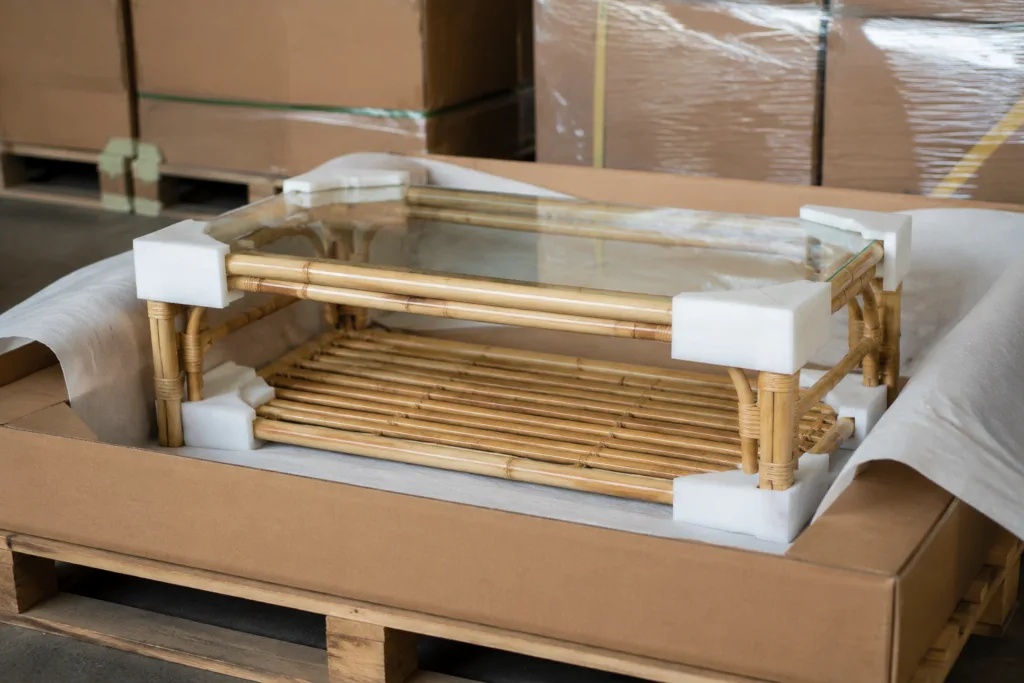
Glass protection should be designed with the frame, carton, and pallet as one system. The supplier must prevent abrasion between the bamboo and the glass, stop vibration movement, and protect corners from impact. For private label programs, packaging also becomes part of the customer experience, so the carton and inserts should still look clean after long-distance transport. We discuss protective packaging solutions for private-label bamboo furniture because most damage claims start with packaging that was designed for the factory floor, not the freight lane.
Freight damage prevention
Practical protection measures include glass film or interleaf, molded foam or corner blocks, frame separation pads, moisture control, and palletization that reduces stacking pressure. In some programs, especially where the glass is large or the route is harsh, an A-frame crate or reinforced carton system can be justified. Buyers should also ask whether the supplier uses silica gel or desiccant where climate swings are expected. Packaging should not just survive the warehouse; it must survive the full route from factory to final delivery point.
Logistics and transit risk mitigation
Transit damage usually appears in a few predictable forms: cracked glass, loose hardware, edge abrasion, frame delamination, and humidity-related swelling or discoloration. Buyers can reduce risk by asking the supplier to show how the carton performs under compression, vibration, and drop handling, even if only through an internal test protocol. Insurance terms and Incoterms also matter because responsibility for breakage can become unclear if the packing specification is not documented. For cross-border programs, we also recommend reviewing international shipping and logistics for bamboo furniture so warehouse teams and freight partners understand the handling logic before the first shipment moves.
Supplier evaluation and RFP checklist
When sourcing a bamboo coffee table with glass top, the supplier questionnaire should be as much about process control as about price. A factory that can explain its bamboo moisture targets, glass sourcing route, adhesive choices, and packaging method is usually giving the buyer a better basis for comparison than a factory that simply quotes a unit price.
- What bamboo material is used, and what moisture content is controlled before machining?
- Is the glass sourced from a qualified supplier, and what safety specification is requested?
- Which adhesive type is used at structural joints, and where is it applied?
- What are the tolerances for ledge depth, frame flatness, and glass fit?
- Can the factory show photos or samples of similar bamboo and glass assemblies?
- Does the supplier handle CNC, lamination, finishing, hardware insertion, and packing in house?
- What testing is performed before mass production and before shipment?
Common failure modes and how to prevent them
The most common failure modes are predictable. Warping often comes from unstable moisture content, poor sealing, or insufficient acclimatization. Glass creep or movement usually means the support points are too shallow, too smooth, or too dependent on adhesive alone. Adhesive delamination can come from poor substrate preparation or the wrong adhesive for the load path. Scratches generally point to weak finishing or packing abrasion. Brittle fracture risk rises when the glass edge is not specified carefully or the support layout creates point stress. The best prevention is to catch these issues in the drawing phase, not after the first shipment.
Recommended starter specs by market tier
| Tier | Starter bamboo spec | Glass spec direction | Hardware level | Finish direction | Why it works |
|---|---|---|---|---|---|
| Budget | Laminated bamboo panels | Standard clear tempered glass | Basic pads and concealed fasteners | Simple protective finish | Good entry price and practical retail availability |
| Mid-range | Better-selected laminated bamboo or strand-woven parts | Clear or low-iron tempered glass | Reinforced inserts and better pad system | Refined sanded finish with stronger surface protection | Balanced margin and stronger brand presentation |
| Premium | Strand-woven bamboo with tighter control | Low-iron or specialty safety glass | Upgraded reinforcement and serviceable retention | Premium color control and cleaner edge treatment | Highest perceived value and best showroom impact |
Contract, warranty, and post-sale support
Contracts should define what happens if the glass breaks versus what happens if the bamboo frame fails. Those are different failure categories and often require different support paths. Buyers should also confirm whether replacement glass can be supplied separately, whether spare bumpers and pads are included, and whether assembly or care instructions are branded for the end channel. For hospitality programs, a simple spare-parts pack can save significant time when one unit needs service during operations.
Two-week onboarding plan for buyers
- Days 1-2: confirm style direction, target channel, and assembly model.
- Days 3-4: freeze the frame concept, glass type, and support method.
- Days 5-6: request a visual sample and review tolerance questions.
- Days 7-8: evaluate packaging, labeling, and replacement-part planning.
- Days 9-10: approve the structural sample and document any changes.
- Days 11-14: schedule pilot production, inspection timing, and shipment planning.
Conclusion
A bamboo coffee table with glass top can be a strong commercial product when the design is engineered as a system rather than as a decorative frame with a sheet of glass on top. The best results come from early decisions on style, load path, safety glazing, packaging, and supply chain control. If those decisions are written into the spec, procurement teams can compare suppliers more clearly, reduce revision cycles, and protect the product from avoidable claims after launch.
FAQs
Which glass type is safest for a bamboo coffee table with glass top?
For most branded furniture programs, tempered safety glass is the first option to evaluate because it is designed to perform better than ordinary annealed glass in breakage events. Laminated glass can also be useful when the design calls for extra retention after breakage, although it usually changes cost, weight, and edge detail. The right choice should match the frame geometry, support points, target market, and any relevant safety requirements.
Which bamboo construction is best for stability and cost?
Laminated bamboo panels are often the most practical starting point because they balance appearance, machinability, and dimensional stability. Strand-woven bamboo can offer a more substantial premium feel and better surface wear resistance, while solid bamboo parts can be attractive but usually bring more movement risk. The best option depends on the market tier, the amount of machining, and how much variation the buyer can accept.
How should buyers specify glass-to-frame fixing to prevent movement?
Buyers should specify the retention method in the drawing pack, not only in the sample approval. Silicone bumpers, recessed ledges, stainless standoffs, or mechanical fasteners each solve different problems. The spec should show support depth, clearance gap, serviceability, and any pads or stops that keep the glass stable without creating hard pressure points.
What QC checks matter before bulk production?
Important checks include bamboo moisture content, panel flatness, joint quality, ledge depth, glass fit, finish film, and a basic load or stability test on sample units. The inspection plan should also confirm that the packaging protects the glass and frame together, because a product that passes visual inspection can still fail in transit if the carton design is weak.
What MOQ and lead time should buyers expect?
MOQ and lead time vary by how much of the design is custom. Standardized ODM programs usually move faster, while custom sizing, specialty glass, custom hardware, and retail-ready packaging raise the setup load. A buyer should expect sampling first, then pilot approval, then production planning, with more time needed if the glass or finish must be sourced or validated separately.
How should packaging protect glass during export?
Packaging should control abrasion, vibration, corner impact, and moisture. Practical protection often includes glass film or interleaf, foam corners, frame separation pads, palletization, and desiccant where climate swings are expected. For larger or more fragile programs, a stronger crate or reinforced carton can be justified if the route is long or the handling environment is difficult.