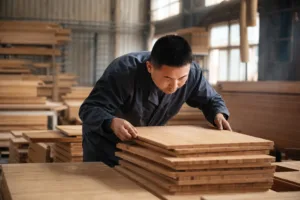
When retail buyers source wholesale bamboo cutting boards, the real job is not simply finding a low unit price. It is validating whether the boards will stay consistent across batches, arrive ready for shelf or online fulfillment, and sell through without generating avoidable returns. A sample can look excellent and still hide issues in thickness tolerance, moisture control, packaging, barcode placement, or pallet damage risk once production scales. That is why a retail buyer checklist should focus on manufacturing consistency, pack-out readiness, and order controls before the purchase order is approved.
bamboo cutting board manufacturing capabilities matter when you are comparing suppliers, because retail programs depend on repeatable production, not just a pretty prototype. At Bamboo Wood Art, we support OEM and bulk programs with material selection, surface finishing, custom sizing, packaging planning, and QC checkpoints that help buyers move from sample approval to stable replenishment with less risk.
Why wholesale bamboo cutting boards need a different buying checklist
Consumer-grade buying decisions often focus on appearance and a single use case. Wholesale buying is different. Retailers need a board that can be stocked in multiples, labeled consistently, packed efficiently, displayed cleanly, and shipped without a high damage rate. The board itself is only part of the order; the packaging, barcodes, carton structure, and assortment logic are just as important.
For wholesale bamboo cutting boards, the main question is not “Does this sample look good?” but “Can this specification be repeated at scale with acceptable tolerance and low return risk?” That question affects everything from lamination quality to ink or laser marking placement, from moisture balance to retail shelf appeal. Buyers who only review the product photo or the first sample often miss the production variables that show up later in the season.
The risks retail buyers overlook most often
- Sample bias: the first sample may be hand-selected, while bulk production uses broader material lots.
- Unclear tolerances: a board that is “about” 0.75 inch thick may not work for planogram, packaging, or display requirements.
- Poor packaging fit: oversized cartons or weak inner protection increase transit damage.
- Barcode and label errors: retail packaging may be rejected if symbols are low contrast, poorly placed, or scuffed in transit.
- Moisture inconsistency: too much or too little moisture can raise the risk of warping after warehouse storage or container shipment.
Why a perfect sample does not guarantee stable mass production
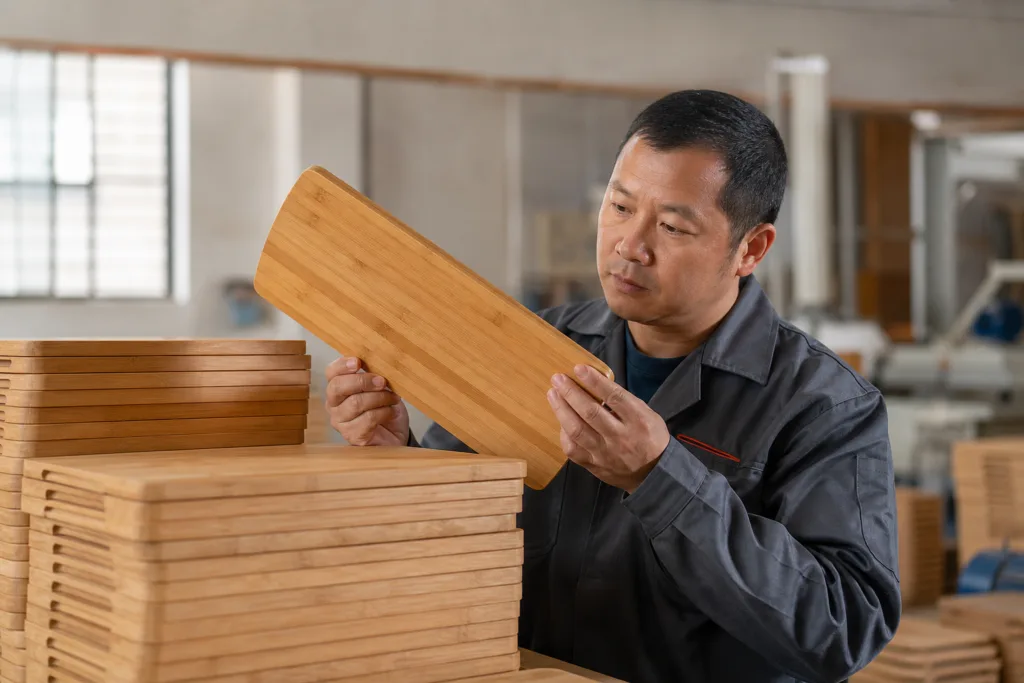
A perfect sample often reflects careful hand selection and extra finishing time. Bulk production, by contrast, must rely on repeatable material input, consistent tooling, and process controls. That means retail buyers need to ask what changed between the sample stage and the bulk stage. Did the supplier switch lamination pattern, board thickness, or finishing method? Did they confirm the same bamboo blank grade? Are the same sanding standards and packaging inserts being used?
This is also where comparison sourcing becomes important. In many programs, buyers evaluate several material options before locking the line. For example, some retailers compare bamboo boards with hardwood alternatives such as acacia or maple to understand surface feel, hardness, visual character, and relative maintenance behavior. If your assortment includes different materials, a side-by-side material review helps align margin goals with customer expectations. A useful starting point is this material comparison for retail buying decisions.
We also advise buyers to compare material hardness and wear behavior when they are building a family of kitchen products. A board that will be used for light prep or serving can have a different specification than a board intended for heavy knife use. The right choice depends on the retailer’s positioning, not just on what looks premium in a photo. A broader wood hardness and durability comparison can help buyers align durability expectations with category price point.
How to evaluate bamboo board consistency before you place the bulk order
Consistency is the core retail issue. A board line can look attractive and still produce complaints if the size varies too much, the edges feel rough, or the lamination shows uneven color shift from batch to batch. Retail buyers should inspect more than one sample and, if possible, review pre-production or early production units against an agreed specification sheet.
Thickness, flatness, and edge finishing
Thickness affects packaging fit, stacking presentation, and perceived value. Flatness matters for shelf display and consumer confidence. Edge finishing matters because rough edges create handling complaints even when the board functions correctly. Ask the supplier how they control thickness tolerance, what sanding sequence is used, and how they check for cupping or bowing before packing.
For retail-ready products, edge treatment should feel intentionally finished rather than simply machine-cut. Rounded or softened edges can improve hand feel and reduce the chance of corner damage in shipping. If your buyer program expects a specific board profile, lock that profile into the drawing rather than describing it verbally.
Color, grain, and batch-to-batch variation
Bamboo is a natural material, so slight variation is normal. What retail buyers need to manage is not eliminating variation completely, but keeping it within a range that matches the brand story and shelf presentation. Too much contrast between boards can make a set look inconsistent in store or on an ecommerce page. Too little variation can be difficult to maintain if the supplier is switching raw material lots without a controlled grading method.
When finish color is important, ask whether the product line uses natural bamboo, carbonized bamboo, or another finish treatment. Finish choice can change the look, tone, and even the moisture behavior of the board. If your assortment includes a darker tone, this finish selection for kitchen product lines can be useful when planning retail presentation and SKU consistency.
Moisture control and dimensional stability
Moisture control is one of the most important but least visible quality points. Boards that are too wet may shrink after arrival; boards that are too dry may absorb ambient moisture later and move out of flatness. For shipment across climates, the issue becomes even more important. Ask the supplier how moisture is monitored during production, storage, and packing, and whether they maintain batch-level consistency.
Wood and bamboo materials respond to humidity changes, so a well-made board still needs proper conditioning before export. In our manufacturing process, we treat moisture consistency as a production control, not a finishing afterthought. The relationship between moisture content and warping risk is well explained in wood moisture content and warping risk in bamboo board production, and it is one reason buyers should request moisture-related controls before approving a bulk order.
How to plan the right size mix and SKU structure
Retail buyers often lose sell-through momentum when the SKU mix is too narrow or too broad. A narrow assortment may not cover common shopper needs, while an overly broad assortment creates slow-moving inventory and packaging complexity. The right SKU structure depends on whether the boards are being sold as singles, sets, or tiered size families.
Think about the merchandising job first. A smaller board may work well for bar prep, cheese, or gift sets, while a larger board may anchor a kitchen prep assortment. If you are building a line for big-box retail, ecommerce, or promotional resale, size structure should map to shelf space, carton efficiency, and price ladder. Buyers should request a size chart, master carton counts, and inner pack structure before confirming assortment.
For custom retail programs, we often help buyers define size families, handle-hole options, juice grooves, logo locations, and packaging layouts together so the whole line works as one system. If your board program requires custom dimensions or branded pack-out, this overview of custom sizing, engraving, and packaging options shows how specification choices affect retail readiness.
Packaging checks that affect shelf appeal and transit performance
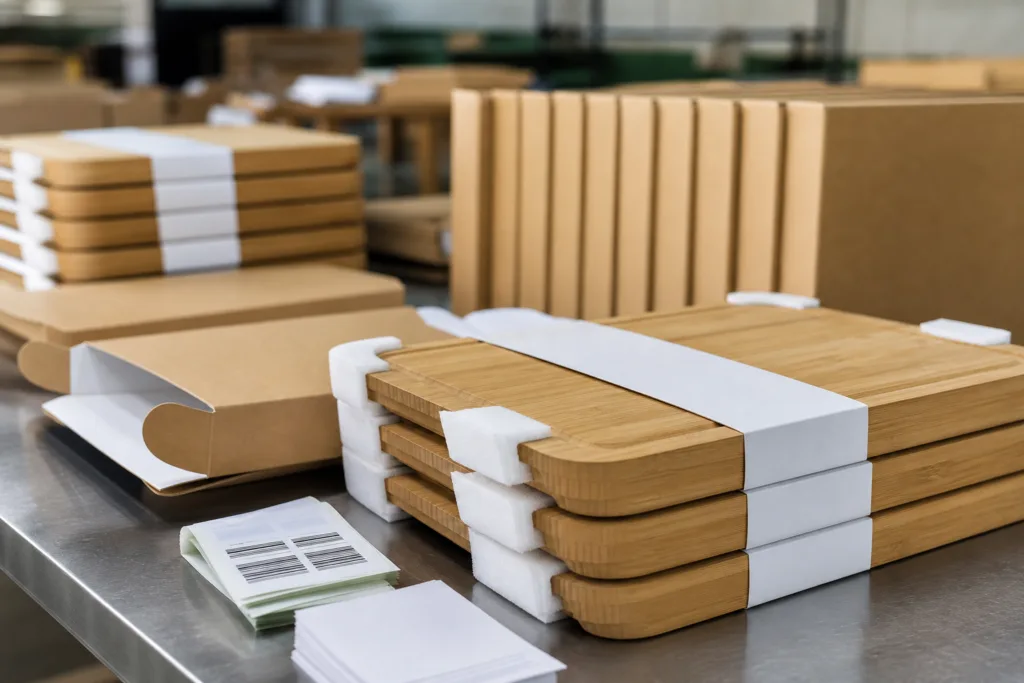
Packaging is where many wholesale bamboo cutting boards programs succeed or fail. A board can be structurally sound and still underperform if the pack looks inconsistent, the barcode is hard to scan, or the carton arrives dented. Packaging should support three goals at once: retail presentation, shipping protection, and operational speed.
Retail-ready packaging checklist
- Barcode readability: confirm symbol size, contrast, placement, and quiet zone requirements for each SKU.
- Label consistency: check that SKU name, size, and variant information match the buyer’s item file.
- Display convenience: if the product will be shelf-ready, verify hang tabs, window placement, or straight-shelf orientation.
- Protection: ensure the board is protected from scuffs, corner dents, and friction marks during transit.
- Carton efficiency: review master carton dimensions, unit count, and pallet build to reduce cube waste.
Barcode quality is often treated as a logistics detail, but for retail buyers it is a product acceptance issue. If a barcode is smeared, low contrast, or too close to an edge, it can slow receiving and create avoidable replenishment problems. A practical reference for this is barcode quality and retail-ready packaging checks for wholesale orders, which is especially helpful when finalizing pack labels and case marks.
Packaging materials and insert decisions
Packaging inserts should protect without over-engineering the pack. Too little protection risks surface scratches and breakage at corners or handles. Too much packaging raises cost and can weaken retail appeal. The right balance depends on board size, finish, and route-to-market. Ecommerce shipment usually needs more internal protection than palletized wholesale store delivery. Private label retail also needs cleaner graphics, tighter color control, and consistent label placement.
When product and packaging are tied together, buyers should ask whether the supplier can manage both the manufacturing and the private label pack-out sequence. At Bamboo Wood Art, we plan product structure, finishing, and packaging in one workflow so the board, carton, and label are aligned before mass production starts.
What warping, cracking, glue-line issues, and color variation mean for sell-through
Retail returns are expensive because the cost is not just the replacement unit. There is also reverse logistics, customer service time, and possible loss of shelf confidence. Minor cosmetic variation may be acceptable in a natural material line, but visible defects or instability often show up quickly in ratings and reorder reluctance.
How to read common defect signals
- Warping: suggests a moisture or storage control problem; often linked to conditioning or packaging exposure.
- Cracking: may indicate over-drying, weak lamination, or stress from sudden climate change.
- Glue-line visibility: can be acceptable if controlled, but excessive contrast or uneven lines may look low quality in retail packaging.
- Color variation: may be normal within a natural range, but it should still align with the SKU image and assortment plan.
Some defect types are cosmetic, while others are functional. A buyer should decide in advance what is acceptable for retail sale and what is automatic rejection. This is especially important for bamboo boards because the material can show visual differences from panel to panel even when the board is fully functional. The goal is not to eliminate nature, but to control appearance, structural stability, and customer expectation.
How to assess transport damage risk and carton efficiency
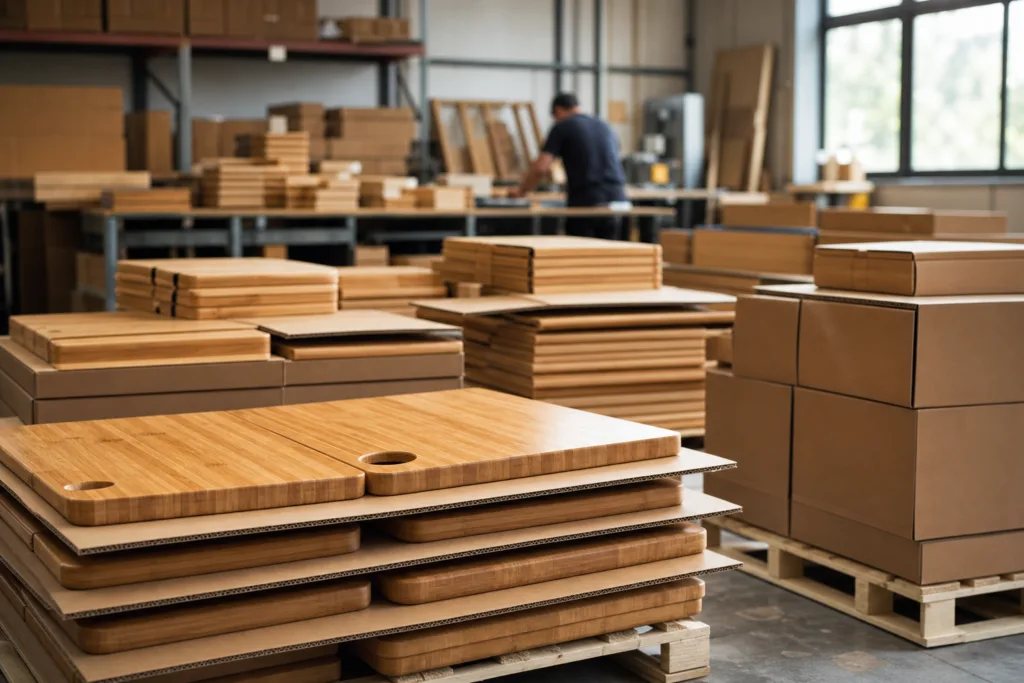
Many wholesale bamboo cutting boards travel long distances before they ever reach a shelf. That makes transport durability part of product design. The board’s own strength matters, but so does carton compression resistance, inner protection, and pallet stability.
Retail buyers should ask whether the supplier has tested the unit pack for corner protection, whether the master carton can withstand stacking pressure, and how many layers are recommended per pallet. If the packaging design is heavy on presentation but weak on structure, you may see damaged edges, loose inserts, or package deformation in transit. That is especially costly for ecommerce assortments where the outer carton becomes part of the customer experience.
Reviewing container loading logic in advance can also reduce risk. A tighter, more efficient pack plan can improve freight economics and reduce movement inside the carton. For seasonal programs, aligning production timing with replenishment windows matters as much as product quality. Buyers planning launches around peak retail periods should review inventory planning for peak-season demand before they commit to their order schedule.
Ten questions retail buyers should confirm before placing the order
Before approving a wholesale bamboo cutting boards purchase order, we recommend asking these questions in writing so the supplier’s responses become part of your specification record.
- What is the exact thickness tolerance for each SKU?
- How is flatness checked before packing?
- What moisture control target is used during production and storage?
- Which finish is used, and does it change the board color or feel?
- Are glue lines, lamination direction, and grain pattern controlled by spec?
- What packaging format will be used for retail and transit protection?
- Can the barcode, SKU label, and retail artwork be printed consistently across the batch?
- What is the approved sample, and what production tolerances are allowed from that sample?
- What is the lead time by SKU and by packaging variant?
- What QC checkpoints occur before shipment, and what is the rework or rejection process?
These questions help buyers separate a responsive supplier from a production-ready supplier. They also make it easier to compare bids on a like-for-like basis instead of comparing only unit price.
How to compare suppliers on sample approval, lead time, and QC capability
When a buyer compares suppliers, the lowest quote is rarely the safest choice. A better evaluation looks at specification clarity, sample reliability, and how the supplier handles change control. If a supplier cannot explain how the sample relates to the production run, the buyer is taking unnecessary risk.
Ask whether the supplier works from a written approval sample, whether they freeze the material standard after approval, and whether production tolerances are documented. Review lead time by component, not just by overall order. For example, if packaging, printing, and product manufacturing happen separately, a delay in one element can affect the entire shipment.
Supplier type matters too. Some buyers prefer a direct factory relationship for tighter control over tolerances, packaging, and repeat orders. Others use a trading model for consolidated purchasing. If you are still deciding how to structure your sourcing, this guide on factory-direct sourcing versus trading company options is useful for evaluating control, communication speed, and order visibility.
What good QC looks like in bulk bamboo board production
Good QC is not just a final inspection. It begins with incoming material checks, continues through machining and sanding, and ends with packing verification. For retail buyers, the ideal supplier can show how defects are detected, how they are sorted, and what happens if a batch falls outside tolerance. That includes visual checks, dimensional checks, finish checks, barcode verification, and carton audit steps.
When a manufacturer can explain these steps clearly, buyers have a better chance of receiving consistent wholesale bamboo cutting boards across seasons and reorders. If the supplier cannot document these controls, even a strong sample may not be enough to justify a bulk commitment.
What should be in a wholesale specification sheet
A good specification sheet reduces ambiguity. It should describe the product, packaging, and acceptance criteria in enough detail that the factory and the buyer are aligned before production starts. For bamboo cutting boards, the spec sheet should be treated as a working control document, not a one-time form.
| Spec Area | What Buyers Should Define | Why It Matters |
|---|---|---|
| Product size | Length, width, thickness, handle or groove dimensions | Supports shelf fit, packaging design, and assortment planning |
| Material | Bamboo type, lamination style, finish type | Affects appearance, stability, and retail positioning |
| Surface finish | Natural, carbonized, oiled, coated, or other treatment | Impacts look, moisture behavior, and customer perception |
| Tolerances | Allowed deviation for size, flatness, and visual variation | Defines acceptance criteria for mass production |
| Packaging | Retail pack, inner protection, carton count, labels, barcode | Improves shelf readiness and transit protection |
| QC standard | Inspection points and defect limits | Reduces rework, returns, and order disputes |
If your program requires sharper branding or a line extension, surface and artwork choices should also be fixed in the spec. Buyers who want logos, gifts, or private-label versions should confirm whether engraving, laser marking, or embossing is appropriate for the finish and target market.
A practical bulk order checklist for retail buyers
Before placing the final order, use a last review that ties product, packaging, logistics, and quality together. This is the point where many costly omissions can still be corrected.
- Confirm the final approved sample and keep it as a reference unit.
- Lock the size chart, thickness tolerance, and finish standard in writing.
- Review barcode artwork, SKU naming, and retail packaging layout.
- Check whether protective inserts are strong enough for the route-to-market.
- Ask for carton dimensions and pallet build estimates.
- Confirm lead time for boards, packaging, and any customized components.
- Request batch QC photos or pre-shipment inspection records when appropriate.
- Verify the supplier’s policy for replacing or reworking out-of-spec items.
When retailers treat the order as a system instead of a single SKU, wholesale bamboo cutting boards perform better in receiving, on shelf, and after delivery. That is where source selection becomes a retail strategy rather than a buying transaction. For buyers who want to verify maker capability, this article on how to verify a bamboo manufacturer is a helpful final screening step.
Conclusion
Wholesale bamboo cutting boards can be a strong retail item when the order is validated correctly. The most reliable buying process checks more than appearance: it confirms consistency, moisture control, finish choice, packaging durability, barcode readiness, and production tolerances. Retail buyers who ask the right questions before issuing the PO are far more likely to receive stable bulk shipments, fewer returns, and stronger sell-through.
At Bamboo Wood Art, we approach wholesale bamboo cutting boards as a manufacturing and retail-readiness project. That means we look at the product, packaging, and replenishment plan together so buyers can move from sample approval to bulk production with clearer control and fewer surprises.
FAQs
What is the biggest risk when ordering wholesale bamboo cutting boards?
The biggest risk is assuming the sample will match mass production without verifying tolerances, moisture control, and packaging. A sample may be carefully selected, but bulk orders depend on repeatable material input and stable QC. Retail buyers should confirm the written specification, approved sample, and packaging structure before they approve production.
How many sizes should a retail cutting board assortment include?
Most retail assortments work better with a size ladder than with a single board size. The right number depends on shelf space, price ladder, and customer use cases. Buyers often start with a compact, a medium, and a larger prep size, then adjust the mix based on merchandising strategy and carton efficiency.
Can bamboo cutting boards be customized with logos and special packaging?
Yes. Many wholesale bamboo cutting boards programs include laser engraving, custom sizing, branded labels, and private-label packaging. The main point is to approve the logo placement, artwork file, and finish compatibility early so the branding stays sharp and consistent in bulk production.
How important is moisture control for bamboo boards?
It is very important because moisture affects flatness, shrinkage, and warping risk. Buyers should ask how the supplier controls moisture during production, storage, and packing, especially if the shipment will travel through different climates. Consistent moisture management improves dimensional stability and lowers the chance of post-arrival issues.
What should retail buyers check in packaging before placing a bulk order?
Retail buyers should check barcode quality, label accuracy, unit protection, carton strength, and shelf presentation. Packaging must support both retail display and shipping durability. If the unit pack looks good but cannot survive stacking or scanning, it will create operational problems later.
How do buyers compare suppliers for wholesale bamboo cutting boards?
Buyers should compare suppliers on sample approval discipline, tolerance control, lead time, QC process, and packaging readiness, not just unit price. A reliable supplier can explain how the sample translates into production and can document the checks used before shipment. That is usually the best signal of a stable bulk program.