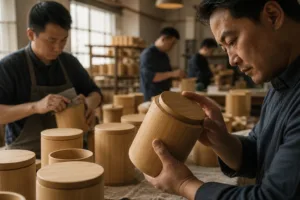
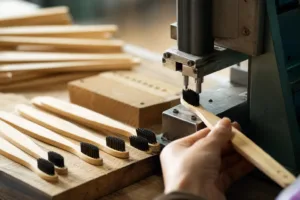
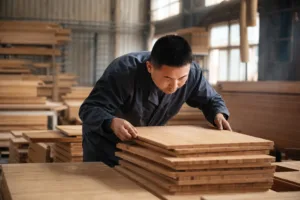
For buyers building kitchenware assortments, the best bamboo cooking utensils are not just the nicest-looking tools on a shelf. They are the sets that balance cooking function, surface quality, packaging appeal, and margin control across retail, gift, and private label channels. From our manufacturing perspective, the right bamboo utensil program starts with the set composition, then moves into shape, finish, food-contact expectations, and the consistency needed for repeat orders.
If your project needs a dependable OEM pathway, our OEM bamboo and wood kitchen utensil manufacturing support can help you align product shape, finish, logo application, and packaging with your channel goals. At Bamboo Wood Art, we work with buyers on material selection, sample approval, and bulk production planning so a spoon, spatula, or tongs set feels coherent as a commercial product rather than a loose collection of tools.
What Makes Bamboo Cooking Utensils a Strong Product Category
Bamboo cooking utensils remain attractive to buyers because they sit in a useful middle ground: they feel natural, they are generally lighter than many hardwood tools, and they can be produced in shapes that suit everyday cooking. For retailers, they also offer strong shelf readability. A matched utensil set in a kraft sleeve, printed box, or hanging package communicates value quickly.
For gift brands and private label developers, bamboo kitchenware is appealing because the category supports many entry points. A simple spatula-and-spoon pair can work for seasonal gifting, while a five- or six-piece set can support a more premium presentation. If the product is sourced correctly, bamboo can also carry a clean visual story without requiring heavy decoration. That said, buyers should not assume all bamboo utensils are equal. Tool thickness, sanding quality, finish behavior, and packaging protection can change the user experience significantly.
We often advise buyers to evaluate bamboo utensil lines the same way they would any functional kitchen tool: start with use case, define the set structure, then test how the product feels in hand, how it looks in packaging, and how well it holds up in repeated handling.
Who This Guide Is For
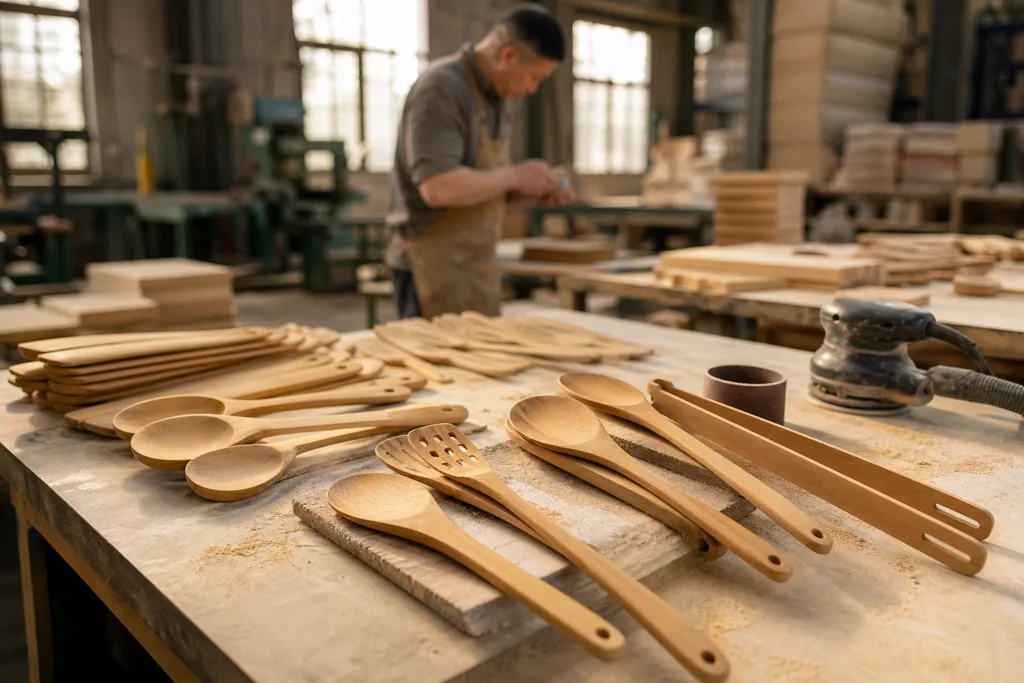
This guide is written for buyers who source bamboo kitchenware in volume or develop private label lines. That includes retail buyers, kitchenware brands, gift companies, promotional distributors, ecommerce sellers, wholesalers, and procurement teams serving hospitality or office use. The buying questions are usually similar even when channels differ: Which pieces belong in the set? What shapes work best? Should the finish be raw, oiled, or coated? How much can be customized without increasing risk?
Channel expectations do vary. Retail programs often need stronger shelf appeal and clearer packaging hierarchy. Gift sets need presentation value and a polished first impression. Private label programs often need logo placement, color coordination, and a repeatable production standard. The most reliable sourcing process is the one that connects all of those requirements before the first sample is approved.
When buyers compare suppliers, we recommend looking beyond the phrase Bamboo Wood Art on a website and instead evaluating the actual manufacturing support behind the offer: tooling ability, finish control, packaging flexibility, and batch consistency. Those are the factors that protect your margin later.
What Buyers Usually Mean by the Best Bamboo Cooking Utensils
In sourcing language, “best” rarely means one universal design. It usually means a set that performs well in the intended channel. A buyer serving home cooks may care most about comfort and visual warmth. A retailer may care about ready-to-display packaging and low return risk. A private label brand may care about how easily the product can be branded without looking generic.
From a manufacturing standpoint, the strongest bamboo utensil programs usually share four traits:
- Functional shape that matches real cooking tasks
- Clean finishing without rough edges, splinters, or odor issues
- Consistent presentation across all pieces in the set
- Practical packaging that protects the product and supports the channel
That definition helps buyers avoid a common mistake: choosing a utensil set based only on appearance. A shallow spoon may look elegant but perform poorly for scooping. A thin turner may feel premium but flex too much. The best product is usually the one that balances function, merchandising, and production stability.
Core Utensil Set Combinations and Why They Matter
Most bamboo cooking utensil programs are built from a few core pieces: spatula, spoon, slotted spoon, tongs, turner, and sometimes specialty items such as a pasta server or rice paddle. Set composition should reflect the intended customer, not just the lowest production cost.
| Piece | Primary Use | Buyer Consideration |
|---|---|---|
| Spatula | Stirring, scraping, folding | Blade width, edge shape, and strength |
| Spoon | Serving, mixing, tasting | Bowl depth and handle comfort |
| Slotted spoon | Draining and lifting food | Slot design and structural rigidity |
| Tongs | Gripping and turning | Spring action, tip alignment, and grip feel |
| Turner | Flipping and lifting | Thinness, flex, and edge finish |
| Specialty pieces | Category expansion or gifting | Merchandising value and use frequency |
When building a retail assortment, a two- or three-piece set may be enough for entry price points. Gift and private label lines often benefit from a broader mix, because the set feels more complete and better supports higher perceived value. Still, more pieces also mean more opportunities for inconsistency, so every additional item should justify its place in the program.
For buyers who want adjacent kitchenware items in the same natural-material story, our bamboo product manufacturing capabilities can support matching pieces across utensils, trays, and other bamboo items. That helps brands build a coherent range rather than one isolated SKU.
How to Choose the Right Shapes for Cooking Use Cases
Utensil shape affects both user experience and product safety around cookware. A spatula used for sautéing should slide cleanly under food without feeling flimsy. A spoon used for serving should have enough bowl volume to be useful, but not so much depth that it feels bulky. Tongs need enough opening range for practicality, yet the tips should still align cleanly when closed.
Buyers should think through the actual use scenarios they want to serve:
- Stirring and folding: Slightly curved edges and moderate width help the user move food efficiently.
- Scraping pans and bowls: Smooth leading edges and comfortable handle thickness matter.
- Serving soups or grains: Spoon bowl depth and balance are more important than decorative detail.
- Gripping and turning: Tongs need stable movement and tip control, not just a nice profile.
- Non-stick cookware use: Rounded edges and smooth surfaces reduce the chance of scratching.
For technical buyers, one useful comparison is with bamboo cooking chopsticks. A product such as our heat-resistant bamboo cooking chopsticks shows how handle balance, tip control, and finish quality all influence usability in the kitchen. The same logic applies to spatulas and spoons: shape is not only a visual decision, it is a performance specification.
One practical rule we use in development is to ask whether a shape helps a tool do one job very well, or many jobs adequately. In retail lines, tools that do several jobs adequately often sell well. In premium or chef-oriented sets, a more precise task-driven shape can justify a higher position.
Material Selection Basics: Bamboo, Grain, Density, and Stability
Bamboo is not a single uniform material. Different species, lamination styles, grain directions, and moisture conditions can affect color, density, and long-term shape stability. Buyers often focus on “bamboo” as a category, but production outcomes depend on the details underneath that label.
For utensils, dense and stable stock is important because the product must survive cutting, sanding, handling, shipping, and eventual kitchen use. If the material is too soft, edges may dent too easily. If the moisture content is not controlled properly, the utensil may warp or open at glued joints after packing or export transit. Grain variation is also a visual issue. Natural variation is normal, but if the set pieces look too different from one another, the product can appear inconsistent on shelf.
Sustainability claims should also be used carefully. Bamboo is widely recognized as a fast-growing resource, but that does not automatically make every bamboo product sustainable. The bamboo growth characteristics and sustainability claims described by FAO are a useful reminder that responsible sourcing depends on species, management, and supply-chain traceability, not just the raw material itself.
For buyers, the practical material questions are simple:
- Is the bamboo dense enough for kitchen use?
- Are the pieces stable after drying and machining?
- Does the supplier control color and grain variation within a set?
- Can the factory explain the sourcing and drying process clearly?
Surface Quality Matters More Than Many Buyers Expect
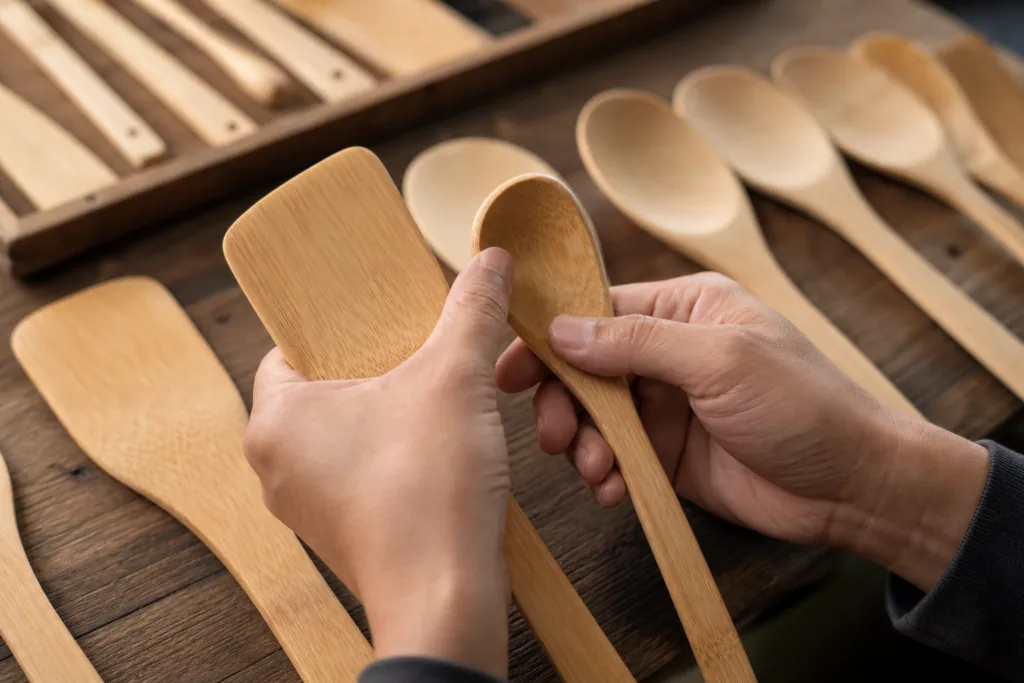
In bamboo utensil sourcing, the surface finish often determines whether a set feels premium or commodity-grade. Buyers may not always identify the issue immediately, but rough sanding, sharp edges, or uneven oiling quickly show up in customer feedback. A utensil that feels smooth in the hand and pleasant against cookware is much more likely to be retained, reviewed positively, and reordered.
Good surface quality usually includes several steps: controlled sanding, edge softening, polishing where needed, and a finish that does not leave a sticky or overly glossy residue. The finish should also avoid creating odor or taste concerns. For food-contact items, buyers should evaluate the product as a functional surface, not as a decorative craft object.
This is where buyers can benefit from regulatory awareness. The FDA guidance on verify coatings, inks, and adhesives for bamboo utensils is especially relevant when a product includes printed decoration, applied coating, or glued components. In private label programs, the finish layer is not only about appearance; it also needs to be appropriate for the way the utensil will be used and cleaned.
From a manufacturing viewpoint, a good finish should meet three conditions:
- Comfortable touch: no splinters, burrs, or rough transitions
- Visual consistency: even sanding and even color absorption
- Practical durability: no premature peeling, cracking, or odor transfer
Food-Safe Expectations and Compliance Considerations
Food-contact expectations vary by market, but the sourcing discipline is similar everywhere. Buyers should ask how the supplier handles material selection, adhesives, inks, coatings, and final inspection. If a utensil has a decorative mark, branded print, or bonded joint, those elements become part of the compliance conversation.
For EU-bound programs, food-contact due diligence is especially important. Kitchen tools should be assessed for migration concerns, odor neutrality, and manufacturing hygiene. In practical terms, that means asking for material declarations, finish details, and process descriptions before final approval. Products should also be evaluated for ease of cleaning, because a utensil with seams, roughness, or hidden residue areas is harder to maintain in real use.
The FDA’s smooth, cleanable, odor-free utensil surfaces guidance is useful here because it reflects what buyers already want from reusable kitchen tools: a finish that is durable enough for normal use, easy to keep clean, and unlikely to transfer unwanted tastes or odors. Even when a market does not require the same exact documentation, the design principle is still valuable.
We recommend that sourcing teams ask for these documents and confirmations early:
- Material specification and component list
- Finish or coating description
- Artwork method and ink or engraving approach
- Cleaning and care guidance intended for the user
- Any testing or compliance documentation relevant to the destination market
Manufacturing Methods: What Changes the Final Result
Bamboo utensils can be produced through cutting, carving, CNC shaping, sanding, laser marking, and finish application. The method chosen affects both cost and final appearance. Buyers sometimes treat these as background manufacturing details, but they directly influence the product they will sell.
For example, CNC shaping can help achieve cleaner repeatability on handles, slot patterns, or curved edges. Laser marking can support branding without thick ink layers. Carving can add a handcrafted feel, though it may increase variation if not controlled well. Simple cutting may be cost-efficient for entry-tier sets, but the product still needs enough sanding and edge finishing to feel polished.
When buyers discuss specifications with us, we try to translate a design into production-friendly instructions: what must be exact, what can vary slightly, and where tolerances should be tightened. That is how we protect both the look and the unit economics of the item.
For custom brand work, our private label customization options usually cover more than logo placement. They can include shape adjustments, finish selection, packaging design, and product mix choices that help a brand express its position clearly.
Function Versus Aesthetics in Retail and Gift Packaging
A bamboo utensil set has to work well, but it also has to sell visually. In retail channels, shoppers often decide quickly based on package clarity. In gift channels, presentation matters even more because the product is being purchased as a ready-made gesture rather than an open-ended utility item.
Premium presentation does not always require expensive materials. Sometimes it comes from proportion, neat printing, and disciplined layout. A simple set can look elevated when the handles align cleanly, the packaging protects the pieces, and the brand story is concise. On the other hand, a busy design or poorly fitted carton can make even a well-made product feel less credible.
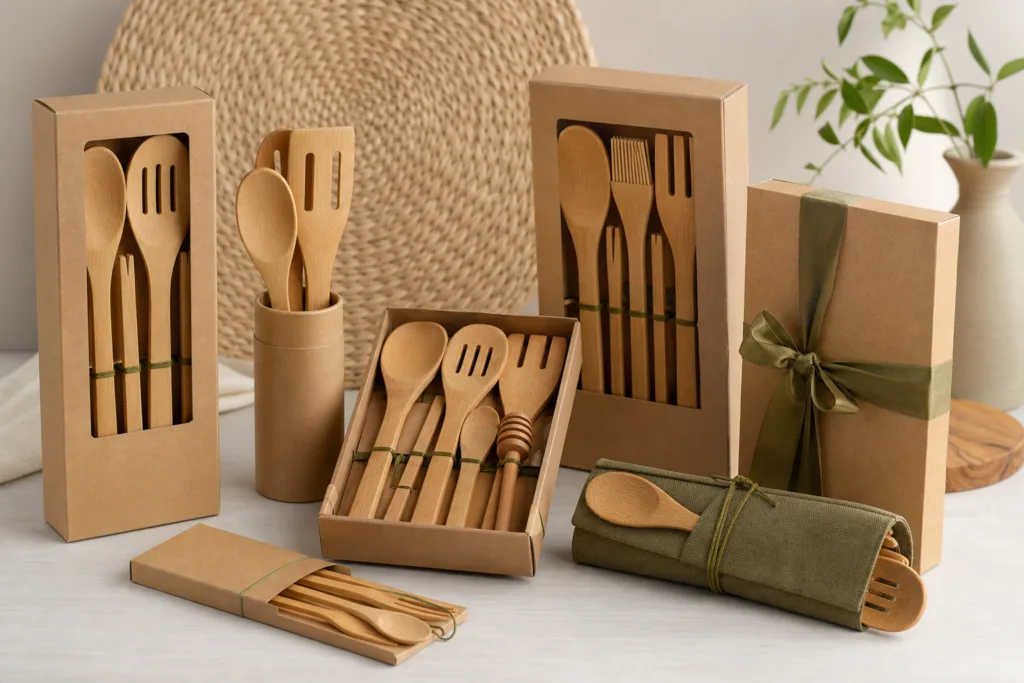
Packaging choices should support both protection and perception. A set that rattles in transit or arrives with surface marks will create avoidable returns. A set that looks tidy in-box, with clear count and easy opening, performs better for retail replenishment and gifting.
Bamboo Utensils for Retail Channels
Retail buyers usually need a clear price ladder. Entry sets should be simple to understand and easy to display. Mid-tier sets can add a second spoon, a slotted piece, or a pair of tongs. Higher tiers can include more specialized shapes, better packaging, or a branded story card.
For shelf appeal, the best bamboo cooking utensils are often those that communicate their use instantly. Buyers do not want customers to guess what the product is for. A visible utensil profile, simple benefits, and a protected package window or printed illustration can all help.
When planning for retail, consider these practical points:
- Will the package hang, stand, or stack?
- Can the barcode and branding be placed clearly?
- Does the count make the offer feel complete at the target price?
- Will the set be easy to replenish without changing the customer experience?
Bamboo Utensils for Gift Sets
Gift buyers usually need presentation first, then function. That does not mean the utensils themselves can be weak; it means the packaging and assortment logic carry more visual weight. A gift-ready set should feel intentional. Pieces should coordinate in size, shape, and finish. The insert card or sleeve should explain the value without too much text.
Seasonal packaging is often effective for gift lines, but it should not lock the brand into a design that becomes unusable outside one holiday window. A flexible, year-round base pack with seasonal sleeves or labels can reduce inventory risk while keeping the product giftable.
For gifting, buyers should also think about unboxing. The first reveal matters. If the product is a bamboo utensil set with a custom logo, the logo placement should be visible but not oversized. If the product is meant to feel eco-conscious, the package should be protective yet restrained, avoiding overdesign that fights the natural-material story.
Private Label Decisions: Logo Placement, Shape Choices, and Brand Positioning
Private label buyers usually want the product to look like it belongs to their brand, not the factory’s catalog. That means logo placement, edge profile, handle thickness, and packaging tone all need to work together. A logo placed too aggressively can make the item look promotional. A logo placed too subtly may disappear in retail photography.
Brand positioning also affects shape choice. A minimalist home brand may prefer thinner silhouettes and neutral packaging. A gift company may prefer a warmer, more decorative presentation. A hospitality or commercial buyer may prefer simpler profiles and robust packing. The right decision depends on how the product will be sold and used.
Private label work benefits from strong communication at the sample stage. Buyers should confirm not only how the item looks, but also how the brand is represented across the set. Handle orientation, logo repeat location, carton color, and insert-copy tone all matter.
How to Reduce Moisture, Warping, and Surface Problems
Bamboo and wood products are sensitive to moisture movement. That is not a defect in the material; it is a production reality that needs to be managed. The main risks in utensil production are warping, cracking, joint opening, and finish irregularity. These issues often become visible after drying, machining, packing, or export transit if the factory has not controlled material conditions well.
Good production starts with properly dried material and continues through machining and storage. If one batch is cut from stock that is still moving, the final product can show curvature or uneven fit. If packed too early, trapped moisture can create later odor or dimensional change. Buyers should ask how the factory stabilizes stock between steps.
Another useful checkpoint is edge design. Thin edges can look elegant, but if they are too fragile they may chip more easily. Rounded transitions and sensible thickness often improve durability without making the tool look heavy.
Packaging Choices That Protect the Product and Improve Value
Packaging is not just a cost line; it is part of the product engineering. The right package reduces transit damage, improves retail presentation, and supports brand positioning. The wrong package can erase the savings from a lower unit price if the product arrives marked, bent, or dusty.
Common packaging formats include hang cards, sleeves, paper boxes, kraft cartons, window boxes, and gift-ready printed sets. Each format has trade-offs. Simple sleeves can be economical and light. Full cartons improve protection. Window packaging can increase shelf visibility but may need tighter alignment and cleaner finishing.
For private label and gift programs, buyers should ask whether the package can support seasonal updates, barcode integration, and insert cards. If the line will be sold online, drop protection becomes even more important. A sturdy yet clean presentation is usually the most cost-effective choice over time.
MOQ, Sample Development, and Lead Time Considerations
Most sourcing problems become expensive only after the buyer skips the sample stage. A good sample should confirm dimensions, finish, branding, packaging fit, and basic usability. For bamboo utensil sets, we recommend checking the sample in the same conditions the final product will face: opened, handled, photographed, packed, and reviewed for consistency.
MOQ and lead time depend on the number of tools, finish complexity, packaging structure, and customization level. A simple unbranded set can often move faster than a fully custom private label pack with unique printing and multiple components. Buyers should plan around artwork approval, sample revision, packaging proofing, and production scheduling rather than assuming a single factory lead time covers everything.
One practical sourcing rule is to separate the specification freeze from the commercial negotiation. If the product is still changing, pricing will keep moving too. If the product is stable, quotes become more reliable.
Quality Control Checklist for Bamboo Utensil Sets
QC should cover more than visual inspection. A usable checklist for bamboo cooking utensils includes dimensions, finish evenness, alignment, odor, splinters, print placement, packaging condition, and batch consistency. If the set includes tongs or assembled pieces, the function of the moving parts also matters.
The following checks are especially useful before shipment:
- Handle thickness and length match the approved sample
- Cut edges are smooth and free of burrs
- Surface finish is even across all pieces
- No abnormal odor is present after packing
- Logo or mark is aligned and legible
- Boxes or sleeves are clean, intact, and correctly labeled
- Mixed-piece sets feel visually balanced in color and grain
We also recommend random pull testing of packaging fit, because products that look fine individually can still rub or shift when packed in volume.
Common Sourcing Mistakes Buyers Should Avoid
One common mistake is over-specifying appearance while under-specifying function. Buyers may ask for a beautiful finish but forget to define handle thickness or spoon depth. Another frequent issue is choosing a set size that looks good in theory but creates packaging or freight inefficiency in practice.
Other avoidable mistakes include:
- Approving a sample without checking final packaging fit
- Ignoring moisture control and storage conditions
- Assuming all bamboo is visually identical
- Using a coated finish without confirming its intended food-contact use
- Comparing suppliers only on price instead of process control
Sometimes the most expensive mistake is a design that seems simple but is hard to reproduce consistently. That is why manufacturability should be part of the design brief from the beginning.
How to Evaluate a Manufacturer Before Placing a Bulk Order
Before committing to a larger order, buyers should evaluate whether the factory understands both product development and channel requirements. A capable supplier should be able to explain material options, production methods, finish choices, packaging protection, and quality checkpoints in clear language.
At Bamboo Wood Art, our process is built around that kind of buyer support. We discuss use case first, then align the structure, surface requirements, artwork, and packing method. That helps reduce revision cycles later and makes the sample phase more meaningful. For buyers, the real value is not just a quote; it is a production path that can be repeated reliably.
If you are comparing sourcing partners, ask questions that reveal depth:
- How do you control sanding and edge consistency?
- What happens if the grain or color varies between batches?
- Can you support custom packaging and private label artwork?
- How do you handle moisture risk during production and storage?
- What QC points are checked before shipment?
Final Buying Framework for Bamboo Cooking Utensils
To source the best bamboo cooking utensils for your channel, start with the use case and work backward. For retail, prioritize clear merchandising, simple set logic, and reliable packaging. For gift programs, focus on presentation and first impression. For private label, make sure the logo, finish, and product mix support the brand story without harming functionality.
As a manufacturer, we recommend a simple decision sequence: define the task the utensil must perform, choose the set structure that fits that task, confirm the finish and packaging standard, and then validate the sample under realistic use. When that sequence is followed, bamboo utensil sourcing becomes much more predictable.
In short, the strongest product is not always the most complex one. It is the one that matches the channel, performs well in kitchen use, and arrives consistently from batch to batch.
Frequently Asked Questions
What should be included in a bamboo cooking utensil set?
Most buyers start with a spatula and spoon, then expand into a slotted spoon, turner, or tongs depending on the channel. The right mix depends on whether the set is for retail, gifting, or private label use. Simpler sets work well for entry price points, while larger sets support higher perceived value if the packaging and finish are equally strong.
Are bamboo utensils suitable for non-stick cookware?
Yes, bamboo utensils are commonly chosen for non-stick cookware because they are less likely to scratch delicate coatings than harder tools. The important point is not just the material but the surface quality. Smooth edges, stable shaping, and clean finishing help the utensil perform safely and comfortably in daily use.
How do I judge the finish quality of bamboo utensils?
Look for smooth sanding, rounded edges, no splinters, and a finish that feels clean rather than sticky or overly glossy. The utensil should also be free of abnormal odor. For B2B buyers, finish quality should be checked across multiple samples, not just one perfect piece, because batch consistency matters in volume programs.
Can bamboo cooking utensils be customized with a logo?
Yes. Bamboo utensils can often be customized with laser marking, engraving, or printed branding depending on the design and budget. The best option depends on how visible you want the logo to be, how premium you want the product to feel, and what packaging style the brand uses. It is important to approve artwork placement on an actual sample.
What is the main sourcing risk with bamboo utensil sets?
The biggest risks are inconsistent surface quality, moisture-related warping, and packaging that does not protect the set during shipping. Some buyers also overlook compliance questions around coatings, inks, and adhesives. A careful sample review and clear production specification reduce those risks significantly.
How should I think about MOQ and lead time for private label orders?
MOQ and lead time depend on the number of pieces, customization level, packaging complexity, and whether the design is standard or custom. Private label orders usually require time for artwork, sample approval, and packaging proofing before production begins. Buyers should build in enough time for revisions so the final product matches the approved sample.