For manufacturers, category managers, and content teams, the challenge is not simply ranking one page for a useful phrase. The bigger task is building a content structure where FAQ answers, buying guidance, product pages, and blog articles each do a different job. When the target term is bamboo laptop table FAQ, that distinction matters even more because the keyword sits between product education and buyer decision support. If a manufacturer publishes similar answers across too many pages, search engines may struggle to understand which URL should rank, and buyers may feel they are reading the same material repeatedly.
Readers planning the next sourcing step may want to explore Explore our complete range of bamboo laptop tables and lap desk manufacturing options. It is a useful next step for buyers, retailers, and product teams who want to connect this content strategy discussion with actual product formats, design directions, material options, and manufacturer-level category presentation.
This article takes a manufacturer-aware approach to that problem. Instead of treating every question as a separate article opportunity, it explains how to sort keyword intent properly. The goal is simple: keep FAQ content short and useful, place selection-based questions inside buying guides, reserve blogs for deeper angles, and reduce internal competition across your bamboo laptop table pages.
SERP Analysis Summary for bamboo laptop table FAQ
Dominant Content Types: product pages, marketplace listings, short FAQ-style answers, light buying guides, and some ergonomic blog content related to laptop desks.
Common Formats: compact product descriptions, bullet-based features, short answer sections, comparison points, use-case explanations, and occasional selection guides.
Observed Angles: buyer-friendly, home-use focused, feature-led, and practical. Most pages explain function, foldability, cooling slots, and comfort benefits, but few discuss content architecture from a manufacturer SEO perspective.
Focus Keywords

bamboo laptop table FAQ, bamboo laptop desk guide, bamboo lap desk questions, bamboo laptop table buying guide, laptop table keyword cannibalization
Meta Details for Publishing
Slug: bamboo-laptop-table-faq
Meta Description: bamboo laptop table FAQ strategy for manufacturers: organize FAQs and buying guides to reduce overlap and improve SEO clarity.
Alt Text Image: Professional content planning scene for bamboo laptop table FAQ strategy, showing bamboo laptop desk product pages, FAQ structure, and buying guide mapping.
Outline
| Section Level | Heading / Subheading | Primary Keyword / LSI Keywords | Search Intent |
|---|---|---|---|
| H2 | Introduction: Why Keyword Integration Matters for Manufacturer Sites | bamboo laptop table FAQ, content strategy | informational |
| H2 | Identifying FAQ-worthy Questions for Bamboo Laptop Tables | bamboo laptop table questions | informational |
| H3 | What FAQs are meant to solve | FAQ content purpose | informational |
| H3 | Typical FAQ examples: product use, cleaning, features | bamboo lap desk FAQ | informational |
| H4 | Usage questions | how to use bamboo laptop table | scenario-solving |
| H4 | Care questions | clean bamboo laptop table | informational |
| H4 | Feature questions | folding legs, vent slots | informational |
| H3 | Criteria for FAQ selection: relevance, repetition risk, user expectations | FAQ keyword selection | informational |
| H4 | High-frequency questions only | common user questions | informational |
| H4 | Avoiding duplicated intent | keyword overlap | informational |
| H2 | bamboo laptop table FAQ | bamboo laptop table FAQ | informational |
| H3 | What belongs inside the FAQ block | FAQ answers | informational |
| H3 | What should stay out of the FAQ block | buying guide vs FAQ | informational |
| H2 | Distinguishing Buying Guide Content from FAQs | bamboo laptop table buying guide | commercial investigation |
| H3 | What makes a good buying guide section | buying guide content | decision-making |
| H3 | Pre-purchase and selection-focused questions | how to choose bamboo laptop table | commercial investigation |
| H3 | Examples: best bamboo laptop table, foldable benefits | best bamboo laptop table, foldable lap desk | comparison |
| H4 | Size and stability factors | laptop table dimensions | decision-making |
| H4 | Use-case differences by buyer type | retail and sourcing fit | commercial investigation |
| H2 | Keywords Unfit for Standalone Blog Posts: Why and How to Re-integrate | keyword cannibalization | informational |
| H3 | Overly narrow and basic questions | thin content keywords | informational |
| H3 | Risks of content cannibalization | internal competition SEO | informational |
| H3 | Re-integrating for depth and cohesion | content consolidation | informational |
| H2 | Reducing Internal Keyword Cannibalization: Practical Strategies | reduce keyword cannibalization | informational |
| H3 | Mapping FAQs vs buying guides vs blogs | content mapping | informational |
| H3 | Avoiding repeat coverage across pages | avoid content overlap | informational |
| H4 | Primary keyword assignment | keyword mapping | informational |
| H4 | Intent-based internal linking | SEO internal links | informational |
| H2 | FAQ and Blog Role Separation: Manufacturer Website Best Practices | manufacturer SEO content | informational |
| H3 | FAQ: compact answers to common user queries | FAQ format | informational |
| H3 | Buying guide: decision-support content for buyers | decision support guide | commercial investigation |
| H3 | Blog: deeper explorations only for unique or research-based topics | blog topic boundaries | informational |
| H2 | Manufacturer Content Strategy Recommendations | manufacturer content strategy | informational |
| H3 | Internal linking to core pages | internal linking strategy | informational |
| H3 | Supporting commercial and informational SEO | commercial and informational intent | informational |
| H3 | Keeping content useful and non-promotional | neutral manufacturer content | informational |
| H2 | Conclusion: Building an Effective Bamboo Laptop Table Content Architecture | content architecture bamboo laptop table | informational |
Introduction: Why Keyword Integration Matters for Manufacturer Sites
A manufacturer website does not need the same content structure as a lifestyle blog or a general review site. Product categories such as bamboo laptop tables often include overlapping search terms: FAQ phrases, use-case questions, design comparisons, and buying-intent queries. If those terms are published without a structure, one site may end up with a product page, a blog post, a guide, and an FAQ page all trying to rank for nearly the same intent. That usually weakens topical clarity instead of improving it.
For bamboo and wood product manufacturers, the issue is also commercial. Buyers may arrive with different goals. A retailer may want a fast answer about folding legs. A sourcing manager may want to compare feature sets and packaging fit. A brand owner may want to understand what should live on a category page versus a supporting article. Good keyword integration helps each of those readers find the right depth at the right stage.
Identifying FAQ-worthy Questions for Bamboo Laptop Tables
What FAQs are meant to solve
An FAQ section should answer short, repeated, low-friction questions. These are the questions people ask before or after they understand the product category, but before they need a full buying framework. In most cases, FAQ content works best when the answer can be delivered clearly in a few sentences without needing a full comparison or long explanation.
Typical FAQ examples: product use, cleaning, features
For bamboo laptop tables, the strongest FAQ topics usually relate to practical use and simple care. Examples include:
- Can a bamboo laptop table be used on a bed?
- How do you clean a bamboo laptop table?
- Do bamboo laptop tables fold flat?
- Are vent slots useful for airflow?
- Can a lap desk hold a mouse and laptop together?
- Is bamboo easy to maintain for daily use?
These questions are useful because they are specific, common, and easy to answer without turning the page into a full editorial article.
Criteria for FAQ selection: relevance, repetition risk, user expectations
High-frequency questions only
If a question appears often in customer discussions, sales inquiries, retail listings, or pre-purchase conversations, it may belong in the FAQ section. If it appears only occasionally, it may not justify a permanent FAQ slot.
Avoiding duplicated intent
If the same question requires a selection framework, trade-off explanation, or comparison between product types, it may be too broad for an FAQ. For example, “Which bamboo laptop table is best for home office use?” usually belongs in a buying guide because the answer depends on size, foldability, stability, ventilation, and user habits.
At Bamboo Wood Art, this distinction is useful during content planning because it prevents one product category from accumulating many thin pages that answer nearly identical questions in slightly different words.
bamboo laptop table FAQ
What belongs inside the FAQ block
The term bamboo laptop table FAQ should lead to a practical block of short answers. The content should help users confirm essential facts, remove minor uncertainty, and move forward. Good FAQ content is concise, accurate, and directly tied to common product questions.
It also helps to keep FAQ answers tightly written. Search engines and AI search systems often prefer clean answer formats when the question is simple. That means a manufacturer page can gain more value from one strong FAQ section than from five weak blog posts built around tiny variations of the same question.
What should stay out of the FAQ block
Do not overload the FAQ with category comparisons, long buying advice, or broad editorial themes. Questions such as “What is the best bamboo laptop table?” or “Should I choose adjustable or fixed construction?” usually need context, trade-offs, and buyer segmentation. Those belong in a guide or comparison article, not in a short-answer section.
Where comparison intent is strong, readers may benefit from a dedicated comparison of adjustable and fixed laptop tables. That kind of page supports decision-making better than forcing a long answer into a cramped FAQ format.
Distinguishing Buying Guide Content from FAQs
What makes a good buying guide section
A buying guide should help users choose. It should explain how to evaluate options, what features change the fit, what trade-offs matter, and how the product may suit different scenarios. In this case, a bamboo laptop table buying guide can cover dimensions, folding structures, storage needs, edge comfort, cooling design, and use environment.
The key difference is intent. FAQ content removes small doubts. Buying guide content supports selection.
Pre-purchase and selection-focused questions
Selection-focused questions often begin with phrases like:
- Which size works for a 15-inch or 17-inch laptop?
- Should I choose folding legs or a fixed platform?
- Is a raised ledge useful or restrictive?
- When do vent slots make sense?
- Which features suit gifting, retail, or wholesale bundles?
These are not weak questions. They are simply too decision-heavy for an FAQ block. They need context and often benefit from examples, side-by-side comparisons, or use-case segmentation.
Examples: best bamboo laptop table, foldable benefits
Take the keyword “best bamboo laptop table.” That phrase sounds simple, but it contains layered intent. One buyer may care about portability. Another may care about bed use. Another may need retail-friendly presentation or a design that fits branded packaging. A short FAQ answer cannot do justice to that decision logic.
The same is true for “foldable benefits.” If a buyer only wants to know whether legs fold, that is FAQ material. If the question is whether foldable construction is better than fixed construction for shipping, storage, gifting, or home use, that is buying guide territory.
Size and stability factors
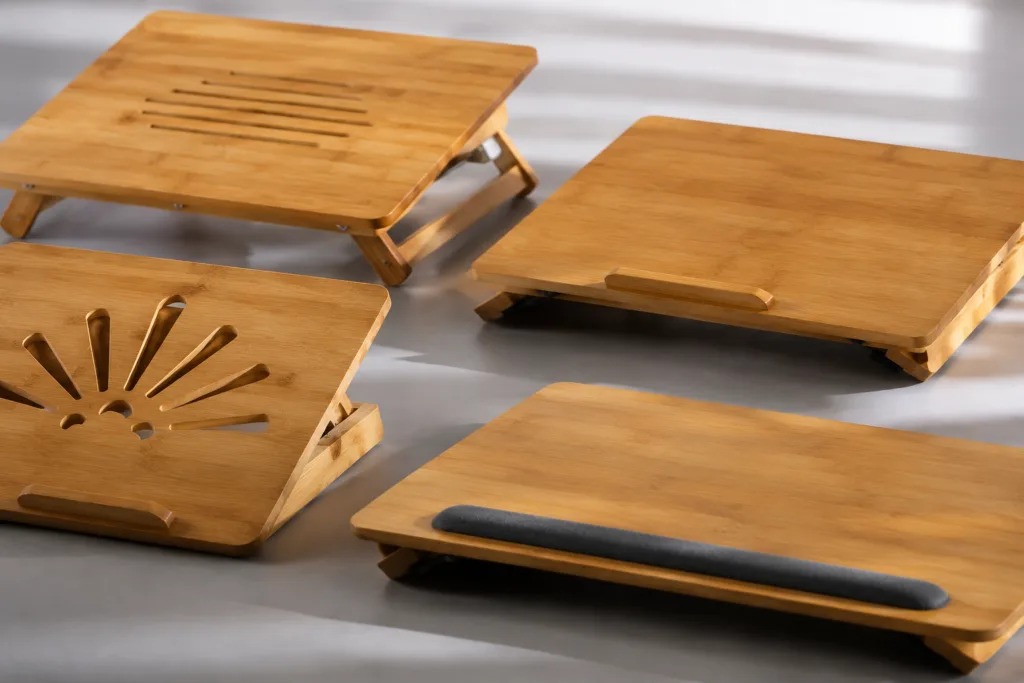
Buying guide sections should explain how product width, leg structure, panel thickness, and edge shape influence usability. This is where a manufacturer perspective is helpful. Feature choices affect not only comfort but also packaging volume, retail presentation, and perceived value.
Use-case differences by buyer type
A home buyer often prioritizes comfort and appearance. A wholesaler may care more about feature consistency across a collection. A brand owner may focus on finish style, accessory combinations, and how the design fits a broader desk or home category. That practical segmentation belongs in a guide, not in a compact FAQ answer.
Keywords Unfit for Standalone Blog Posts: Why and How to Re-integrate
Overly narrow and basic questions
Not every keyword deserves its own article. Phrases such as “can bamboo laptop table fold,” “how to wipe lap desk,” or “does bamboo feel smooth” are usually too narrow to support a strong standalone post. The answer is often short, obvious, and better placed within an FAQ or a product-support section.
When these small keywords are expanded into separate blog posts, the result is usually thin content. Thin content does not just add maintenance work. It also creates confusion about which page should rank for the core product topic.
Risks of content cannibalization
Keyword cannibalization happens when multiple pages on the same site target overlapping intent. A manufacturer might have one category page for bamboo laptop tables, one article about bamboo laptop table FAQ, one post about folding benefits, one post about cleaning bamboo lap desks, and one post about using a laptop table in bed. If each page repeats the same explanations, they start competing with one another.
The risk is not only ranking instability. It also affects user experience. Readers move across pages expecting new insight, but instead find recycled answers.
Re-integrating for depth and cohesion
A stronger approach is to re-absorb narrow topics into larger, higher-value pages. Short care questions can move into the FAQ. Decision questions can move into a buying guide. Unique topics with broader user interest can stay as blog articles. This creates fewer pages, but each page has a clearer purpose and better information density.
Where product specifics matter, it can also help to support guidance with a real example page such as custom bamboo product manufacturing services. That gives readers a practical bridge from content strategy into how manufacturers organize options, customization paths, and category development.
Reducing Internal Keyword Cannibalization: Practical Strategies
Mapping FAQs vs buying guides vs blogs
A simple keyword map often solves most overlap problems. Start by sorting each target phrase into one of three buckets:
- FAQ: short, recurring, answerable in a few lines
- Buying guide: comparison, selection, fit, trade-offs
- Blog: unique exploration, broader context, or deeper theme
Then assign one primary page for each intent. Do not let the same page type repeat the same target unless there is a truly different angle.
Avoiding repeat coverage across pages
Each page should contribute something distinct:
- The product or category page explains the offer and core features.
- The FAQ section answers repeated practical questions.
- The buying guide supports evaluation and filtering.
- The blog explores a separate topic with independent value.
If a point already appears on the category page, the guide should extend it rather than restate it. If the FAQ already answers a care question, the blog should not clone that answer with minor wording changes.
Primary keyword assignment
Assign one main query to one main page. For example, bamboo laptop table FAQ should point to the FAQ-focused article or section. A phrase like “best laptop desk for bed use” should point to a guide. A phrase about neck posture or cooling design might justify a separate blog if the topic expands beyond one product type.
Intent-based internal linking
Internal links should move readers from simple answers to deeper decision content. Someone reading about product use may later want a guide about bedroom or bed-working scenarios. That is why content architecture works best when links reflect user progression rather than random keyword placement.
FAQ and Blog Role Separation: Manufacturer Website Best Practices
FAQ: compact answers to common user queries
A good FAQ section respects reader time. It should be scannable, direct, and easy to extract in search or AI-generated summaries. For manufacturers, this usually means short answers around materials, care, basic features, and use cases.
Buying guide: decision-support content for buyers
Buying guides should be more interpretive. They can explain why one design suits bed use, why another works better for study or sofa use, or how accessories and finish choices influence target markets. This is also the right place to discuss packability, gift presentation, and category fit for retailers or wholesale programs.
Blog: deeper explorations only for unique or research-based topics
Blogs should not exist just to hold leftover keywords. They work best when the topic goes beyond the FAQ and beyond the product selection basics. Examples might include ergonomic setup, cooling design logic, or how laptop elevation affects comfort. If a topic has broader educational value, it can support the cluster without duplicating the category page.
For example, a separate article on posture may complement laptop table content because it addresses a wider comfort issue rather than repeating core product basics. That type of supporting content often strengthens the cluster more effectively than several narrow question posts.
Manufacturer Content Strategy Recommendations
Internal linking to core pages
Internal links should support the commercial structure of the site without turning every article into a sales page. The strongest pattern is usually:
- FAQ article links to the category page
- Buying guide links to relevant product groups or comparison pages
- Blog links to the most relevant decision or category resource
This helps search engines understand hierarchy and helps readers move from curiosity to evaluation in a natural way.
Supporting commercial and informational SEO
Manufacturers often need both. Informational SEO attracts early-stage readers and supports topical authority. Commercial investigation content helps users evaluate whether the category fits their needs. The mistake is mixing both intents on every page in the same proportion. A better strategy is to keep each page clear about its main job while still allowing gentle movement to the next step.
| Page Type | Main Purpose | Best Keyword Style | Recommended Depth |
|---|---|---|---|
| FAQ page or section | Answer repeated practical questions | can, how, is, does | short |
| Buying guide | Help users compare and select | best, choose, which, benefits | medium to deep |
| Blog article | Explore distinct related themes | why, comparison, ergonomic, design | deep if unique |
| Category page | Present product range and core fit | product-intent queries | medium |
Keeping content useful and non-promotional
Neutral, practical content usually performs better over time than exaggerated copy. Buyers want to understand fit, limitations, and trade-offs. They do not need inflated claims. A manufacturer voice is most credible when it explains how content should be organized, how product questions differ from selection questions, and how to reduce confusion across the site.
In practice, that means acknowledging that not all buyers need the same answer. A foldable bamboo laptop table may suit one channel better than another. A slim profile may help storage and presentation, but could involve trade-offs depending on the design. Useful content reflects those conditions instead of forcing one universal conclusion.
Conclusion: Building an Effective Bamboo Laptop Table Content Architecture
The best approach to bamboo laptop table FAQ content is usually not to create more pages, but to create clearer roles. FAQ content should answer repeated, low-complexity questions. Buying guide content should support selection, trade-offs, and buyer fit. Blog content should be reserved for genuinely distinct topics that expand the cluster rather than repeating the basics.
For manufacturers, this structure improves both SEO clarity and user experience. It reduces internal competition, strengthens page purpose, and helps buyers move from simple questions to practical evaluation without friction. A well-planned bamboo laptop table content architecture is easier to manage, easier to scale, and better aligned with how real users search.
Frequently Asked Questions

What is the main purpose of a bamboo laptop table FAQ page?
Its main purpose is to answer common, short, repeated questions about use, care, and basic features without forcing readers to search through longer buying content.
Which bamboo laptop table keywords should go into a buying guide instead of an FAQ?
Keywords that involve choosing between options, comparing designs, or deciding what works best for a certain use case usually fit better in a buying guide than in an FAQ.
Why does keyword cannibalization happen on manufacturer websites?
It usually happens when several pages target nearly the same search intent, such as a category page, blog, and FAQ all covering the same questions with only small wording differences.
Should every bamboo laptop table question become its own blog post?
No, because many narrow questions are too small to support a useful standalone article and are often stronger when combined into an FAQ or a broader guide.
How can manufacturers separate FAQ, buying guide, and blog roles clearly?
They can separate them by intent: FAQs answer quick practical questions, buying guides help readers choose, and blogs cover deeper or more unique topics that add fresh value.
What is the best internal linking approach for this type of content?
The best approach is usually to link short-answer content to core category pages and deeper guide content, so readers can move naturally from basic questions to product evaluation.