Why Material Selection Matters for Private Label Bamboo Toothbrushes
In the best bamboo toothbrush category, product success usually depends less on the word “bamboo” itself and more on the details behind it. For private label buyers, the difference between an average item and a strong retail-ready range often comes down to handle material, bristle choice, finish quality, packaging logic, and how well each part fits the target market. A toothbrush may look simple, but it is still a configured product with clear trade-offs in feel, function, cost, and brand story.
For manufacturers looking to source custom bamboo toothbrushes, see our detailed bamboo toothbrushes manufacturer overview. Readers planning the next sourcing step may want to explore that page because it gives a more focused view of range direction, customization possibilities, and manufacturer-side considerations that sit behind the decisions covered in this guide.
Natural oral care remains attractive because it gives brands a visible, everyday-use product that can express a lower-plastic or more natural positioning. But in many markets, basic bamboo toothbrushes are no longer enough on their own. Brand owners now need clearer differentiation. That may come through a smoother handle profile, child-friendly grip shape, distinct bristle color system, better retail packaging, or accessories that improve travel, gifting, or hospitality use.
This guide is written from a manufacturer-aware perspective for sourcing teams, importers, wholesalers, and brand owners comparing options before sampling. The goal is practical: help you judge which configurations are more likely to support your brand, channel, and price point, while avoiding weak assumptions that often appear in surface-level product comparisons.
Understanding the Core Components of a Bamboo Toothbrush
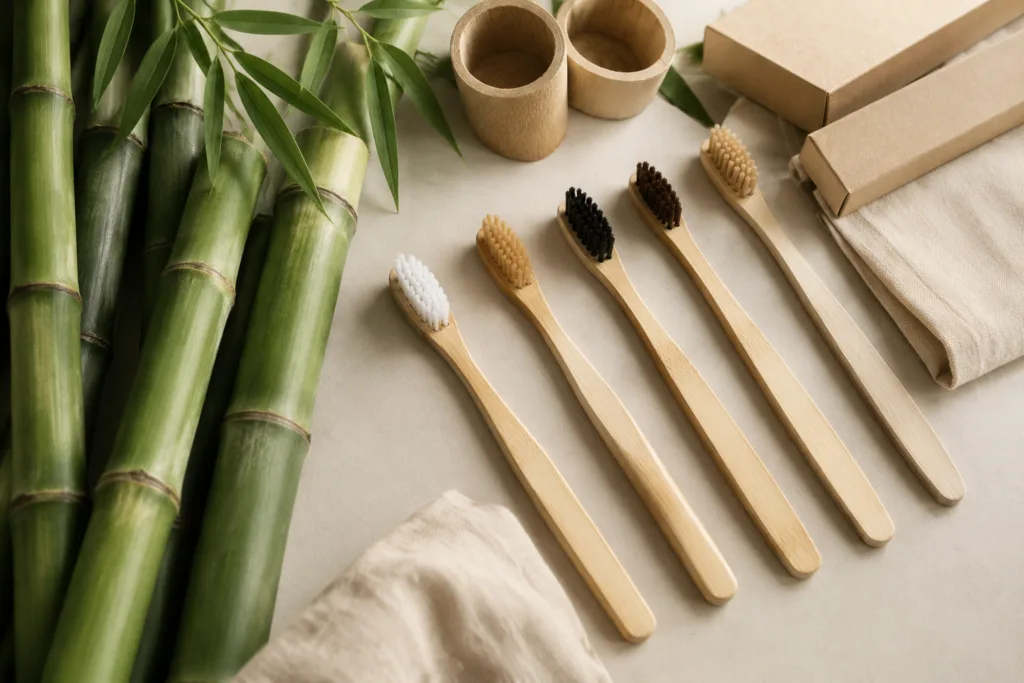
Quick anatomy: handle, bristles, base, accessories, and branding details
A bamboo toothbrush is usually evaluated as one product, but buyers should separate it into parts:
- Handle: bamboo species, density, grain, shape, thickness, finish, and engraving suitability.
- Bristles: softness, filament material, color, tufting quality, and end rounding.
- Base or lower structure: standard flat end, standing design, or added anti-slip element depending on the model.
- Accessories: travel case, holder, sleeve, pouch, or set packaging.
- Branding layer: engraving, printed packaging, family color coding, and set logic.
Private label buyers often make the mistake of choosing only by front-view product photo. That misses the parts that affect repeat orders and customer feedback most: touch feel, bristle comfort, moisture response, and whether the packaging matches the intended sales channel.
How component choices affect perceived value
Perceived value in the best bamboo toothbrush segment is highly sensitive to small details. A handle with visible grain and a smooth, sealed finish can look more premium even if the overall form stays simple. A clean kraft box may suit a value eco line, while a rigid box or coordinated set may fit gifting or hospitality better. The same is true for bristles. Slightly better color control and a neater trim can noticeably improve shelf appeal.
For a manufacturer, these choices also affect production practicality. Some upgrades are visually strong but operationally simple. Others create more scrap, slower assembly, or higher packing labor. Buyers who understand this early usually build a more coherent range.
best bamboo toothbrush
What buyers usually mean by “best”
For end consumers, the phrase often means comfortable bristles, pleasant appearance, and a cleaner material story. For a private label buyer, the best bamboo toothbrush usually means something broader: a specification that fits the target customer, can be produced consistently, supports packaging goals, and leaves room for margin.
That is why there is no single universal answer. The right model for a hotel amenity pack may be too basic for a premium wellness brand. The right model for a subscription set may be too expensive for high-volume retail. Under many conditions, “best” means “best aligned,” not “most feature-heavy.”
Why one specification rarely fits every channel
Buyers should compare the product against channel needs:
- Mass retail: price-sensitive, visually clear, easy to explain.
- DTC: packaging story, unboxing, and bundle options matter more.
- Hospitality: compact size, pack efficiency, and simple hygiene presentation often matter most. Buyers in this space may also want to review hotel amenity bamboo toothbrush sourcing to compare how specification priorities shift in hotel use.
- Gift or premium wellness: texture, engraving, accessories, and coordinated set design can justify more detail.
This channel lens should shape every decision that follows.
How to Select the Right Bamboo Handle Material
Types of bamboo suitable for toothbrush handles
Not all bamboo presents the same way once machined into a handle. Buyers should pay attention to density, visible grain, color consistency, and how the material responds to sanding and finishing. A suitable toothbrush handle material usually needs enough structural stability for daily wet use, enough surface quality for hand feel, and enough visual consistency for batch-level brand presentation.
Moso bamboo is commonly discussed because it is widely used in bamboo product manufacturing and is often associated with good strength and a mature visual grain. Alternatives may still be workable, but the result can vary in color tone, grain uniformity, and finish behavior. That does not make one species automatically superior in every project. It means brand claims should stay honest and product-led.
Moso bamboo versus alternatives in handling and brand story
Moso bamboo often suits toothbrush handles because it tends to support a clean machined look and a familiar natural appearance. In many projects, that helps with mainstream retail acceptance. Alternative bamboo materials may offer different tone or grain character, which can help if the brand wants a more rustic or visibly natural look.
The risk is greenwashing through vague language. Buyers should avoid assuming that any bamboo story is enough on its own. A stronger approach is to describe visible and practical qualities: renewable material use, lower-plastic positioning, durable handle construction, and packaging choices that support the same direction. Clear product logic is more credible than exaggerated environmental messaging.
Finish, tactile feel, and durability tests buyers should request
Before approving a handle, buyers should test:
- Surface smoothness after sanding
- Consistency of edge finishing around the head and neck
- Grip comfort when wet
- Visual grain uniformity across samples
- Any roughness, splinter risk, or over-dry appearance
- How the finish looks after repeated handling
At Bamboo Wood Art, a common practical lesson in bamboo products is that sample photos rarely show the full tactile difference between a passable finish and a refined one. For toothbrushes especially, the hand feel matters because users touch the product twice a day. A handle that looks acceptable online may still feel too sharp, too dry, or too light in real use.
Handle ergonomics, shapes, and grip textures
Ergonomics are a simple but underused way to differentiate a private label line. Common options include straight slim handles, oval profiles, wider thumb-rest shapes, and softer contoured silhouettes. Grip texture can be made through carved lines, flattened panels, or light surface patterning.
These changes influence both function and market fit:
- Minimal straight handles: good for value lines and broad-market simplicity.
- Contoured adult handles: better when comfort and slightly higher positioning matter.
- Shorter thicker kids handles: easier for smaller hands and stronger color coding.
- Textured grips: useful when wet-slip concerns or family use are part of the product story.
Bristle Choices: Softness, Material Types, and Customization Potential
Soft, medium, and hard: what the choice communicates
Soft bristles usually serve the broadest market because they align with comfort expectations for everyday brushing. Medium may work for users who prefer more brushing feedback. Hard bristles are typically a narrower choice and may not be the safest mainstream option for all markets. From a sourcing standpoint, limiting the range to soft and selective medium options often keeps the line simpler and easier to explain.
When buyers want the best bamboo toothbrush for a premium or family-safe positioning, soft bristles often give the most flexible market fit. That does not remove the need to review trim quality and end rounding, which affect perceived comfort as much as the softness label itself.
Bristle material options
Common bristle choices include:
- Nylon-based filaments: still widely used because they are familiar, durable, and consistent in manufacturing.
- Bio-based variants: often selected when brands want partial plant-based content in the bristle story.
- Charcoal-infused bristles: mainly a visual and marketing differentiator, especially for darker premium-style lines.
- Other emerging alternatives: worth reviewing carefully for consistency, availability, and realistic positioning.
Each option involves trade-offs. Standard nylon may be easier for consistency and export familiarity. Bio-based options can strengthen product positioning, but buyers should still confirm practical details rather than assuming all “green” claims mean the same thing. If your team is comparing category narratives, the bamboo vs. bioplastic toothbrush comparison can help frame that decision more carefully.
Color, tip shape, and visual customization
Bristle color has a bigger branding role than many buyers expect. It can:
- Differentiate adult and kids lines
- Create family pack color coding
- Support a clean clinical look with white or neutral tones
- Support a bold natural-premium look with black, charcoal, or muted earth colors
Tip shape matters too. Rounded or refined filament ends usually support a more comfortable perception. Buyers should ask suppliers for close sample photos and, where possible, physical samples under normal use rather than only catalog shots.
Regulatory and export considerations buyers should check
Requirements can vary by market, so buyers should confirm material declarations, product labeling expectations, and any destination-specific rules with their importer or compliance team before mass production. From a supplier review standpoint, it is reasonable to ask how bristle materials are described in technical documents, how batch consistency is controlled, and how packaging claims are reviewed before printing. The key is to verify, not assume.
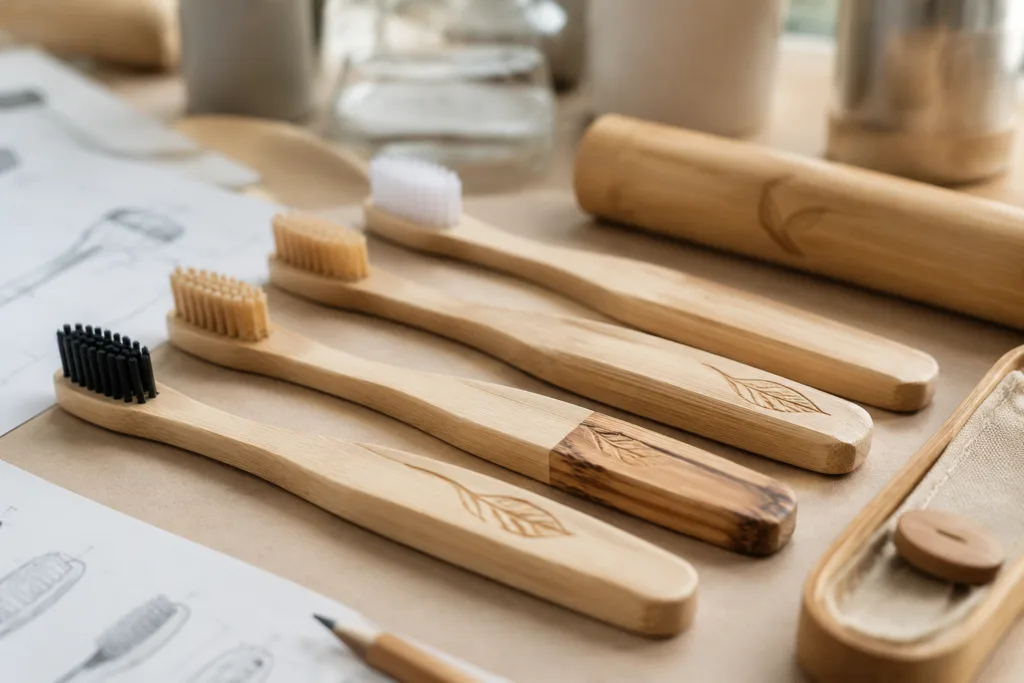
Base Options and Color Accents: Brand Recognition and Functional Design
Different base shapes and their purpose
Some toothbrushes use a standard flat base. Others are shaped to stand more easily on a counter. In certain designs, a slightly broader base can improve visual stability in merchandising as well as home storage. Anti-slip or added base elements may also be considered, but they need to justify the extra complexity.
The right base design depends on use context. A standing base can be useful in home bathrooms or travel kits where a holder is not included. A simpler flat base may be better for carton efficiency and lower unit cost.
Using color accents to make a line easier to recognize
Color undercoats or accent areas can be practical branding tools. They are especially helpful when:
- You are building couple, family, or kids sets
- The outer packaging has a clean minimal look and needs internal product distinction
- You want a small visual cue without changing the natural bamboo feel too much
These details work best when they connect to the wider brand system rather than appearing as decoration. Matching the accent color to packaging, engraving tone, or accessory fabric can make a simple SKU feel more considered.
Travel Cases, Holders, and Accessories: Extending Value and Market Appeal
Common accessory options
Accessories can help a toothbrush move into a more giftable or travel-ready category. Common additions include bamboo travel tubes, ventilated cases, simple cardboard sleeves, fabric pouches, or countertop holders. The best option depends on whether the goal is portability, shelf presentation, bundle value, or hospitality use.
When accessories add value and when they only add cost
Accessories usually make sense when they solve a clear problem or support a clearer price step-up. A travel case can help DTC bundles, premium gift sets, or wellness kits. A holder may suit a bathroom set. But if the core sales channel is entry-level retail, extra pieces can raise cost without improving conversion enough to matter.
Buyers should also test compatibility. A well-made toothbrush can still feel poorly specified if it fits loosely in the case, traps moisture, or clashes with the brand look. In many projects, less is better when the accessory does not clearly improve use or presentation.
Laser Engraving, Personalization, and Branding Techniques
Logo, text, and pattern options
Laser engraving is one of the most natural branding methods for bamboo handles because it avoids heavy visual clutter and works with the grain rather than against it. Buyers may choose a simple logo mark, small brand name, icon system, or understated decorative line. Fine details need testing because very small marks can lose clarity depending on bamboo tone and engraving depth.
Batch customization versus individual personalization
Batch-level branding is usually straightforward: one logo across a production run, often with limited effect on production flow. Individual naming or one-by-one personalization is different. It may slow handling, affect MOQ logic, or make packaging coordination more complicated. That does not make it unworkable, but it should be treated as a separate program rather than a standard production assumption.
Engraving should also be reviewed together with packaging. A refined engraved handle in a low-detail, oversized carton can feel mismatched. The better result usually comes when the branding layer, pack structure, and product positioning are planned together.
Packaging Solutions: Material, Design, Retail and Gifting Scenarios
Packaging materials buyers commonly compare
Typical packaging options include kraft paper boxes, recycled paperboard sleeves, printed folding cartons, wood boxes for premium presentation, and simple compostable-looking wraps where market fit allows careful claim control. Each format carries a different message.
- Kraft or recycled board: practical for eco lines and cost control.
- Printed board cartons: stronger for retail communication and education.
- Wood boxes or rigid gift packs: more suitable for gifting or premium bundles.
- Minimal sleeves: useful when the product itself is the hero and shelf protection needs are low.
Buyers comparing broader category consistency may also want to look at how a bamboo products manufacturer approaches packaging logic across different bamboo goods, because the right packaging decision often depends on how the product will be merchandised, shipped, and presented as part of a wider line.
Retail versus DTC packaging considerations
Retail packaging usually needs clearer front-panel communication, stronger shelf durability, and faster visual recognition. DTC packaging may place more value on compact shipping, neat unboxing, and bundle flexibility. If the toothbrush will be sold in sets or mailed in subscription packs, packaging dimensions and insert design become more important than traditional peg-hook display needs.
At Bamboo Wood Art, packaging conversations often reveal whether a buyer is designing for sales reality or only for concept boards. A beautiful box that wastes shipping space, damages easily, or does not support reorder efficiency can weaken the whole program.
Gifting, subscription, and hospitality packaging
These sub-channels need different logic:
- Gifting: coordinated color, better insert structure, and clean finish hierarchy.
- Subscription: compact dimensions, repeatable insert logic, and range continuity.
- Hospitality: hygiene presentation, efficient unit packing, and straightforward branding.
For teams mapping out broader pack structures across SKUs, it can help to review packaging for private label bamboo goods as a related reference point when comparing material, cost, and channel fit.
Building a Differentiated Product Line: Decision Framework for Private Label Buyers
Use a simple range matrix
Instead of treating every toothbrush as a custom one-off, build a line architecture. A practical matrix may look like this:
| Segment | Handle | Bristles | Accessories | Packaging |
|---|---|---|---|---|
| Eco entry line | Simple straight bamboo handle | Soft nylon or basic bio-based option | None | Kraft box or sleeve |
| Mainstream retail line | Refined ergonomic handle | Soft bristles, color coded | Optional family set pack | Printed carton |
| Premium wellness line | Smooth contour handle, engraving | Soft premium-look bristles | Case or holder | Rigid or elevated presentation pack |
| Kids line | Shorter thicker handle | Extra-soft or soft, bright color cues | Set option | Friendly printed box |
Mix and match without overcomplicating the range
The strongest private label ranges usually limit major variables. For example, keep one or two handle families, then vary bristle color, engraving, and pack design. Too many structural changes can reduce consistency and complicate reordering. Differentiation works better when customers can still recognize a family resemblance across the line.
Quality control and prototype requests
Before approval, ask for prototypes that let you compare:
- Handle shape and feel side by side
- Bristle softness options under real handling
- Color consistency across several units
- Engraving visibility on actual bamboo tone
- Packaging fit, closure, and print clarity
- Case compatibility if accessories are included
A useful first sample order is not just one hero SKU. It is usually a small comparison set that helps your team choose between two or three realistic configurations.
Sourcing Best Practices and Manufacturer Selection Criteria
Questions to ask suppliers
When comparing suppliers for the best bamboo toothbrush project, ask practical questions such as:
- What bamboo material is used for the handle, and how is finish consistency managed?
- What bristle options are available, and how are they documented?
- What handle shapes are standard versus custom?
- How do sampling and production differ in lead time and cost?
- What packaging options are already proven in production?
- How are engraving, color accents, and accessories integrated into MOQ planning?
Good answers are usually specific and process-based. Vague sustainability slogans or overly broad customization promises are less useful than a clear explanation of what can be done reliably.
Balancing OEM, ODM, cost, and flexibility
OEM works better when you already have a defined specification and need controlled execution. ODM can be useful when you want to build from existing models and adjust details such as engraving, color, packaging, or accessory combinations. Many buyers start with ODM-style sampling, then move toward a tighter OEM specification once the product line becomes clearer.
The right choice depends on volume, timeline, and how differentiated the final line needs to be. A heavily customized structure may not be the best starting point for a first order if your forecast is still uncertain.
Internal resources that support the next decision
For many sourcing teams, the next step after reading a guide like this is to compare sample-ready configurations against packaging, channel, and MOQ realities. That is where product category pages, custom development pages, and related manufacturing articles become more useful than general trend content. Used together, they help narrow the shortlist faster and reduce unnecessary back-and-forth during sampling.
Conclusion: Next Steps for Launching or Upgrading a Bamboo Toothbrush Range
The best bamboo toothbrush for a private label project is usually the one that balances material feel, brushing comfort, packaging fit, and production practicality for a specific market. Handle species, finish quality, bristle choice, base design, accessories, and branding details all shape how the final product is perceived. None of these should be selected in isolation.
If you are planning a first sample round, start with a focused comparison set rather than too many variations. Compare one or two handle profiles, two bristle options, and packaging formats that match your actual sales channel. Review them as a system, not as separate parts. That approach usually makes approval decisions faster and gives the manufacturer clearer direction for the next stage.
A differentiated bamboo toothbrush range does not require endless complexity. It requires disciplined choices, honest material positioning, and a product configuration that fits the brand as well as the market. When those elements align, the range is far easier to present, reorder, and expand with confidence.
Frequently Asked Questions

What is the most important factor when choosing a bamboo toothbrush for private label?
The most important factor is overall fit between the product specification and your target market. Handle feel, bristle comfort, packaging style, and cost all need to support the same sales channel and price position.
Is Moso bamboo always the best choice for toothbrush handles?
Moso bamboo is often a strong option because it is widely used and usually presents well in finished products, but it is not automatically the best choice for every project. Buyers should compare finish quality, grain appearance, and consistency rather than relying on species name alone.
Which bristle type works best for most retail markets?
Soft bristles usually work best for broad retail use because they match common comfort expectations and are easier to position for everyday brushing. The final choice should still be tested for trim quality and end feel.
Should a private label bamboo toothbrush include a travel case?
Only if the accessory supports the product story and channel. Travel cases often add value in premium, gift, or travel-focused lines, but they may add cost without enough benefit in entry-level retail programs.
How many custom features should be added to a first sample order?
It is usually better to test a limited set of meaningful variables, such as one or two handle shapes, two bristle options, and one or two packaging directions. Too many changes at once can make evaluation slower and less clear.
What should buyers ask a manufacturer before placing an order?
Buyers should ask about handle material, bristle options, finish consistency, customization limits, MOQ structure, sample process, packaging capabilities, and how product claims are documented for export review.