For a bamboo toothbrush FAQ, the real SEO challenge is not writing more questions; it is deciding which questions deserve to live on the main product or category page and which ones should become separate content. When a brand publishes too many overlapping pages, search intent gets diluted, internal links get messy, and the same keyword can compete with itself across FAQ blocks, buying guides, and blog posts. From our manufacturer perspective, a strong content map should help buyers, retailers, and ecommerce teams find the right answer quickly while keeping the page architecture clean and commercially useful.
OEM bamboo toothbrush manufacturing support becomes especially relevant when a brand is building a product page, bundle page, or private label landing page around the same set of consumer questions. At Bamboo Wood Art, we typically help buyers align question types with product structure, bristle options, packaging needs, and custom branding so the main page answers high-frequency concerns and the blog handles only genuinely distinct topics. That split supports better SEO, clearer navigation, and stronger conversion intent without creating redundant pages.
Why bamboo toothbrush FAQ content should be mapped intentionally
The phrase bamboo toothbrush FAQ often attracts mixed intent. Some searchers want a simple answer before purchasing. Others are comparing materials, bristle types, storage options, or family pack formats. A few are looking for post-purchase care advice. If all of those questions are scattered across separate posts, the result is usually thin content and avoidable cannibalization. If they are grouped too aggressively, the page can become cluttered and difficult to scan.
The right approach is to treat the main FAQ as a commercial support layer for the product page or category page. It should answer common purchase blockers, clarify differences between variants, and cover basic care questions that most shoppers ask. Deeper or more distinct topics can move into buying guides or standalone educational posts when they have enough demand and a clearly different intent.
This is not only a content decision; it is a merchandising decision. For bamboo products, the page structure should reflect how the product is actually sold: single pack, multi-pack, kids version, travel version, soft or medium bristles, and branded sets. Search engines respond better when the page hierarchy matches the buyer journey, and buyers respond better when the information they need is easy to find.
One useful way to think about this is: if the question helps someone choose, it belongs close to the product. If it helps someone compare, it belongs in the buying guide. If it answers a niche or high-intent query that needs its own angle, it may justify a separate post. Industry SEO guidance on keyword overlap and consolidation follows the same logic; see how to avoid cannibalizing bamboo toothbrush FAQ keywords for a practical framing of when multiple pages start competing for the same intent.
Identify the search intent behind bamboo toothbrush questions

Before deciding where to place a keyword, it helps to identify the intent behind it. Most bamboo toothbrush questions fall into three broad groups: basic product education, purchase evaluation, and post-purchase support. Each group behaves differently in search and should be handled with a different content format.
Basic product education
These are the universal questions buyers ask before they trust the product. Examples include whether bamboo toothbrushes are durable, what bristle options are available, how to replace them, and whether they are suitable for adults or children. These questions belong in the main FAQ because they reduce friction and support the purchase decision.
Purchase evaluation
These queries compare options: soft versus medium bristles, family pack versus single pack, travel case versus no case, custom logo versus plain stock, and natural handle finish versus coated finish. These questions often belong in the buying guide or a comparison module because they need context, not just a short answer.
Post-purchase support
These queries focus on use, storage, wear, drying, and replacement timing. They are valuable, but they rarely justify a standalone blog post unless the topic is unusually technical or important to a specific buyer segment. For most brands, these questions should stay inside the main FAQ so the page can support both conversion and retention.
| Intent type | Best page placement | Typical question style |
|---|---|---|
| Basic education | Main FAQ on product or category page | What is it, how it works, how to use it |
| Purchase evaluation | Buying guide or comparison module | Which option is better, what to choose, what differs |
| Post-purchase support | Main FAQ or support content | How to store, when to replace, how to care for it |
Questions that belong in the main bamboo toothbrush FAQ
The main FAQ should cover questions that are common, practical, and directly tied to the product page. These are the questions most likely to influence conversion, reduce confusion, and prevent returns. If a topic is asked often enough by buyers or customer service, it usually belongs here first.
- What bristle type is best? Keep this on the main page if the answer is short and tied to the product variants you sell.
- How often should a toothbrush be replaced? This is a universal care question and should not become a thin standalone post.
- How should the toothbrush be stored after use? A concise storage answer supports hygiene and product durability.
- Is a bamboo handle suitable for daily use? This is a purchase reassurance question, so it belongs close to the product.
- Can the toothbrush be used in retail bundles or starter sets? If you sell bundles, the FAQ should reflect that merchandising structure.
When the answer is direct and the keyword intent is broad, keep it on the main page. This reduces the chance that a blog post and product page both try to rank for the same question. It also keeps the page useful for ecommerce buyers who need one page that answers the basics without sending them away.
For brands building retail or subscription bundles, a family pack bamboo toothbrush options page can work as a variation page, but the surrounding FAQ should still answer common pack-related questions. That lets the page support purchase decisions while avoiding a separate article for every bundle size or household scenario.
Questions that belong in the buying guide or selection guide module
Some bamboo toothbrush FAQ terms sound simple but actually contain comparison intent. These should usually move into a buying guide, a selection guide, or a comparison section on the product page. The goal is to help buyers choose between options rather than to repeat a short FAQ answer.
Examples include questions such as whether soft bristles are better for sensitive gums, whether a charcoal bristle version feels different, whether a travel case matters, or whether custom engraving is worth the added cost. These are not purely factual questions; they are decision-making questions. They deserve a little more explanation, often with a short comparison table or a product recommendation note.
When a product line has meaningful variation, the buying guide should do the heavy lifting. A shopper who is comparing soft, medium, charcoal, travel, and branded versions needs framing, not just definitions. If the page is focused on conversion, the guide can answer the “which one should I choose?” question and the FAQ can support it with short, specific clarifications.
This is also where a manufacturer-led brand can add value. At Bamboo Wood Art, we see buyers make better decisions when they understand how handle diameter, bristle firmness, packaging format, and logo placement affect the final product. A guide that explains those factors often performs better than several short posts that all repeat the same language in different ways.
For example, a bamboo charcoal bristle toothbrush details section can support a more detailed comparison if your catalog includes different bristle feels. That type of page should focus on product differentiation, while the main FAQ stays compact and answers only the most frequent buyer questions.
Queries that are too narrow or repetitive for a separate blog post
Not every search term deserves its own article. In fact, many bamboo toothbrush queries are too narrow, too repetitive, or too close to existing intent to justify standalone content. Creating a new post for each of these often leads to content fragmentation and poor internal linking.
Common examples include:
- How to store a bamboo toothbrush in a bathroom cup
- Whether bristles should be rinsed after use
- How long a bamboo handle lasts in normal conditions
- Whether a travel case is needed for short trips
- Whether a family pack is better than buying singles for a household
These questions are useful, but they are not usually distinct enough to earn a separate URL. They fit better in a main FAQ, a short comparison block, or a bundled product page. If the answer is only three or four sentences long, it is probably not a standalone blog topic.
The same logic applies to variations that differ only by wording. If one query asks about replacing worn bristles and another asks when to swap a toothbrush, they likely belong on the same page. Consolidation helps the page stay stronger, reduces duplication, and gives search engines a clearer signal about which page should rank.
How to decide whether a keyword deserves a separate blog post
A separate blog post is justified only when a keyword has enough search demand, a distinct angle, and commercial value that cannot be covered well on the main page. We use a simple decision framework internally when planning product content.
| Check | Question to ask | If the answer is yes |
|---|---|---|
| Demand | Does the topic have meaningful interest beyond one or two closely related phrases? | Consider a dedicated article |
| Differentiation | Can the topic be explained without repeating the product page? | Separate content may be useful |
| Commercial value | Does the topic support purchase, bundle selection, or brand trust? | Prioritize it over low-value education |
| Content depth | Can the article offer more than a short FAQ answer? | A blog post may be justified |
When all four checks are weak, the topic should stay inside the main FAQ or buying guide. When one or two checks are strong but the rest are weak, the topic probably needs a supporting section rather than a standalone page. Only when the topic clearly differs in intent and offers enough depth should it become a separate post.
This framework is particularly important for ecommerce brands because product, category, and blog pages often target overlapping phrases. If a site creates too many near-duplicate pages, those pages can compete instead of compound. A clean map is more important than a large page count.
How to handle bamboo toothbrush bristles without thin content
Bristle-related queries are some of the most common and also some of the easiest to mishandle. Topics such as soft bristles, medium bristles, charcoal bristles, and bristle wear can quickly create duplicate content if each version gets its own vague article.
The best approach is to make the product page or buying guide the home for bristle decisions. The FAQ can answer practical questions like what the differences are, who each type is for, and how long the bristles usually maintain their shape in normal use. If a brand offers multiple versions, the product detail page should explain the available options in one clear comparison instead of splitting the same explanation across several thin posts.
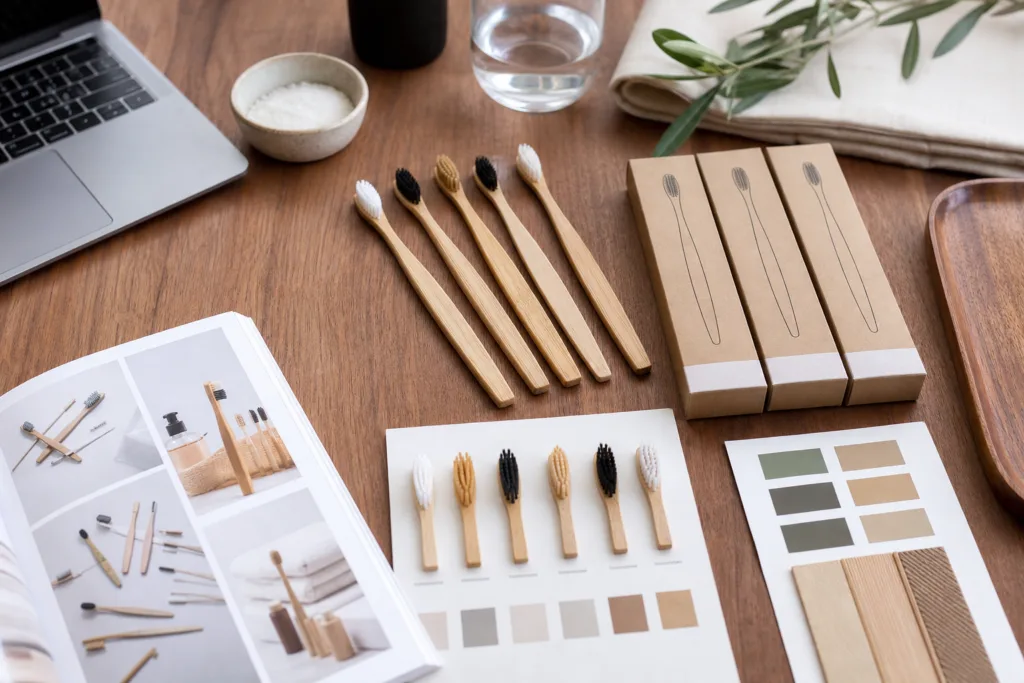
Only create a standalone article if the bristle topic requires a deeper technical or compliance-based explanation that is not already covered by the product pages. For most brands, it does not. A concise comparison table and a few FAQ answers are usually enough to serve both users and search engines.
If your catalog includes specialized variants, such as a medium bristle toothbrush selection or a sensitive-gum option, keep the comparison on the buying page and avoid repeating the same claims in every supporting article. That structure gives each page a distinct role and lowers cannibalization risk.
How to handle bamboo toothbrush storage queries as support content
Storage questions are useful, but they are rarely blog-worthy unless they connect to a larger hygiene or travel-use topic. Most of the time, storage belongs in the main FAQ because it is a simple post-purchase support question.
For example, buyers may ask whether the toothbrush should be dried upright, whether it can be kept in a case, or how to prevent moisture buildup during travel. Those are practical concerns that should sit close to the product description and care instructions. If the answer is brief and actionable, there is no need to create a separate post.
When a travel scenario is central to the product, a dedicated product page may be better than a blog post. A travel toothbrush with protective case page is a good example of where storage and portability can be part of the product story. In that case, the FAQ should support the product with short care notes rather than splitting the topic into multiple articles.
How to handle family pack queries in product and FAQ content
Family pack, multi-pack, and household bundle queries often have both commercial and SEO value. They can support higher order value, but they also create a temptation to publish duplicate pages for every quantity variation.
Our recommendation is to treat pack-size questions as product-variation content first and FAQ content second. If the pack differs only by quantity, keep the explanation on the product page or bundle page. Use the FAQ to answer practical questions about household use, value, storage, and whether the pack is suitable for retail display or gifting.
This structure keeps the content efficient. Buyers can compare pack sizes without navigating away, and search engines can recognize one primary page for that product family. If the pack format is truly different in positioning, such as a starter kit or eco retail set, then a dedicated page may be justified. Otherwise, keep the page count lean and the intent clear.
For retail buyers, bundle pages often perform better when they are supported by simple use-case language rather than separate blog articles. A compact FAQ can cover pack count, household rotation, and packaging, while the product module remains focused on sales conversion.
How to reduce keyword cannibalization across page types
Keyword cannibalization happens when multiple pages target the same or nearly the same query and search intent. For bamboo toothbrush content, this often occurs when the main product page, an FAQ page, a buying guide, and a blog post all talk about the same care or comparison topic.
The simplest way to avoid this is to assign roles before publishing:
- Product page: explains the exact item, available variants, and purchase details.
- FAQ module: answers common objections and care questions.
- Buying guide: helps the buyer choose between versions.
- Standalone blog post: covers a distinct topic with enough depth to stand on its own.
Once those roles are clear, the content team can avoid repetition. The product page should not keep re-explaining everything the buying guide already covers. The blog should not restate the FAQ in a different tone. Instead, each page should add a new layer of value.
This is where manufacturer-led content teams have an advantage. We can map the content to real product differences such as handle shape, finish, bristle type, packaging format, and branding method. When the content reflects actual product architecture, cannibalization risk drops because each page has a different job.
On a branded catalog, the homepage and core product pages should carry the strategic message, while support pages should answer only the questions necessary to move the buyer forward. At Bamboo Wood Art, we use that same logic in custom manufacturing planning: define the product structure first, then decide which questions belong at the top of the funnel and which belong closer to conversion.
Recommended content split for a bamboo toothbrush cluster
When building a content cluster, keep the content stack simple and intentional. A good split often looks like this:
- Main product page: primary product details, materials, variants, and buy-now context.
- FAQ block: replacement timing, storage, bristle softness, cleaning basics, household use.
- Buying guide: soft vs medium, charcoal vs standard, travel vs home use, family packs.
- Standalone post: only for a topic with clear differentiation, such as brand sourcing, toothbrush lifecycle, or a unique material angle.
This split keeps the site from bloating with near-duplicate pages. It also improves internal linking because every page has a clear reason to exist. The FAQ points users toward the right variant, the guide explains the differences, and the blog handles the topics that need a broader editorial treatment.
For branded packaging or promotion, a product like the custom engraved toothbrush branding page can serve as the definitive home for personalization questions. That way, logo-related queries do not leak into unrelated FAQ posts or duplicate blog content.
Decision checklist: merge, expand, or publish separately
Use this checklist before you create a new page for a bamboo toothbrush query:
- Does the query already fit naturally in the main FAQ?
- Does the answer require more than a short paragraph?
- Is the topic materially different from the main product page?
- Will a separate post reduce or increase overlap with existing content?
- Is there enough commercial value to justify its own URL?
If the answer is mostly yes to the first question and mostly no to the others, keep it in the FAQ. If the topic requires a deeper explanation but still supports the product page, expand the buying guide. If the topic has distinct search intent and enough detail to offer a unique perspective, then a separate post may be worthwhile.
In practice, many bamboo toothbrush topics do not need a blog at all. They need a better page hierarchy. That distinction saves time, improves internal linking, and keeps the site easier to manage as the catalog grows.
Final keyword mapping table for bamboo toothbrush FAQ planning
| Topic | Best placement | Why |
|---|---|---|
| How often to replace a toothbrush | Main FAQ | Universal care question with simple answer |
| Soft vs medium bristles | Buying guide | Comparison and purchase decision intent |
| Family pack for households | Product page or FAQ | Variation-based merchandising question |
| Travel case storage | Product page or FAQ | Supportive use-case question, not a standalone topic |
| Custom logo engraving | Product page or dedicated customization page | High commercial value and distinct intent |
| Bristle material details | Buying guide | Needs comparison context |
| Brand sourcing or private label setup | Standalone blog or manufacturer guide | B2B decision content with broader depth |
The best bamboo toothbrush FAQ strategy is not to publish more pages. It is to place the right question on the right page so the site remains easy to crawl, easy to understand, and easy to buy from. When the FAQ, buying guide, and blog each have a clear role, the content cluster becomes stronger than the sum of its parts.
For manufacturers, distributors, and ecommerce teams, that structure also makes internal planning easier. You can see which questions drive sales support, which ones deserve education, and which ones are just repeats in different wording. That clarity helps reduce keyword cannibalization and keeps your content investment focused on pages that actually move buyers forward.
Frequently Asked Questions
Should every bamboo toothbrush question have its own blog post?
No. Most bamboo toothbrush questions are better handled in the main FAQ, product page, or buying guide. A separate blog post is only useful when the topic has distinct intent, enough depth, and clear commercial value that cannot be covered well in a shorter page section.
What kinds of questions belong in the main bamboo toothbrush FAQ?
Keep common purchase and care questions in the main FAQ, such as bristle softness, replacement timing, storage, basic use, and whether the product is suitable for daily use. These are high-frequency, practical questions that support the buying decision without needing a separate article.
When should a bamboo toothbrush topic move into a buying guide?
Move the topic into a buying guide when the question is really about comparison or selection. Soft versus medium bristles, family pack versus single pack, and travel case versus no case are all better explained with context and options rather than a short FAQ answer.
How do I avoid keyword cannibalization with bamboo toothbrush content?
Assign one clear role to each page. Use the product page for the item itself, the FAQ for common objections and care questions, the buying guide for comparison, and a standalone post only when the topic is genuinely distinct. This prevents multiple pages from targeting the same intent.
Should bristle questions be separate articles?
Usually no. Bristle questions are important, but they are often best handled in the main FAQ or buying guide. Only create a separate article if the bristle topic requires deeper technical explanation or supports a unique product angle that does not fit elsewhere.
Is packaging or family pack content better as FAQ or blog?
In most cases, keep it on the product page or in the FAQ if the topic is tied to pack size, household use, or storage. A blog post is only justified when the packaging story is broader, such as retail strategy, bundle positioning, or a distinct sourcing angle.