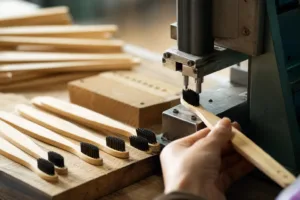
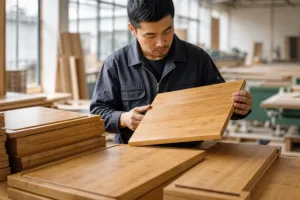
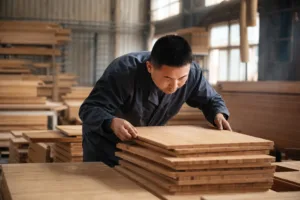
A high quality bamboo cutting board should do more than look attractive on a shelf. For buyers, the real question is whether the board will stay flat, resist cracking, feel smooth at the edge, and hold up after repeated washing and drying. From a manufacturing perspective, quality comes from the whole process: material selection, moisture control, pressing, sanding, finishing, and packaging. If any one of those steps is weak, the board may still look acceptable at first but create returns later.
For buyers comparing models or planning a private label program, our bamboo cutting board manufacturing solutions page is a practical starting point because it connects product structure, custom sizing, finish choices, and bulk production planning. At Bamboo Wood Art, we look at bamboo board quality the same way serious retail and wholesale buyers do: by checking stability, processing consistency, food-contact considerations, and how well the design fits the intended use, whether that is daily prep, display, gifting, or retail merchandising.
Why a high-quality bamboo cutting board is more than a thick-looking board
Thickness alone does not guarantee a better board. A board can feel heavy and still warp if the bamboo was not dried correctly, the lamination was uneven, or the finish only covered one side. Buyers often overvalue bulk because a thicker board suggests durability, but in actual use the more important factors are flatness, balanced construction, edge quality, and moisture behavior.
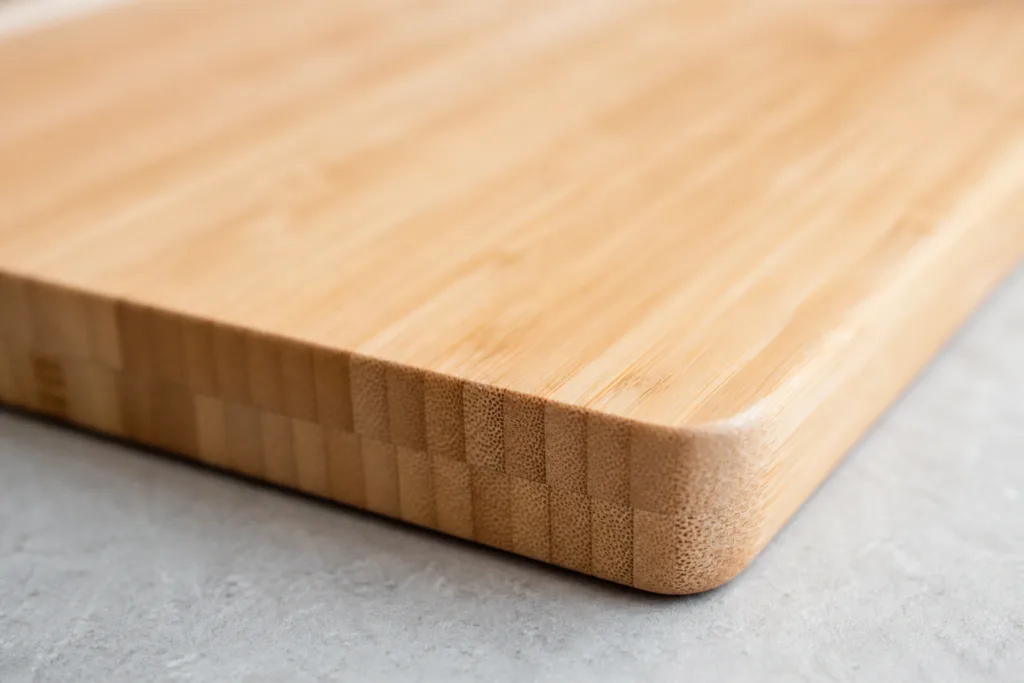
A well-made board should sit level on a counter, show consistent surface sanding, and have no open joints or sharp transitions where liquid can collect. The cutting surface should feel even under the hand, but not polished to the point of becoming slick. On the manufacturing side, a stable board usually starts with properly selected bamboo strips, controlled pressing, and a finish that helps slow moisture exchange without creating a plastic-like surface.
What buyers should focus on first
- Flatness: The board should not rock on a counter or show visible bowing.
- Surface finish: It should feel smooth, not fuzzy, splintery, or overly glossy.
- Construction consistency: Joints and grain direction should look intentional and even.
- Moisture behavior: A well-processed board should be less prone to seasonal movement.
- Food-use suitability: Adhesives, coatings, and edge treatments should match the intended application.
What bamboo cutting board quality really means from a buyer’s perspective
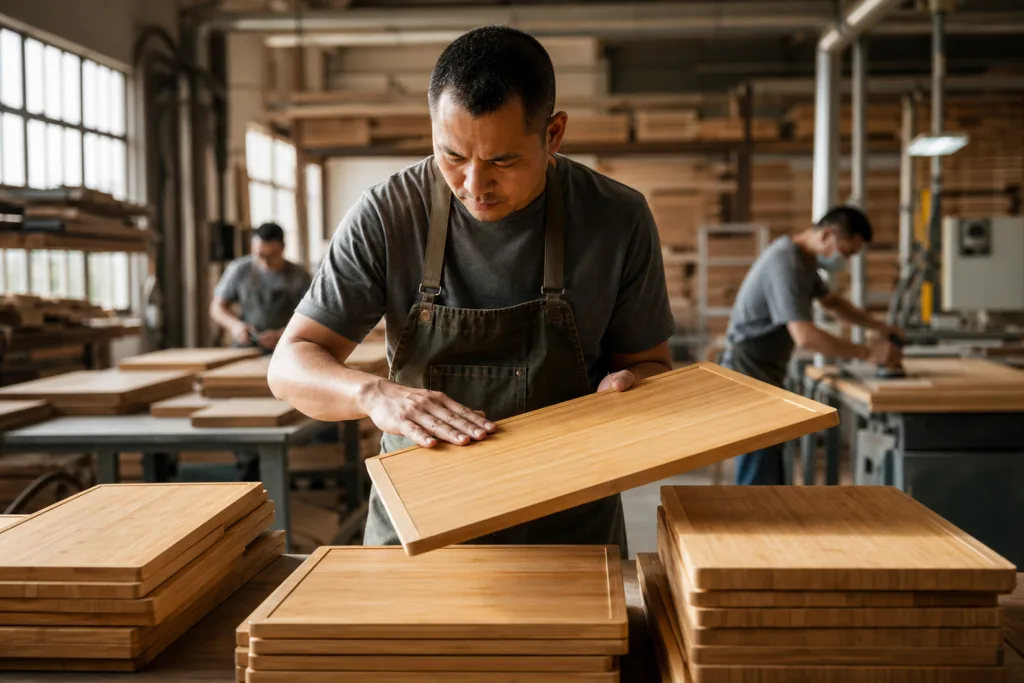
In sourcing, quality is not a single attribute. It is a combination of structure, finish, usability, and repeatability. A sample may look excellent, but a purchase order of hundreds or thousands of units is only successful if the full lot stays consistent. That is why buyer evaluation should go beyond appearance and include construction details that reveal how the board was built.
For example, a clean top layer can hide poor internal lamination. A board may also pass a quick visual check but still contain moisture imbalance that becomes visible after shipping to a different climate. Serious buyers should ask how the bamboo was dried, whether the board was pressed evenly, and whether both faces and all edges were sealed as part of the finishing process. These details matter because bamboo-based products still respond to humidity changes, even when they are carefully made. A useful technical overview of moisture behavior and warp risk is explained in moisture content, shrinkage, and warping risk in bamboo boards.
A simple way to judge quality quickly
| Buyer Check | What Good Looks Like | What May Indicate Risk |
|---|---|---|
| Flatness | Sits evenly on a flat table | Rocks, bows, or twists |
| Edges | Rounded, smooth, and uniform | Sharp corners, rough fibers, or chipping |
| Glue lines | Neat and consistent, not excessive | Visible squeeze-out, gaps, or discoloration |
| Surface feel | Clean hand feel with no fuzziness | Grain lift, splinters, or patchy sanding |
| Odor | Mild natural smell only | Harsh chemical odor or lingering solvent smell |
Surface sanding and edge finishing: how to spot smooth, safe, and well-processed boards
Sanding quality is one of the fastest ways to tell whether a bamboo cutting board was carefully processed. A good board should feel uniformly smooth across the center, along the edges, and around any handle cutouts or juice grooves. If the sanded surface feels uneven or catches lightly on the hand, the board may have rushed finishing, inconsistent grit progression, or poor attention to edge work.
Edge finishing deserves equal attention. In retail, many returns come from customers who notice rough edges before they even use the board. In B2B sourcing, that translates into avoidable quality complaints. Rounded edges are usually more comfortable to handle and less likely to chip during transport. Sharp corners can also weaken faster if the board is frequently washed or stacked in distribution.
When the design includes deeper cut features, such as a groove or shaped handle, buyers should inspect those areas carefully. We often see that the best results come from balancing CNC or cutting accuracy with final hand finishing. If you are evaluating juice groove cutting board options, check whether the groove is clean, evenly spaced, and deep enough to function without weakening the board’s structure.
Inspection cues for sanding quality
- Run a clean hand or glove across the full surface, including corners and grooves.
- Look for fiber lift near end grain or around cutouts.
- Check whether the finish looks uniform under angled light.
- Inspect whether engraved or routed areas were re-sanded after machining.
Board construction quality: joint lines, glue lines, panel flatness, and what they reveal
Construction quality is where a board either proves itself or fails. Bamboo cutting boards are often made from laminated strips or panels, and buyers should understand that glue lines are not automatically bad. What matters is whether those lines are controlled, food-appropriate, and structurally consistent. Clean, narrow glue lines are normal. Wide, uneven, or overly visible glue lines can suggest poor pressing or inconsistent moisture content in the components.
Panel flatness is another key sign. If one corner sits higher than another, the board may have come out of pressing with internal stress. This is a warning sign because a board that is already uneven before shipment is more likely to move later in storage or after washing. In our production experience, balanced lamination, proper panel conditioning, and stable finishing all contribute to a better final result. For buyers who want a more robust format, butcher block bamboo cutting boards can be evaluated for the same fundamentals, but with extra attention to thickness consistency, assembly accuracy, and edge stability.
Buyers should also consider how the product was bonded. Adhesives and coatings used in kitchen products should be appropriate for food-contact applications and not create uncertainty about use safety. The FDA provides useful plain-language guidance on food-contact components and how materials used in finished products should be assessed in food-safe adhesives and coatings in laminated bamboo construction.
Construction red flags
- Glue squeeze-out visible on multiple edges.
- Open seams where strips do not meet cleanly.
- Uneven thickness across the panel.
- Localized swelling or panel lift near joints.
- Patchwork appearance that suggests inconsistent sorting or pressing.
Thickness, weight, and stability: how to judge durability without overvaluing bulk
Heavier boards are not always better boards. A product can be thick and still have poor balance or weak bonding. A thinner board can perform well if the lamination is sound, the bamboo is well dried, and the finish is properly applied. Buyers should use thickness and weight as supporting indicators, not as the main proof of quality.
That said, thickness does influence feel and market positioning. A thicker board may be better for gift sets, premium retail displays, or carving tasks where the customer expects a substantial product. A lighter board may suit everyday prep or promotional ranges where shipping cost and shelf price matter more. When sourcing, the right question is not “How heavy is it?” but “Does the weight support the intended use and price point?”
How to interpret thickness and weight
- Too light for its size: may suggest lower material use or a less durable construction.
- Excessively heavy: can raise shipping costs without adding meaningful performance.
- Even density feel: a good sign that the panel is consistent from end to end.
- Stable hand feel: the board should feel solid but not warped or hollow in spots.
Odor, moisture feel, and color variation: what normal signs look like and what may signal poor processing
One of the simplest buyer checks is smell. A bamboo cutting board should have a mild natural odor, especially when new. A strong chemical smell is more concerning and can point to overapplied coatings, insufficient curing, or adhesive issues. Likewise, the surface should feel dry and clean, not tacky or oily in an uneven way.
Color variation is not always a defect. Bamboo is a natural material, and even carefully sorted boards can show shade differences across strips or batches. What matters is whether the variation looks intentional and controlled. If one unit has blotchy dark patches while another is noticeably pale, the lot may not have been well matched during processing or staining.
Buyers should also watch for surface dryness versus over-sealing. A board that feels too dry and raw can absorb moisture quickly, while a board that feels heavily coated may not be ideal for daily kitchen use. For many applications, a balanced surface finish is more effective than a thick film. Care also matters after shipment: a clear conditioning routine, such as the board conditioning and care basics approach, can help buyers and downstream customers understand how to maintain surface performance.
Normal versus concerning signs
| Sign | Usually Normal | Potential Concern |
|---|---|---|
| Odor | Mild natural bamboo smell | Strong chemical or solvent odor |
| Color | Some natural variation between strips | Random blotches or inconsistent staining |
| Surface feel | Smooth and dry to the touch | Tacky, greasy, or fuzzy texture |
| Appearance over light | Even sheen | Patchy coating or visible streaks |
Moisture content control and warping risk: why seasoning, storage, and production consistency matter
If there is one factor that most directly affects long-term performance, it is moisture control. Bamboo behaves like other wood-based materials in the sense that it exchanges moisture with its environment. If the board is too wet when made, it may shrink later. If one side is sealed differently from the other, it may cup or bow. If storage conditions are inconsistent, a board can move before it ever reaches the end customer.
This is why buyers should ask how the material is conditioned before lamination and how finished goods are stored before shipment. The board may look perfect in a climate-controlled showroom and still fail after moving into a humid warehouse or a dry winter market. In our manufacturing work, we pay close attention to symmetry: balanced layer structure, controlled drying, and finishing that slows moisture exchange on all exposed faces. These are not cosmetic details; they are practical steps that reduce return risk.
If your program requires a shaped edge, core layering, or deeper profile, you should ask whether the structure is designed to reduce movement. Our anti-crack board construction guidance explains why design balance matters, especially for boards that are expected to survive frequent washing, stacking, and seasonal humidity changes.
Questions to ask your supplier
- How is the bamboo dried before pressing?
- Is the board finished on both sides and all edges?
- How is flatness checked before packing?
- What storage conditions are used before shipment?
- Has the design been tested for seasonal movement risk?
Common manufacturing factors that affect long-term performance, including lamination, pressing, and finishing
Long-term performance is built into the manufacturing process. Good boards are usually the result of a chain of controlled steps rather than one dramatic feature. Lamination quality affects structural integrity. Pressing affects flatness and bond uniformity. Sanding affects user comfort and the final look. Finishing affects stain resistance, moisture exchange, and cleaning behavior.
Buyers evaluating a high quality bamboo cutting board should understand that a perfect top surface does not guarantee strong internal construction. A board with weak press alignment may later separate at the edges or develop a slight arch. Likewise, a board with good construction but poor finishing may feel rough, absorb moisture too quickly, or have visible tool marks that reduce its retail appeal. At Bamboo Wood Art, we treat these steps as part of one quality system, not separate departments, because a good board requires the same standard from raw material to final packaging.
Where custom logos or decorated surfaces are involved, the manufacturing method matters too. Laser engraving, CNC cutting, and carving all affect how much finishing work remains after decoration. A shallow, clean engraving on a flat board can look refined, while aggressive cutting without proper sanding can leave rough edges or burn marks. Buyers should ask for a sample that reflects the final production method, not just a prototype made under different conditions.
Manufacturing steps that influence buyer satisfaction
- Material sorting: helps reduce visible mismatch and weak sections.
- Controlled drying: lowers warp and crack risk.
- Balanced pressing: improves flatness and bond strength.
- Final sanding: improves touch, safety, and visual appeal.
- Coating or oiling: helps protect the surface during use and transport.
- Packaging design: prevents edge damage and moisture exposure in transit.
How to inspect a bamboo cutting board when it arrives: a quick buyer acceptance checklist
Receiving inspection should be simple enough for warehouse staff or retail QC teams to follow consistently. The goal is not to test every board to destruction; it is to catch obvious deviations before they turn into customer complaints. A practical receiving checklist should focus on flatness, finish, odor, dimensional consistency, and pack integrity.
Start by opening a few cartons from different parts of the shipment. Check whether the boards are protected well enough that edges and corners have not been damaged. Then lay a few boards on a flat table and look for rocking or visible bowing. Finally, check the surface for sanding quality and inspect the packaging for signs of excess moisture, crushing, or abrasion. If the product includes juice grooves or decorative cuts, verify that those areas were cleaned and finished properly after machining.
Buyer acceptance checklist
- Confirm dimensions against the approved sample or spec sheet.
- Place the board on a flat surface to check for wobble.
- Inspect glue lines, joints, and corner finishing.
- Check surface smoothness with a clean hand or cloth.
- Smell the board for unusual chemical odor.
- Review packaging protection and carton condition.
- Randomly test multiple units from different cartons.
Red flags that suggest low-quality production or higher return risk
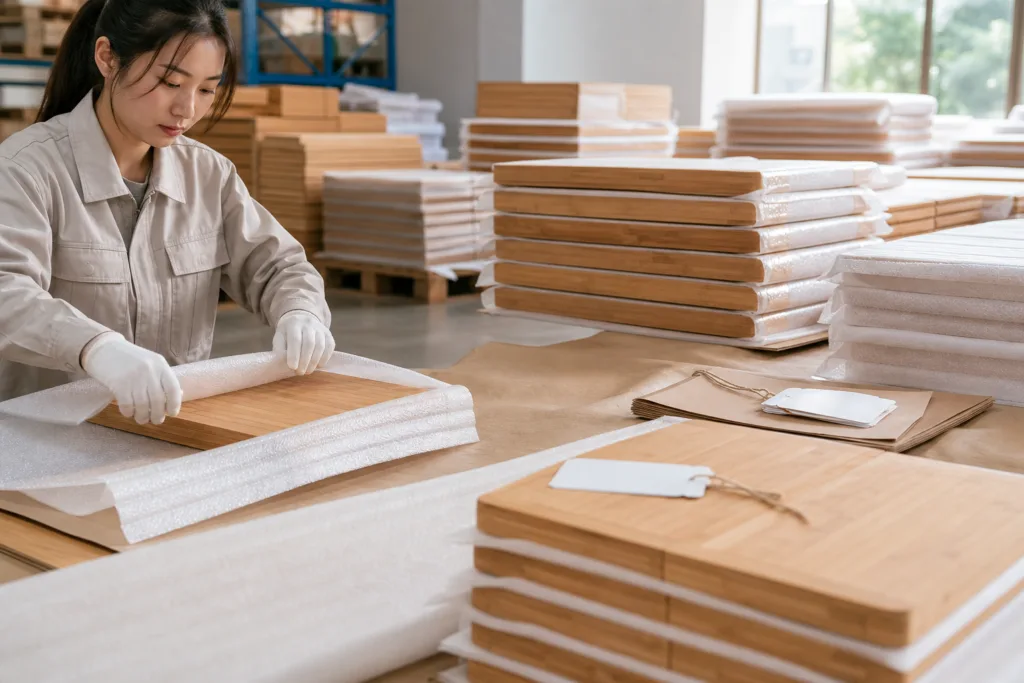
Some problems are obvious once you know what to look for. These warning signs usually point to weak process control, rushed finishing, or inconsistent raw material preparation. In wholesale and private label programs, even a small percentage of poor units can create disproportionate support costs because customers tend to notice board quality immediately when they use the product in their kitchen.
Common red flags
- Visible warping before the board has been used.
- Large or messy glue lines that distract from the surface.
- Rough end grain or splinters at the rim.
- Uneven stain or coating coverage.
- Strong odor that does not fade after airing out.
- Packaging that allows edges to knock together in transit.
- Boards that vary too much in tone within the same lot.
When these issues appear together, it often means the board was produced with limited quality control or without enough attention to moisture balance. For buyers, that usually translates into higher returns, inconsistent reviews, and lower resale confidence.
A practical bamboo board buyer checklist for wholesale, retail, or private label sourcing
For sourcing teams, the most useful checklist is the one that can be used across samples, pilot orders, and repeat production. If you are building a retail line or private label collection, consistency matters as much as appearance. The following checklist is a practical basis for supplier comparison and final approval.
- Construction: Are lamination lines even and secure?
- Flatness: Does the board sit level after unpacking?
- Finish: Is the sanding smooth, safe, and consistent?
- Moisture behavior: Has the product been dried and stored correctly?
- Odor: Is there only a mild natural scent?
- Customization: Does the logo method suit the design and use case?
- Packaging: Will the board survive shipping without edge damage?
- Production repeatability: Can the supplier match the approved sample?
- Lead time and MOQ: Are they realistic for your launch plan?
If you are comparing board formats, you may want to test both plain and feature-added versions, such as boards with grooves, handles, or thicker profiles. That comparison helps reveal whether the supplier can maintain quality across different designs and whether the product line can support a broader retail assortment without losing consistency.
FAQ
What makes a high quality bamboo cutting board different from a cheaper one?
A high quality bamboo cutting board usually has better flatness, smoother sanding, cleaner glue lines, and more controlled moisture behavior than a cheaper board. Lower-cost products often save time in drying, pressing, finishing, or packaging, which can raise the risk of warping, rough edges, or inconsistent appearance.
Is a thicker bamboo cutting board always better?
No. Thickness can improve perceived value and may suit certain premium or heavy-use applications, but it does not guarantee performance. A thinner board with balanced construction and good moisture control may outperform a thicker board that was pressed poorly or finished unevenly.
How can buyers tell if bamboo cutting board glue lines are acceptable?
Glue lines should be narrow, even, and structurally clean. Buyers should be cautious if they see excess squeeze-out, open seams, discoloration, or joints that look uneven across the panel. For food-use products, it is also wise to confirm that adhesives and coatings are appropriate for the intended application.
What odor is normal for a new bamboo cutting board?
A mild natural bamboo odor is normal when the board is new. A strong chemical smell, solvent smell, or sticky surface feel may indicate overapplied finish, incomplete curing, or another processing issue that should be checked before purchase.
How do buyers reduce warping risk when sourcing bamboo cutting boards?
Ask about drying, storage, balanced construction, and whether the board is sealed on both sides and all edges. Warping risk increases when moisture is uneven or when boards are stored in unstable humidity. Sampling from different cartons and checking flatness on arrival can also help detect issues early.
What should be checked before approving a private label bamboo cutting board sample?
Review flatness, finish quality, logo clarity, edge smoothness, odor, packaging strength, and dimensional accuracy. It is also important to confirm that the sample reflects the same production method, materials, and finishing plan that will be used for the bulk order.