Why bamboo shelf sample approval takes more than a visual check
A shelf sample can look attractive on a table and still fail in real use. Bamboo shelves often combine laminated boards, dowels, screws, inserts, brackets, and protective coatings, so approval needs to cover the full construction system. Buyers who only inspect color and polish may miss issues such as movement after acclimation, weak screws, uneven drilling, or packaging that is too light for export transit.
In wholesale sourcing, the sample is also the reference point for future production consistency. If the sample is approved too quickly, the factory may build to an unclear target. If the sample is over-optimized for presentation and not for manufacturability, the mass order may drift from the approved look or fail under normal use. A better approach is to treat the sample as a technical standard: it should be beautiful, but it also has to be measurable.
Define the product specification before sample inspection
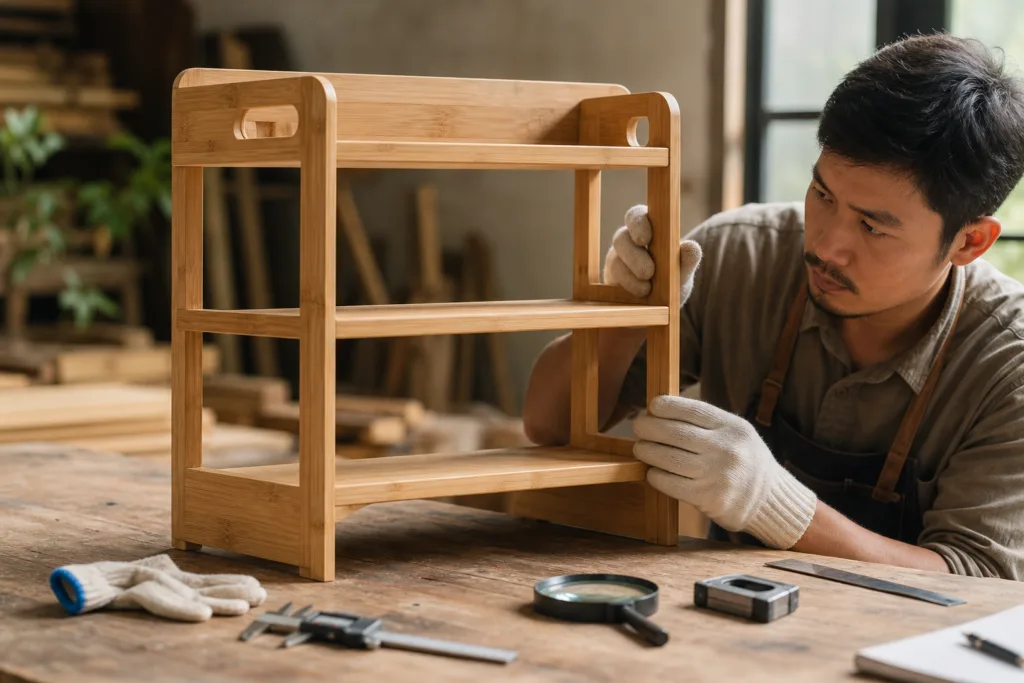
Before opening the carton, the buyer should confirm the intended specification. This is the only way to judge whether the sample is genuinely suitable for production. At minimum, the agreed spec should cover dimensions, shelf count, target load, material composition, finish type, hardware details, packaging structure, and any logo or labeling requirement.
| Specification item | What to confirm | Why it matters |
|---|---|---|
| Dimensions | Overall size, shelf spacing, thickness, and tolerance | Prevents fit problems and inconsistent bulk output |
| Load target | Expected static load and everyday use scenario | Determines whether structure and joints are sufficient |
| Finish | Oil, varnish, paint, or clear coating | Affects touch, odor, color consistency, and durability |
| Hardware | Screws, inserts, brackets, anti-rust treatment | Influences assembly reliability and corrosion resistance |
| Packaging | Inner protection, carton strength, labels, inserts | Reduces transit damage and customer complaints |
When a buyer defines these details early, the sample becomes easier to evaluate and easier to reproduce. This is one reason our sample development workflow always starts with a clear brief, as described in our sample development workflow from prototype to approval guide. A shelf sample is not only a product; it is the first version of a controlled manufacturing process.
Bamboo shelf sample checklist before functional testing
Once the spec is confirmed, inspect the shelf sample in a logical sequence. Start with the boards, then the frame, then the connectors, and finally the finish and packaging. This reduces the risk of overlooking a structural defect that can be hidden by a nice surface.
Inspect the shelf boards for flatness and consistency
The shelf boards should be flat, even, and free from obvious twist. Check thickness consistency across every board, especially if the shelf uses multiple laminated pieces or visible edge lines. If one board is thicker or narrower than the rest, the product may look acceptable in photos but become uneven in assembly.
Pay close attention to grain direction and glue lines. Bamboo is naturally patterned, and that variation can look attractive, but the lamination lines should still be neat and stable. Excessive glue squeeze-out, gaps at the edges, or visible internal movement can be a warning sign. To understand why this matters, buyers should also review how bamboo grain direction affects strength and stability, because grain orientation influences warping risk and the visual rhythm of the shelf surface.
Inspect uprights and frame alignment
Vertical posts, side frames, and support rails must sit square. If the uprights lean even slightly, the shelf may wobble or appear distorted once it is fully assembled. Check whether the joints meet cleanly and whether holes are drilled in matching positions on both sides. A small drilling error on a prototype can become a large assembly problem in mass production.
We also inspect symmetry from both front and side views. Shelves used in retail display, home organization, or hospitality settings need a balanced appearance because customers usually notice uneven lines faster than raw material defects. If the shelf uses mixed materials or added fittings, the manufacturing complexity rises further. Our how added hardware affects bamboo assembly performance article explains why non-wood components can change fit, stress points, and long-term stability.
Check connectors and hardware carefully
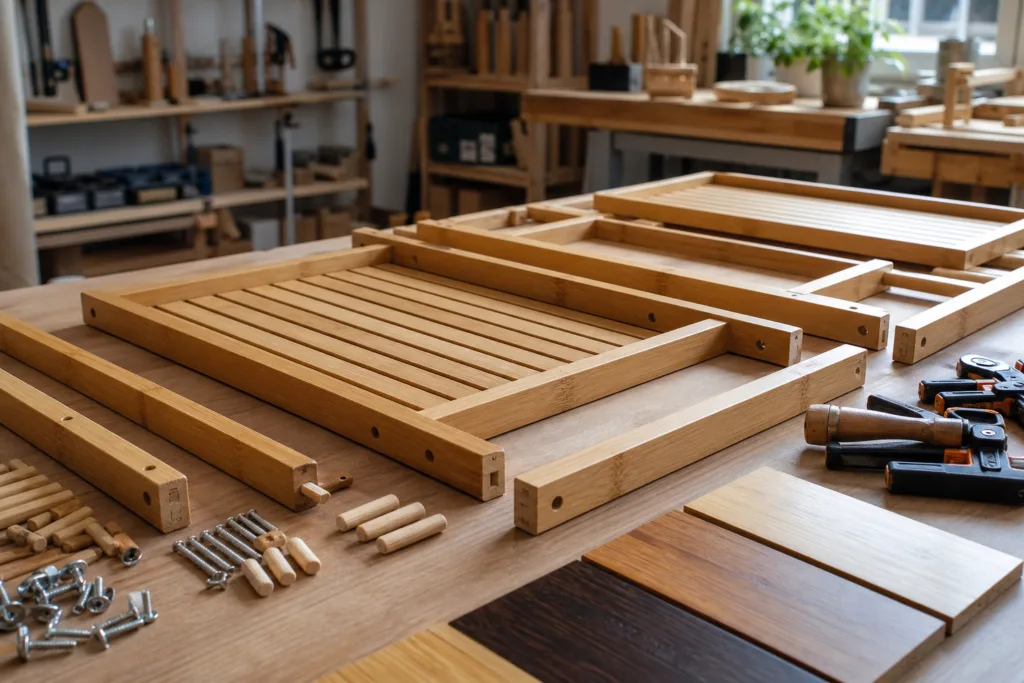
Hardware is one of the most common sources of hidden failure in bamboo shelf programs. Screws, inserts, brackets, dowels, and connecting plates must all work together. Even if the bamboo panels are excellent, the shelf can still fail if the hardware is too soft, too short, poorly aligned, or not suitable for repeated assembly.
Inspect whether the screws bite cleanly without stripping. Check whether dowels fit with consistent pressure rather than forcing the joint apart. If there are metal components, look for coating quality and signs of rust risk, especially for humid markets or warehouse storage. For exposed fittings, it is reasonable to request corrosion-related evidence or test reports that support the metal parts used in the sample. In procurement terms, the shelf should not only assemble well once; it should remain reliable after transport, humidity change, and repeated handling.
| Hardware item | What to look for | Typical risk if overlooked |
|---|---|---|
| Screws | Head integrity, length, bite, and stripping resistance | Loose joints or damaged assembly holes |
| Dowels | Fit accuracy and alignment | Misaligned frames and weak structure |
| Brackets | Shape consistency and coating | Wobble or surface rust |
| Inserts | Thread quality and pull-out resistance | Assembly failure during use or reassembly |
Evaluate stability and load-bearing performance
A shelf sample should be tested in the same way the finished product will be used. Static load matters, but so does tilt resistance, side wobble, and the way the structure behaves when weight is placed unevenly. A shelf that is strong in the center may still deform at the corners or on the top level if the support path is weak.
Start with a realistic loading scenario. For retail, that may mean books, cosmetics, kitchen items, or folded towels. For hospitality, it may mean toiletries, amenity kits, or display products. For office use, it may mean files or equipment accessories. The goal is not to simulate laboratory perfection; it is to see whether the shelf can handle the intended daily load without permanent deformation.
We recommend also checking how the sample behaves after a period of rest under load. Some structures feel stable for a short test but slowly lean or sag as joints settle. This is where a disciplined approval process protects the buyer. If the design includes a metal frame, silicone pads, or additional fittings, each added part changes the load path and must be inspected as part of the whole assembly rather than as a separate detail.
When buyers ask us at Bamboo Wood Art to develop shelves for bulk production, we usually align the load target with the product’s real usage category and then build the sample around that expectation. That keeps the approval process focused on function, repeatability, and manufacturing feasibility instead of one-time presentation quality.
Test the finish, sanding, and touch safety
Surface finishing is more than appearance. It affects touch safety, odor, cleaning performance, and the shelf’s resistance to moisture and staining. Run your hand over all exposed edges, corners, and joints. The sample should feel smooth without splinters, rough patches, or sharp transitions between laminated parts.
Look for finish uniformity under angled light. A shelf with blotchy coating, uneven sheen, visible brush marks, or inconsistent color may create trouble in production if the sample is approved without correction. Color consistency matters especially for product lines that must match other home decor or display items in the same collection.
Also check for strong or unusual odor. Some finishes need more curing time, and an under-cured sample can still smell when packed. That may be acceptable in some cases if the buyer understands the process, but it should not be ignored. The approved sample should represent the final expected finish condition, including dryness and touch feel. If packaging is also being developed, our packaging choices that protect shelf products in transit guide explains how surface quality and packaging design should work together to protect the product from scuffing and impact during shipment.
Review moisture behavior and dimensional stability
Bamboo and wood-based products respond to moisture, so a good-looking sample can still change shape after acclimation. Before approval, check whether the shelf has been conditioned properly and whether it remains flat after exposure to the expected working environment. This is especially important if the destination market is humid, coastal, or subject to wide seasonal changes.
Moisture content is not visible to the eye, but it affects shrinkage, swelling, warping, and bond stress. The USDA Forest Service has published technical guidance on moisture content and dimensional stability of bamboo materials, which is useful background when buyers want to understand why a shelf can move after production even if it looked perfect on inspection day. In practical terms, the sample should be checked for signs of future movement: end grain cracking, panel cupping, frame twist, or joints that open after acclimation.
If the buyer’s market is especially sensitive, request that the factory explain the drying or conditioning process used before assembly and finishing. A shelf made for dry indoor markets may not need the same moisture target as one intended for a humid warehouse, hotel, or coastal retail environment. The point is not to chase an ideal number in isolation, but to verify that the production process suits the actual use environment.
Assess packaging and transit protection
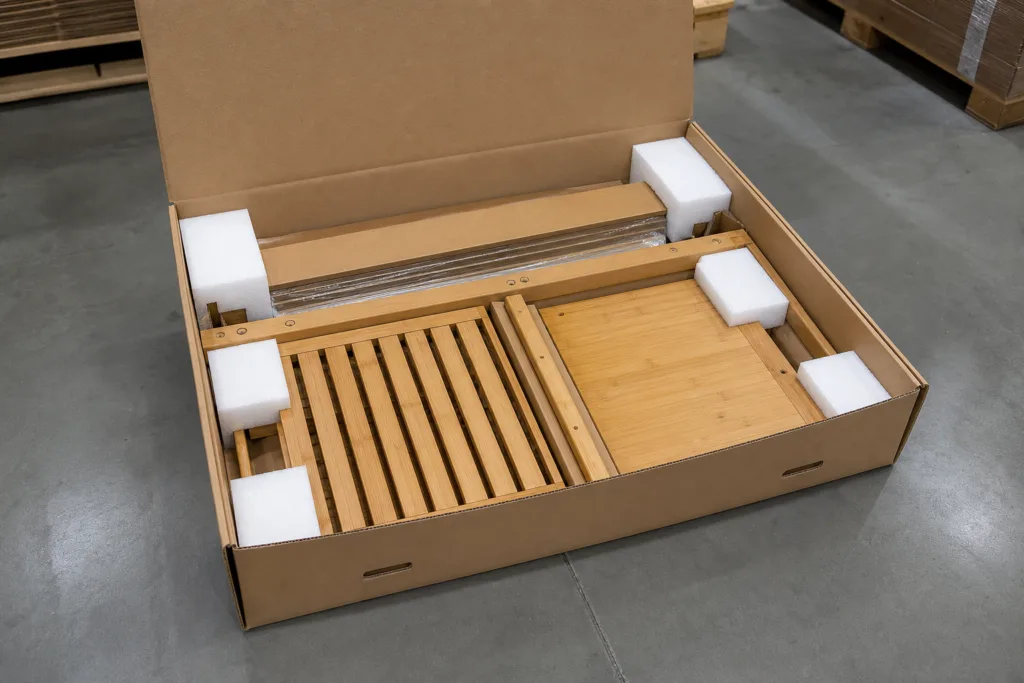
Packaging approval is part of sample approval, not an afterthought. A shelf sample that survives inspection on the factory floor can still arrive damaged if the carton, cushioning, or corner protection is weak. Buyers should open the sample package and check whether it is designed for the real shipping route, handling method, and final order quantity.
Look at carton strength, internal separators, edge guards, and whether the parts are immobilized well enough to avoid abrasion. If the shelf ships flat-packed, confirm that the instructions are clear and that all hardware is labeled consistently. If the shelf ships assembled, inspect how the corners, legs, and protruding parts are protected from impact. For export orders, it is reasonable to ask whether the transport package has been considered against a recognized drop-test approach, since transit damage often starts with weak packaging rather than weak product structure.
Good packaging also supports bulk efficiency. Clear labels, correct part counts, and protected surfaces reduce receiving issues and assembly complaints. If the pack-out is not stable, even a well-made shelf may reach the buyer in a condition that no longer reflects the approved sample.
Compare the sample with bulk production requirements
A sample should not be approved simply because it is attractive in isolation. It should be compared with what the factory can repeat at scale. This is where buyers should ask practical questions about tooling, jigs, drilling precision, sanding consistency, coating control, and assembly time. If the sample depends on extra handwork that cannot be repeated economically, the mass order may drift in quality or price.
We often recommend comparing the sample against the expected production route: which surfaces are machine-sanded, which are hand-finished, where tolerances are tight, and which dimensions need control checks during assembly. A design with overly complex edges or hidden fastener positions may look elegant, but if it creates frequent rejection during mass production, the buyer may face lead time delays and inconsistent units.
This is also the right time to confirm whether any custom logo, engraving, or marking needs to be part of the final production method. A sample can be approved with a beautiful logo placement, but if the marking method is not repeatable, the final order may show variation. In our custom programs, we treat repeatability as a core part of the sample, not as a post-approval detail.
Turn the approved sample into a production control standard
Once the sample is approved, it should become a control standard that both buyer and factory can use during bulk production. The best practice is to sign off the physical reference sample, photograph key details, and document the critical dimensions, finish expectations, and hardware specifications. This removes ambiguity later if a production dispute arises.
A strong approval package usually includes: one sealed reference sample, a dimension sheet, finish notes, packaging photos, and a list of acceptable tolerances. The factory can then compare each production batch against the approved standard instead of relying on memory or informal descriptions. This is one of the simplest ways to reduce quality drift in wholesale bamboo shelf programs.
For product teams that want a more systematic path from concept to mass production, our private label support for bamboo and wood products article shows how approval documentation, packaging planning, and branding requirements can be built into the workflow before the order is released.
Common red flags that should delay approval
Some sample issues are minor and correctable. Others are signs that the design or production process needs revision before bulk approval. Buyers should delay or cancel approval if they see repeated misalignment, unstable joints, thin or uneven coatings, loose hardware, visible cracking, or a finish that feels unfinished after curing.
Red flags also include a sample that only passes inspection after manual adjustment, a sample with packaging that is clearly too weak for export, or a design that looks good but cannot be repeated without excessive handwork. If the sample changes after sitting overnight, or if joints loosen after basic load testing, that is a sign to revise the process rather than push into production.
Our experience is that early corrections are much cheaper than late corrections. When a buyer approves a weak sample, the factory may spend the whole order trying to reproduce a problem rather than solving it. That is why a proper bamboo shelf sample evaluation should always prioritize control, not just appearance.
Buyer checklist before final sign-off
- Confirm the approved dimensions and tolerances against the buyer specification.
- Check flatness, thickness, grain direction, and glue line quality on all shelf boards.
- Inspect alignment, drilling accuracy, and symmetry in the frame and uprights.
- Verify that screws, brackets, dowels, and inserts assemble cleanly and hold firmly.
- Test load-bearing performance, wobble, and deformation under realistic use conditions.
- Review finish smoothness, coating uniformity, color consistency, and odor after curing.
- Check moisture behavior, including any signs of warping, swelling, or cracking.
- Open the package and confirm protection, labeling, instructions, and carton strength.
- Make sure the approved sample is documented as the production reference.
- Align the factory on QC checkpoints, acceptable defects, and rework rules before release.
When these points are checked carefully, the sample becomes a dependable production guide rather than a one-time prototype. Buyers who use this method usually have fewer surprises in the first shipment and fewer disputes over whether bulk units match the approved version.
FAQ
How many sample revisions are normal before approving a bamboo shelf?
One or two revision rounds are common when the first sample needs adjustment in dimensions, finish, hardware fit, or packaging. What matters is whether each revision is based on clear feedback and whether the factory can repeat the corrected version consistently. If the same problems keep returning, the issue is usually the structure or process, not just the sample.
Should MOQ change after a sample passes approval?
Sometimes it can, but MOQ should be discussed before final sign-off because design complexity, hardware count, finish steps, and packaging requirements all affect production planning. A sample passing approval does not automatically guarantee the same cost or lead time at a different order volume. Confirm the order structure before releasing the batch.
What if the bamboo shelf looks good but fails load testing?
That usually means the appearance is acceptable but the structure is not. The buyer should not approve production until the shelf is reinforced, the joint design is improved, or the load target is reduced and clearly documented. A shelf that fails basic load testing should be treated as a development issue, not a finish issue.
How should I judge whether the finish is production-ready?
The finish should look even, feel smooth, show no sharp edges, and remain stable after curing. If the sample has strong odor, patchy gloss, visible brush marks, or inconsistent color between parts, ask for correction before approval. The approved finish should be repeatable in bulk and suitable for the target market’s use environment.
What is the most important sign of good sample quality?
The most important sign is consistency across the whole product. A shelf that is flat, square, well joined, properly finished, and packaged securely is much more reliable than a sample that only looks good from one angle. In wholesale production, consistency is what protects both the buyer and the end customer.
Can I approve a sample if the packaging is still not final?
You can, but only if packaging is documented as a separate approval item with clear requirements. If the shelf will ship long distance or through multiple handling points, packaging should be tested before production release. Weak packaging can turn a good shelf into a damaged shipment, so it should not be left vague.