When buyers search for the best bamboo steamer, they are usually not looking for a single “perfect” product. They are trying to match a steamer to a market: retail shelves, restaurant supply, gift sets, or private label packaging. In wholesale sourcing, the right choice depends on layer count, diameter, rim construction, bamboo quality, lid fit, and how consistently the factory can repeat those details at scale. A steamer that looks good in a sample but arrives with loose rims, uneven slats, or weak packaging will quickly turn into a return problem.
OEM bamboo steamer manufacturing support matters when your project needs more than a standard catalog item. At Bamboo Wood Art, we help buyers evaluate steamer structure, material options, logo placement, retail packaging, and sample approval before bulk production. That approach is useful whether you are building a foodservice line, a private label retail set, or a bundled product program that needs consistent appearance and practical shipping protection.
What “Best Bamboo Steamer” Means in a Wholesale Context
In consumer content, “best” often means the prettiest or cheapest item. In sourcing, it means the steamer that performs reliably for the intended use and customer segment. A wholesale buyer should define “best” by balancing cooking performance, presentation, durability, unit cost, and branding flexibility. The same bamboo steamer can be ideal for dim sum restaurants, but too small for a retail family set or too decorative for a value-oriented supermarket program.
For wholesale orders, the practical question is not whether the steamer is beautiful in isolation. It is whether it can be produced with stable dimensions, acceptable finish quality, safe food-contact materials, and packaging that survives distribution. That is why we advise buyers to evaluate the product as a system: body, lid, rim, base ring, liners, printed artwork, carton strength, and pallet loading efficiency all matter.
| Buyer goal | What “best” usually means | What to confirm with the supplier |
|---|---|---|
| Retail brand | Strong shelf appeal and clear packaging | Artwork, carton design, logo placement, color consistency |
| Restaurant supply | Durability and repeatable size fit | Layer stability, lid fit, rim strength, replacement consistency |
| Private label | Branding options and scalable production | MOQ, sample process, printing methods, custom inserts |
| Gift set | Presentation and packaging protection | Retail box, liner compatibility, drop-test style packing review |
Who Should Buy Bamboo Steamers: Retail, Foodservice, and Private Label Use Cases
Retail buyers usually care about visual appeal, product story, and packaging that can sell without heavy explanation. Foodservice buyers care more about performance, repeat use, and the ability to stack or handle multiple pieces in daily service. Private label buyers need both: the item must function well and also support branding, specifications, and a reliable reorder program.
For retailers, the best bamboo steamer may be one with a clean natural appearance, a well-fitting lid, and packaging that communicates size and use clearly. For restaurants, a more practical choice may be a steamer with a robust rim, predictable nesting, and a format that works across common wok sizes. For private label programs, the best option often includes a balance of standard construction and flexible customization so the buyer can control both quality and brand identity.
If you are comparing product structures and retail-ready sets, our two-tier bamboo steamer set is a useful format to study because it reflects a common wholesale configuration: enough capacity for shared meals, but still compact enough for shelf display and shipping efficiency.
Bamboo Steamer Types by Layer Count
Single-Tier, Two-Tier, and Multi-Tier Options
Layer count affects both cooking function and wholesale value perception. Single-tier steamers are simple, lower cost, and easier to merchandise for buyers who want an entry-level option. Two-tier steamers are the most common for many retail and foodservice programs because they create separation between foods and increase capacity without making the unit too tall. Multi-tier steamers are useful for larger portions or presentation sets, but they add cost, height, packaging complexity, and shipping risk.
From a manufacturing perspective, each extra tier means more parts to align and more opportunities for tolerance variation. The lid must sit properly, the layers must nest smoothly, and the stack must not wobble excessively. Buyers should not judge layer count by capacity alone. A poorly made two-tier model can perform worse than a carefully built single-tier model if the rim, slats, or lid alignment are inconsistent.
For many wholesale buyers, a medium-size two-tier format remains a strong starting point. If you want a practical benchmark for product planning, review a bamboo steamer buyer checklist before comparing samples. It helps teams separate cosmetic appeal from structural quality.
Choosing the Right Diameter and Depth for Different Dishes and Serving Styles
Diameter is one of the most important decisions in bamboo steamer sourcing because it directly affects fit with cookware, food portioning, and shelf presentation. Buyers should select diameter based on the end use, not just on what is easiest for the factory to produce. Smaller diameters suit dim sum portions, appetizers, and individual servings. Medium diameters work well for buns, dumplings, vegetables, and mixed side dishes. Larger diameters are better for family meals, buffet presentation, or restaurant batch cooking.
Depth matters too. A deeper steamer may accommodate taller buns or stacked foods, but if it becomes too deep, it can reduce practical steam circulation and make the unit more cumbersome to handle. For wok use, compatibility is critical. The steamer should sit stably on the wok or pot without overhanging too much, and the base ring or bottom profile should support secure placement.
If your assortment depends on wok compatibility, our guide on choosing the right steamer size for wok use helps frame size selection around real cookware dimensions rather than generic product assumptions.
Bamboo Structure Matters: Slats, Lining, Hoop/Rim Construction, and Lid Fit
When sourcing the best bamboo steamer, the bamboo body is only part of the story. The slat pattern affects steam movement and moisture drainage. Tighter slats can improve food support, while open spacing can help steam circulate more freely. The inner lining or reinforcement structure influences how the basket holds shape during repeated heating and cooling cycles. Hoop or rim construction determines how the steamer feels in the hand and how well the tiers stack.
Lid fit is another detail many new buyers underestimate. A lid that is too loose can release too much steam and look low quality in retail presentation. A lid that is too tight can make handling inconvenient and may signal poor tolerance control. For private label projects, we recommend agreeing on the expected lid fit standard during sampling, not after production begins.
At Bamboo Wood Art, we often review these structure points with buyers at the quotation stage because small design choices affect not only function but also tooling, assembly time, and final unit cost. If a brand wants a more premium feel, we may suggest refining the rim profile or adjusting the lid shape before locking the final sample.
Edge and Rim Craftsmanship: How Build Quality Affects Durability and Appearance
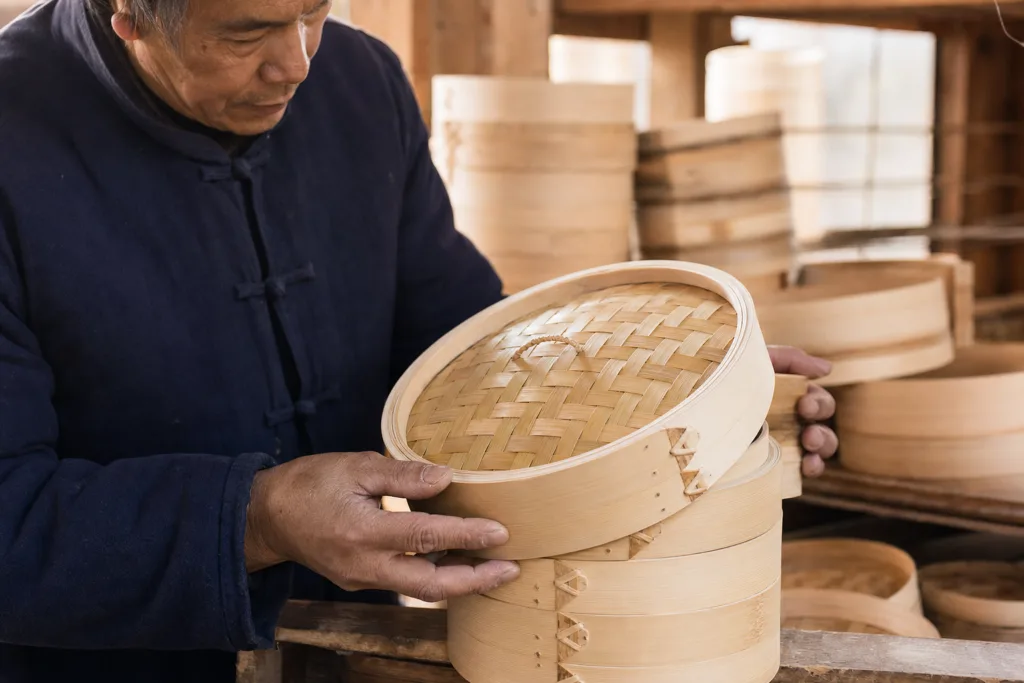
Rim craftsmanship is one of the clearest signs of factory discipline. A clean rim with smooth edges, consistent binding, and even assembly makes the steamer look more refined and usually improves user comfort. Rough rims, splintering, uneven trimming, or visible glue marks can quickly downgrade the product in the eyes of both retail buyers and restaurant operators.
Durability is also tied to edge quality. The rim takes stress during stacking, handling, shipping, and repeated washing or steaming cycles. A weak edge can deform or separate faster than the basket body itself. Buyers sourcing for repeated use should ask how the rim is reinforced, whether the trimming process is controlled, and what visual inspection standards are applied before packing.
When evaluating samples, place special attention on the points where bamboo slats meet the rim, where the lid edge closes, and where the tiers touch each other. These areas often reveal whether the production line is controlled or merely assembled to look acceptable from a distance.
Material and Finish Comparison: Natural Bamboo, Carbonized Bamboo, and Surface Treatment Options
Natural bamboo is the classic choice because it gives the steamer a light color, natural texture, and familiar food-service appearance. Carbonized bamboo offers a deeper tone that can feel more premium or more visually consistent across a set, although the final look still depends on the source material and finish process. The right option depends on the market positioning and the product range around it.
Surface treatment matters as much as the bamboo itself. A light finish can help improve appearance and reduce roughness, but the coating must suit the intended use and not interfere with food-contact expectations. Buyers should also ask whether the finish changes color over time, whether the odor is neutral after airing, and whether any glue, stain, or coating is applied in areas that may contact food. When a product includes liners, labels, or printed inserts, each component should be reviewed as part of the final assembly. For a regulatory framework on food-contact evaluation, see the FDA food-contact safety requirements for the broader principles buyers should verify on materials and accessories.
| Material or finish | Buyer advantage | Possible trade-off |
|---|---|---|
| Natural bamboo | Classic look, familiar perception | More visible variation in color and grain |
| Carbonized bamboo | Deeper tone, more premium shelf look | Color differences may still appear by batch |
| Light surface treatment | Smoother feel, better presentation | Must be checked for intended-use suitability |
Performance Factors: Steam Circulation, Heat Resistance, Moisture Behavior, and Warp Risk
Bamboo steamers work because the structure allows hot air and steam to move through the basket while keeping the food elevated. Good steam circulation depends on slat spacing, basket depth, lid shape, and how well the tiers fit together. Heat resistance is usually adequate for normal steaming use, but wholesale buyers should be more concerned about moisture behavior than about a single heat event. Repeated exposure to steam, drying cycles, and storage humidity is what usually stresses the product over time.
Warp risk increases when bamboo is not dried correctly, when thickness is inconsistent, or when the basket is packed before it has stabilized. If the steamer will be exported to humid climates, packaging and storage conditions become part of product quality. A steamer that looks fine in the factory can still arrive distorted if the carton protection is poor or if the product was not dried sufficiently before packing.
That is why we ask buyers to discuss climate, distribution route, and expected shelf life early in the project. The right construction for a dry inland market may not be the same as the right construction for coastal or high-humidity retail channels.
Best Bamboo Steamer by Application: Dumplings, Buns, Seafood, Vegetables, and Presentation Sets
Application determines the ideal format. For dumplings, a smaller diameter and good steam flow are usually more important than decorative details. For buns, a slightly deeper basket can be helpful, especially if the product is marketed as a multipurpose steamer. For seafood and vegetables, buyers may want a broader surface area and a sturdy lid that can support repeated restaurant use.
Presentation sets are different. In that case, appearance can matter as much as cooking function because the steamer is part of the table experience or retail gift concept. Buyers in this segment often want a cleaner rim, smoother surface, coordinated liners, and more polished packaging. If your market needs a standard cooking solution with strong commercial appeal, the right format may be a proven size and layer combination rather than the most visually elaborate option.
Customization Opportunities for Private Label Buyers
Private label projects give buyers room to differentiate without redesigning the whole product. Logo placement can be handled through engraving, printing on packaging, or branded bands and labels depending on the material and desired finish. Some buyers want a subtle logo on the lid or base ring; others want packaging to carry the main brand message while the steamer itself stays understated. Each choice affects tooling, cost, and lead time.
Artwork preparation should be handled carefully. Vector files are generally easier to use than low-resolution images, and it helps to confirm line thickness, placement, and print color expectations before sampling. If the brand wants a more premium retail story, custom inserts and printed instructions may add value without changing the steamer structure itself. From a sourcing perspective, the challenge is to keep the design distinct while preserving manufacturability.
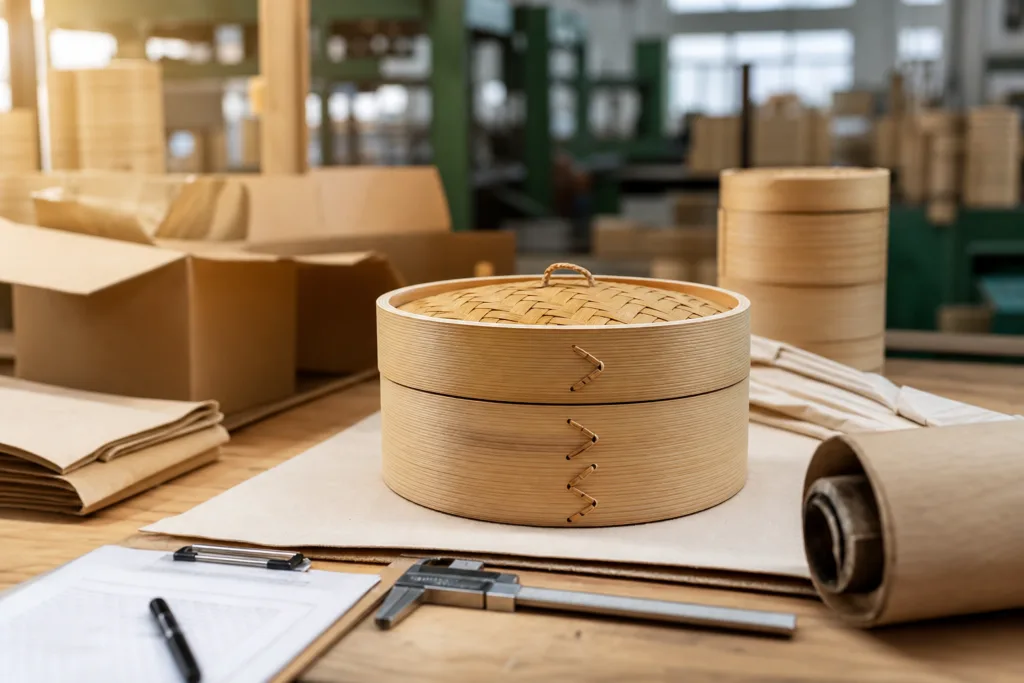
The best customization plan is usually the one that can be repeated consistently. That means verifying what can be engraved, what should be printed, and what is better left to packaging. The more complex the customization, the more important it becomes to approve a sample that reflects the final production method rather than a hand-finished prototype.
Packaging Options for Wholesale: Retail Box, Bulk Pack, Gift Set, and E-commerce Protection
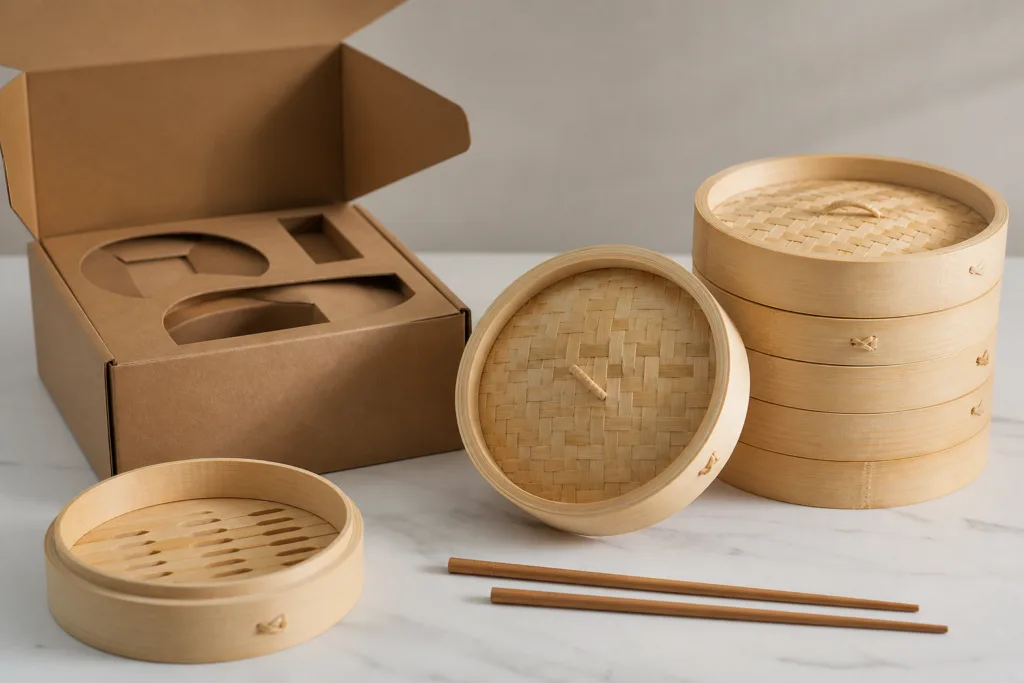
Packaging is not an afterthought for bamboo steamers. It is part of the product experience and often a major cost driver. Retail boxes support shelf presentation and barcode requirements. Bulk packs reduce unit cost and work for foodservice accounts or distribution centers. Gift sets need stronger visual storytelling and often include layered protection to keep the steamer clean and intact. E-commerce packaging should account for movement, vibration, and corner impacts during parcel shipping.
Buyers should discuss whether liners, instruction sheets, and desiccant-style protection are needed, especially if the product will pass through long transit cycles or humid warehouses. For a manufacturer, packaging decisions also affect carton size, loading efficiency, and damage risk. Well-designed packaging can reduce returns even when the steamer itself is well made.
For example, a product with a premium presentation may still require a compact internal structure to prevent the lid from shifting. When a buyer wants clearer internal fit between the basket and the lid, our bamboo steamer with lid and base ring is a useful reference for discussing protective structure and assembly logic.
MOQ, Sampling, and Lead Time: What Buyers Should Confirm Before Ordering
MOQ is often shaped by raw material preparation, labor setup, packaging customization, and the number of variants in the order. A simple standard steamer may allow more flexible quantities than a custom set with branded packaging and printed inserts. Sampling is important because a photo or drawing cannot fully represent lid fit, surface feel, smell, or stacking stability. Buyers should ask for a sample that reflects the intended finish, branding method, and packaging method whenever possible.
Lead time should be discussed together with order complexity. A project that requires custom artwork, new cartons, and a specific finish will usually need more time than a standard catalog order. If the product is seasonal, build in buffer time for sample revision, approval, and shipping. A rushed order often creates avoidable compromises in quality or packaging.
One practical rule: if a supplier cannot clearly explain how the sample relates to the final bulk production version, the buyer should slow down and clarify the specification before issuing the order.
Quality Control Checklist: Dimension Tolerance, Smell, Surface Smoothness, Mold Prevention, and Assembly Consistency
Quality control for bamboo steamers should go beyond visual inspection. Buyers need to define acceptable size tolerance, nesting fit, rim alignment, surface smoothness, and the consistency of the lid. A small size deviation can create big problems when the steamer is used with a wok or stacked into a retail set. Surface smoothness matters because rough areas can reduce perceived quality and may indicate insufficient sanding.
Smell is another practical checkpoint. Bamboo products should not have a strong chemical odor after proper drying and finishing. If the product is intended for food use, buyers should ask about moisture control, storage conditions, and whether the factory has procedures to reduce mold risk during warehousing and packing. Consistent assembly is also essential: loose slats, uneven glue lines, or misaligned rims can make a whole order look inconsistent even when the raw material is acceptable.
For buyers who want a structured inspection approach, the component-by-component compliance review is a useful reminder that each part of a food-contact item should be evaluated, not just the visible bamboo body. In wholesale buying, the same discipline applies to QC: every component and every assembly step should be checked against the final use case.
Pricing Factors: How Size, Layer Count, Material Grade, and Customization Affect Cost
Price is shaped by more than bamboo raw material. Larger diameters use more material and often require more labor to shape and assemble. Additional layers increase complexity, packaging size, and carton volume. Higher-grade selection can improve consistency but may reduce yield. Custom printing, branded bands, retail boxes, and inserts all add cost, but they can also improve sell-through if they match the market.
Wholesale buyers should separate cost drivers into three buckets: product structure, finish and branding, and logistics. A product that is slightly more expensive at the factory may still be better value if it reduces breakage, lowers returns, or supports a more profitable retail price. The cheapest steamer is rarely the most economical one once freight, damage, and customer complaints are counted.
For private label projects, it is often useful to ask the supplier to quote both a standard version and a custom version. That comparison helps the buyer see where the real cost increases come from and whether each upgrade is worth the added margin pressure.
Common Buying Mistakes to Avoid When Sourcing Bamboo Steamers in Bulk
One common mistake is choosing a product based on appearance alone. Another is approving a sample without testing actual cookware fit or food portion size. Buyers also sometimes overlook packaging strength and then discover damage only after the first shipment reaches distribution. A third mistake is assuming all “bamboo steamer” products are built to the same standard, when in fact structure, finish, and assembly quality can vary widely.
Another issue is failing to define what happens if the order includes custom artwork, a special liner, or a different band specification. Small changes can create rework if they are not documented clearly. Buyers should also avoid treating sustainability as a vague selling point. It is better to specify the material, explain the intended use, and confirm the production process than to rely on unsupported marketing language.
When in doubt, use a supplier-side comparison document that covers structure, dimensions, finish, branding, packaging, and sample approval. It is much easier to align early than to fix misunderstandings after production starts.
How to Evaluate a Bamboo Steamer Supplier for OEM/ODM and Private Label Projects
Supplier evaluation should start with manufacturing fit. Does the supplier produce bamboo items at scale, and can they repeat the same build quality across batches? Can they explain their drying, sanding, assembly, and packing methods clearly? Do they understand private label expectations, including barcode placement, brand packaging, and customer-facing presentation?
We recommend asking for clear answers on sample process, revision limits, lead time, carton protection, and QC checkpoints. A reliable manufacturer should be able to discuss not only the item itself but also how the steamer is packed, labeled, and shipped. That is part of how we approach projects at Bamboo Wood Art: product structure, finish, packaging, and order planning should be designed together, not in isolation.
If the supplier can explain trade-offs clearly, provides samples that match production intent, and shows confidence in repeatability, that is usually a stronger signal than a polished sales pitch. For wholesale buyers, the ability to maintain specification consistency matters more than a single perfect photo.
Final Buyer Checklist: How to Select the Best Bamboo Steamer for Your Market
Before placing a wholesale order, confirm the steamer’s use case, target customer, and required price position. Then check the most important variables in sequence: layer count, diameter, depth, slat structure, rim strength, lid fit, surface finish, packaging method, and customization options. If the product is for foodservice, performance and durability should lead the decision. If it is for retail or private label, packaging and branding become equally important.
The best bamboo steamer for one buyer may be a simple single-tier model, while another buyer may need a branded two-tier set with retail packaging and a custom insert. The right answer depends on how the product will be sold, used, and replenished. A good supplier will help you balance appearance, cost, and functionality instead of pushing one generic version for every market.
If you are building a retail line, restaurant supply assortment, or private label program, we recommend treating the sample as a decision tool, not just a product preview. Validate performance, inspect craftsmanship, test packaging, and confirm that reorder consistency is realistic before you commit to bulk production.
FAQs
What size bamboo steamer should a wholesale buyer choose first?
Start with the size that fits the most common cookware or serving need in your target market. For many buyers, a mid-size option is the safest starting point because it works for a wider range of dishes and retail display needs. If your sales channel focuses on dim sum or single portions, smaller sizes may be better; if you serve family-style or buffet customers, larger diameters can perform better.
Is a two-tier bamboo steamer better than a single-tier model?
It depends on the market. A two-tier model usually offers more capacity and stronger retail value perception, which makes it attractive for home cooks and many private label programs. A single-tier model can be more compact, easier to price, and simpler to ship. The better option is the one that matches how customers will actually use the product.
What should buyers check in a bamboo steamer sample?
Check lid fit, rim smoothness, nesting stability, surface finish, smell, size accuracy, and whether the steamer sits properly on the intended cookware. It is also smart to review the packaging, because damage protection is part of product quality in wholesale distribution. A sample should represent the final production method as closely as possible.
Can bamboo steamers be customized for private label brands?
Yes. Common customization options include logo engraving, printed packaging, branded bands, inserts, and carton design. Some buyers also request changes to size, layer count, or finish. The most effective customization plan is one that stays practical for mass production and does not create unnecessary quality risk.
How can buyers reduce mold or warping risk?
Choose properly dried material, confirm the supplier’s moisture control approach, and use packaging that protects the product during shipping and storage. Buyers should also consider the climate of the destination market, since humidity can affect bamboo products during transit and warehousing. Good packaging and good drying work together to reduce problems.
What is the most important factor when buying bamboo steamers in bulk?
Consistency is usually the most important factor. A steamer that performs well once but varies from batch to batch creates problems for retail, foodservice, and private label programs. Buyers should confirm dimensions, finish quality, assembly standards, and packaging strength before approving mass production.